
Top 4 Ranklyx.com Alternatives for 2026
Managing ongoing SEO content publishing without overspending on agencies or stretching a small team’s workload is difficult for founders and marketing leaders. Most alternatives either require high per-article or per-link fees or lock essential automation behind complex enterprise plans. This comparison breaks down pricing, automation depth, and unique workflows across four platforms so founders and marketing leaders can pick the best fit for steady content growth.
Table of Contents
Ranksector
At a Glance
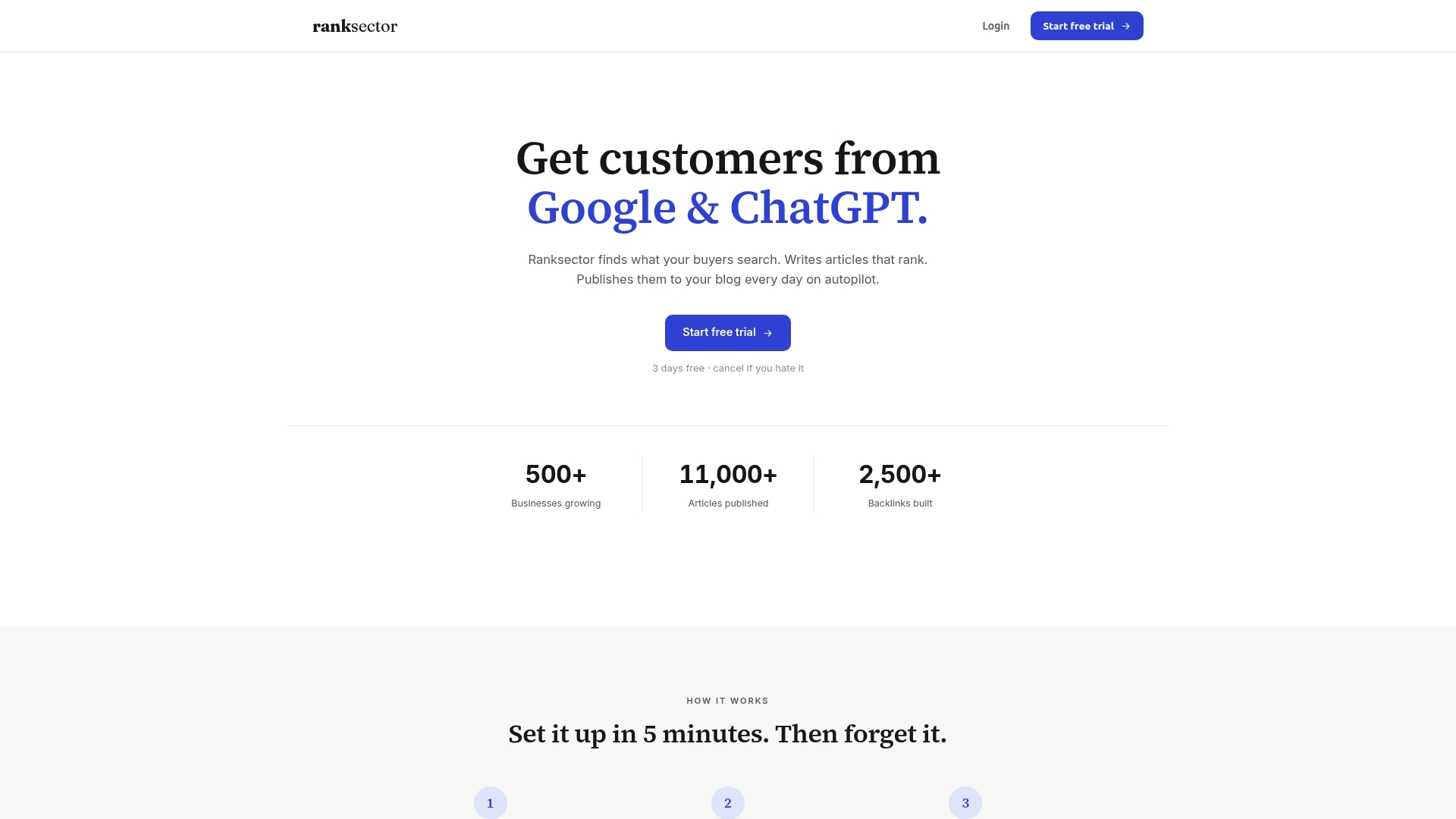
Ranksector reports over 11,000 articles published. The vendor advertises demonstrated results in increasing domain ratings quickly and effectively. The service charges a flat rate of $99/month for unlimited articles and backlinks, which places publishing and link acquisition on a fixed monthly budget.
Core Features
Ranksector runs competitor-driven keyword research that maps what prospective buyers search for and converts those queries into article briefs. The system produces AI-generated long-form articles with SEO titles, meta descriptions, and images, and it schedules auto-publishing to CMS platforms without repeated uploads. A contextual backlink exchange network handles link placement, and a Reddit AI Agent can recommend products in relevant threads to extend exposure.
Key Differentiator
The platform’s single standout feature is the flat-rate, all-in-one AI pipeline with unlimited articles and backlinks included in every plan. That model removes per-article and per-link billing and shifts cost planning from variable retainers to a predictable monthly fee. For teams that publish frequently, the pricing model and included backlink network form the core value proposition.
Pros
Ranksector automates the end-to-end content pipeline so your team spends time on strategy rather than publishing tasks. Its flat pricing at $99/month removes per-piece billing and simplifies budgeting for ongoing content needs. Multiple CMS connectors and a built-in backlink exchange reduce setup and outreach work, while real-time dashboards pull Google Search Console data for rankings and traffic visibility. The platform also offers GEO audits and structured data emission to help search engines and AI models understand content context.
Cons
- AI-generated articles often need human oversight for factual accuracy and brand voice, so plan for an editorial review step.
Notable Integrations
- WordPress
- Shopify
- Wix
- Webflow
- Notion
- Ghost
- Framer
- Webhook
Who It’s For
Founders and small marketing teams that must publish regularly but lack headcount for an in-house editorial staff will find the model useful. E-commerce owners who need SEO-optimized blog content and automatic publishing across platforms benefit from the CMS connectors. Agency owners seeking a white-label option for multiple client sites can use the flat pricing to control margins while delivering steady output.
Unique Value Proposition
Daily auto-publishing across major CMS platforms plus an included contextual backlink exchange turns ongoing blog growth into a one-time setup task. That workflow reduces recurring outreach and removes per-link fees, letting you replace variable agency costs with a predictable monthly spend. For small teams, that converts content production from a recurring project into an automated system.
Real World Use Case
A small e-commerce shop sets up Ranksector to generate and publish daily product-adjacent articles. The service automatically inserts contextual backlinks and reports rankings to the dashboard. The store owner spends time on product pages while content and links run on schedule.
Pricing
Ranksector offers a single flat-rate plan at $99/month that covers unlimited article creation, publishing, and access to the backlink exchange. The pricing model eliminates per-article and per-link charges, which simplifies month-to-month budgeting for content-heavy sites.
Website: https://ranksector.com
theStacc
At a Glance
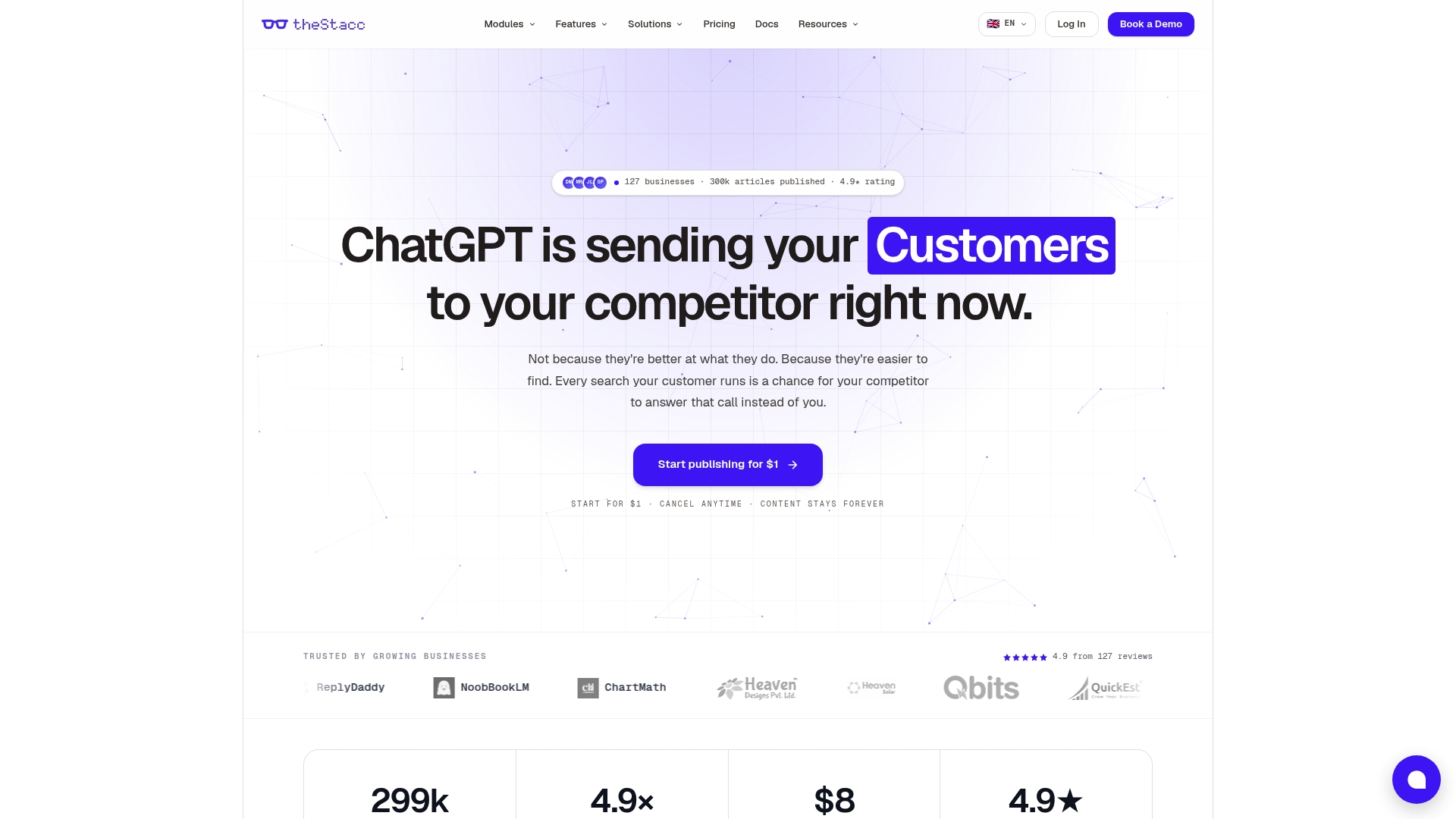
30+ fully optimized posts per month is the headline capability theStacc advertises for agency and local business plans. That volume supports daily blogs, local pages, and social posts without hiring writers. The platform packages content with rank tracking and review monitoring to keep listings active.
Core Features
theStacc automates keyword research, rank tracking with daily updates, and AI generated content for blogs and local pages. It manages citations and directory submissions while monitoring reviews with instant alerts and responses. The system also publishes directly to common CMS platforms so content goes live without manual copy and paste.
Key Differentiator
theStacc combines full local SEO workflows with direct CMS publishing and white label options, delivering automated, high volume content that plugs into existing sites. Its selling point is the packaged output of 30+ optimized posts monthly paired with local citation management and review response automation.
Pros
Automated publishing removes much of the manual work you would otherwise pay an agency or freelancer to do. The platform supports multi location businesses and franchises by centralizing content, citations, and rank tracking in one product. Agencies can use white label options to resell content and reporting while small businesses get a cheaper path to consistent publishing and local signals.
Cons
-
Some readers question whether AI generated content matches a seasoned human writer for nuance and local voice. Most users report the copy reads naturally, but skepticism persists.
-
The platform gives limited visibility into the detailed, manual SEO strategy behind each campaign. You get automation and outputs but less hands on strategic explanation.
-
Pricing may be less flexible for very large enterprise deployments when custom volume and service SLAs are required.
When It May Not Fit
The vendor states results can vary and that most customers see improvements within 3–6 months. If your team needs bespoke SEO strategy or deep consultancy, theStacc does not replace that role. Large enterprise programs that require granular customization or internal agency governance may find the packaged automation too prescriptive.
Notable Integrations
-
Google Business Profile
-
Facebook
-
Instagram
-
WordPress
-
Ghost
-
Wix
-
Webflow
Who It’s For
Small to medium local businesses, marketing agencies, and multi location enterprises that need steady publishing without high agency retainers. Teams that prioritize volume publishing and local citation management will find the product aligned with their workflows. Agencies wanting white label deliverables and repeatable local programs can package the outputs for clients.
Real World Use Case
The vendor reports a dental practice in Austin improving from page 4 to page 1 for a main keyword in 87 days after publishing 30 articles through the platform. That case shows how sustained volume plus local signals can move rankings in competitive local niches. Results will vary by industry and competition, so measure progress against your own benchmarks.
Pricing
Plans start at $99 per month with higher bundles for agencies and multi location customers. The vendor lists comprehensive packages up to $1,299 that include website and social media services. Custom enterprise pricing is available for larger rollouts.
Website: https://thestacc.com
FlyRank

At a Glance
FlyRank’s marketing materials guarantee 3X organic reach in 90 days or your money back. The platform pairs supervised AI agents with senior human editors to create and publish search and AI citation content at scale. FlyRank targets DTC brands, B2B SaaS teams, and agencies that need multilingual content and ongoing page audits.
Core Features
FlyRank combines automated content generation with a unified growth dashboard that collects SEO, visibility, and workflow signals in one place. The system includes multilingual localization, continuous page audits, and real-time AI citation monitoring so you can track presence across Google and AI assistants. Content creation runs under human supervision to keep brand voice aligned while scaling output.
Key Differentiator
FlyRank centers on an end to end supervised content and SEO workflow managed from a single operational dashboard. That mix of automated agents plus editor oversight, coupled with a money back guarantee, separates it from tools that only generate drafts or only surface SEO data. The model aims to move produced content all the way to published pages and ongoing maintenance.
Pros
The platform offers an integrated approach that covers content, technical SEO, and AI visibility in one operational stack. FlyRank reports up to 10X verified organic growth within months, and it supports scaling to multiple markets with localization and multilingual content. Supervised AI content creation reduces revision cycles and helps maintain brand voice while producing high volumes of pages.
Cons
- Requires CMS and analytics integration for full automation, which may demand engineering time.
- Heavy reliance on automation means high-stakes content still needs human review.
- Pricing starts at a level that may be out of reach for very small or early stage brands.
When It May Not Fit
If your team lacks a CMS or an analytics setup, FlyRank will need more technical onboarding before it runs fully. Small startups with tight content budgets will likely find the starting price a poor match. Teams that prefer manual editorial control over every published sentence will miss the platform’s automation focus.
Notable Integrations
FlyRank connects to mainstream content platforms and commerce systems including Shopify, WordPress, BigCommerce, Wix, Squarespace, Drupal, Contentful, and Strapi. Those integrations enable automated publishing and content syncing across storefronts and headless CMS implementations.
Who It’s For
Growth teams at mid sized DTC brands, B2B SaaS companies, and agencies that need a managed, high volume SEO production system will get the most value. Teams that plan to expand into international markets will benefit from the localization and multilingual workflows. Buyers should expect some technical setup and a budget for managed services.
Real World Use Case
The vendor cites a health supplement company that used FlyRank to generate thousands of optimized product pages and to earn AI assistant citations, producing a 9X increase in organic traffic within six months. That example illustrates how the platform pairs content scale with ongoing audits to keep pages competitive.
Pricing
FlyRank starts at $1,499/month for the Sparrow plan and scales to custom enterprise packages. The model targets teams that need managed production and ongoing optimization rather than a low cost DIY writer.
Website: https://flyrank.ai
RankUp
At a Glance
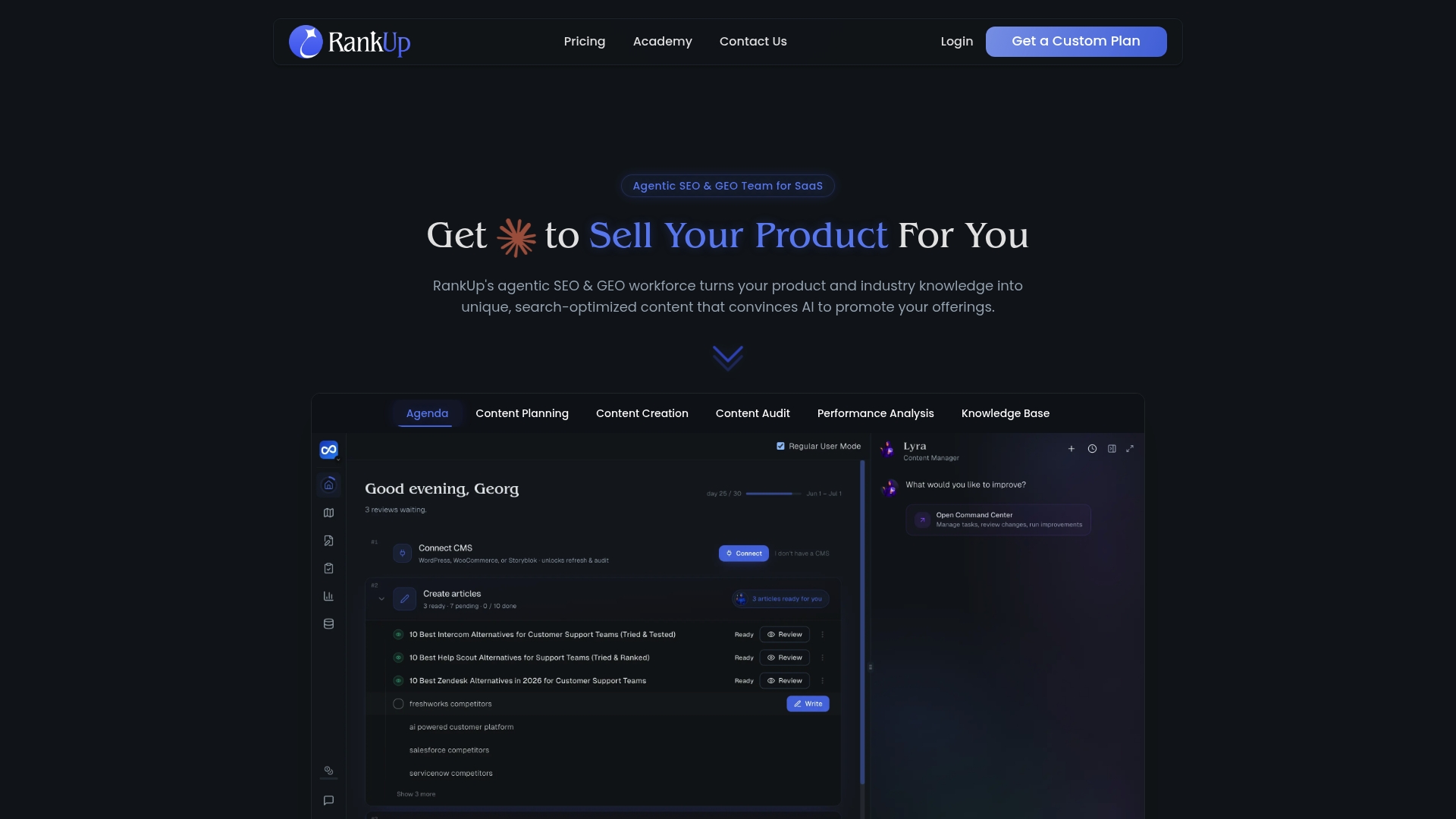
Monthly content audits and updates are part of RankUp’s core service offering. The platform pairs a team of AI agents with your product and industry knowledge to keep articles current and aligned with search intent. This combination targets SaaS companies that need steady, topic focused publishing without building a large in house content team.
Core Features
RankUp handles content strategy creation and ongoing updates while mapping keywords into topical clusters that guide writing. The platform produces AI driven content outlines and full drafts, and it maintains a centralized knowledge base for product and industry signals. Continuous performance analysis and monthly audits feed back into the strategy so published pages receive iterative improvements.
Key Differentiator
RankUp’s defining angle is an end to end AI driven SEO content system built specifically for SaaS companies. It blends automated agents with product level context to create search optimized content and repeatable SEO workflows. That focus on SaaS product knowledge differentiates it from generalist content automation tools.
Pros
RankUp scales the SEO process by automating keyword mapping, outline generation, and scheduled audits while keeping human review in the loop. The service blends AI output with expert input to produce unique content that reads like product informed writing rather than generic drafts. Multi region and language support plus a simple layout for managing campaigns help small teams run complex publishing programs without a large staff.
Cons
-
Pricing is customized and not publicly listed, which reduces price transparency for budget planning.
-
Heavy reliance on automation means you must allocate time for editorial oversight to protect brand voice and technical accuracy.
-
The product targets SaaS companies and may not fit businesses outside that sector.
When It May Not Fit
If your business is not SaaS focused, RankUp’s content signals and topical mapping may misalign with your product stories. If you need a fixed price or a single project engagement, the tailored pricing model will feel opaque. Teams that cannot commit to a steady publishing cadence will not see the full benefit of the monthly audit and update cycle.
Who It’s For
RankUp suits SaaS companies and marketing leaders who want automated content creation paired with ongoing optimization. You should have a minimum content volume in mind and some internal product knowledge to feed the platform. This product fits teams that want to publish regularly without hiring a larger content staff.
Real World Use Case
The vendor reports a SaaS startup used RankUp to produce and optimize 10+ blog posts monthly, which led to higher search rankings and new leads. That example shows how steady output plus monthly audits can convert publishing volume into measurable organic gains. For a small marketing team, RankUp acts as an external content engine that absorbs the heavy lifting.
Pricing
RankUp uses tailored pricing based on content volume, audit frequency, and update needs rather than fixed tiers. You request a proposal and receive a quote that matches your monthly production and optimization requirements. The vendor states costs vary with the scope of ongoing work.
Website: https://rankup.so
Comparison of alternatives
Businesses must attentively evaluate their options when deciding on an SEO content management platform. Each competitor provides distinctive advantages tailored to unique scenarios and operational needs.
Pricing and inclusivity
Ranksector emerges as a cost-efficient choice with its flat-rate pricing structure. Especially for businesses with high publishing volumes, this pricing ensures predictable expenditure without surpassing predetermined budgets. TheStacc, on the other hand, offers tiered pricing, accommodating a wider range of businesses, but the costs of its upper tiers may not suit small enterprises. Meanwhile, FlyRank’s premium pricing delivers multilingual and localization-focused capabilities designed for mid-sized and large organizations. RankUp tailors pricing proposals for SaaS businesses but lacks transparency up front.
Specialized features and scalability
FlyRank leverages supervised AI and multilingual workflows, rendering it highly effective for international marketing strategies. Local businesses requiring SEO integration with CMS and affiliation management benefit from theStacc, given its dedicated tools for optimizing local digital presence. RankUp specializes in SaaS-focused content strategies, ensuring customized and product-specific outputs. Ranksector excels in end-to-end automation, covering AI-generated content, backlink exchanges, and daily auto-publishing.
Best fit
- Businesses with frequent publishing requirements and budget consistency can take advantage of Ranksector’s flat-rate pricing and broad feature coverage.
- Agencies focused on multilingual content for cross-border campaigns will find FlyRank’s supervised AI approach a significant asset.
- Smaller enterprises aiming to strengthen their local digital visibility can benefit from theStacc’s attention to local directory management and reputation monitoring.
- SaaS firms demanding complex, product-tailored approaches should explore RankUp for its industry-oriented content clustering and audit cycles.
Our pick
Ranksector distinguishes itself by making SEO content automation not only effective but also accessible through its budget-friendly and inclusive pricing model paired with its automated contextual backlink exchange feature. While it may not suit businesses requiring a multilingual or deeply industry-specific approach, it substantially simplifies operations for content-heavy teams managing moderate to high publication frequencies.
Choose the right SEO content creation platform based on features, pricing, and use case.
| Product | Core Feature | Key Differentiator | Best For | Pricing | Limitation |
|---|---|---|---|---|---|
| Ranksector | Competitor-driven keyword research, AI auto-publishing | Flat-rate AI pipeline with unlimited content and backlinks | Small teams automating regular publishing | $99/month | Articles need human editorial review |
| theStacc | Local SEO automation with CMS integration | Content, citations, and review response automation | Local businesses, franchises, agencies | Plans from $99/month | Limited strategic insight into SEO workflows |
| FlyRank | Supervised multilingual content generation and ongoing page audits | Operational dashboard with editor oversight | Mid-sized DTC brands, international markets | Starting at $1,499/month | Requires technical setup for CMS and analytics integration |
| RankUp | AI-driven SEO content tailored for SaaS companies | End-to-end topical mapping with product knowledge | SaaS companies with steady publishing needs | Price not published | Content may misalign if brand isn’t SaaS focused |
Choosing the Right Solution for Regular SEO Content Production
Keeping up with steady SEO content can challenge founders without large teams or deep budgets. Ranksector tackles this by automating keyword research and daily publication of SEO-optimized articles tailored for small marketing teams and B2B SaaS companies. Its built-in backlink exchange accelerates domain rating growth without ongoing manual outreach, a major pain point when searching for ranklyx.com alternatives.
Ranksector offers:
- Over 11,000 articles published with proven results
- Flat-rate pricing with unlimited content and backlinks
- Seamless publishing across popular CMS platforms
Get hands-free content growth that frees your time for product and strategy. Visit Ranksector to explore how automated daily blogging can keep your site active and competitive with less effort.
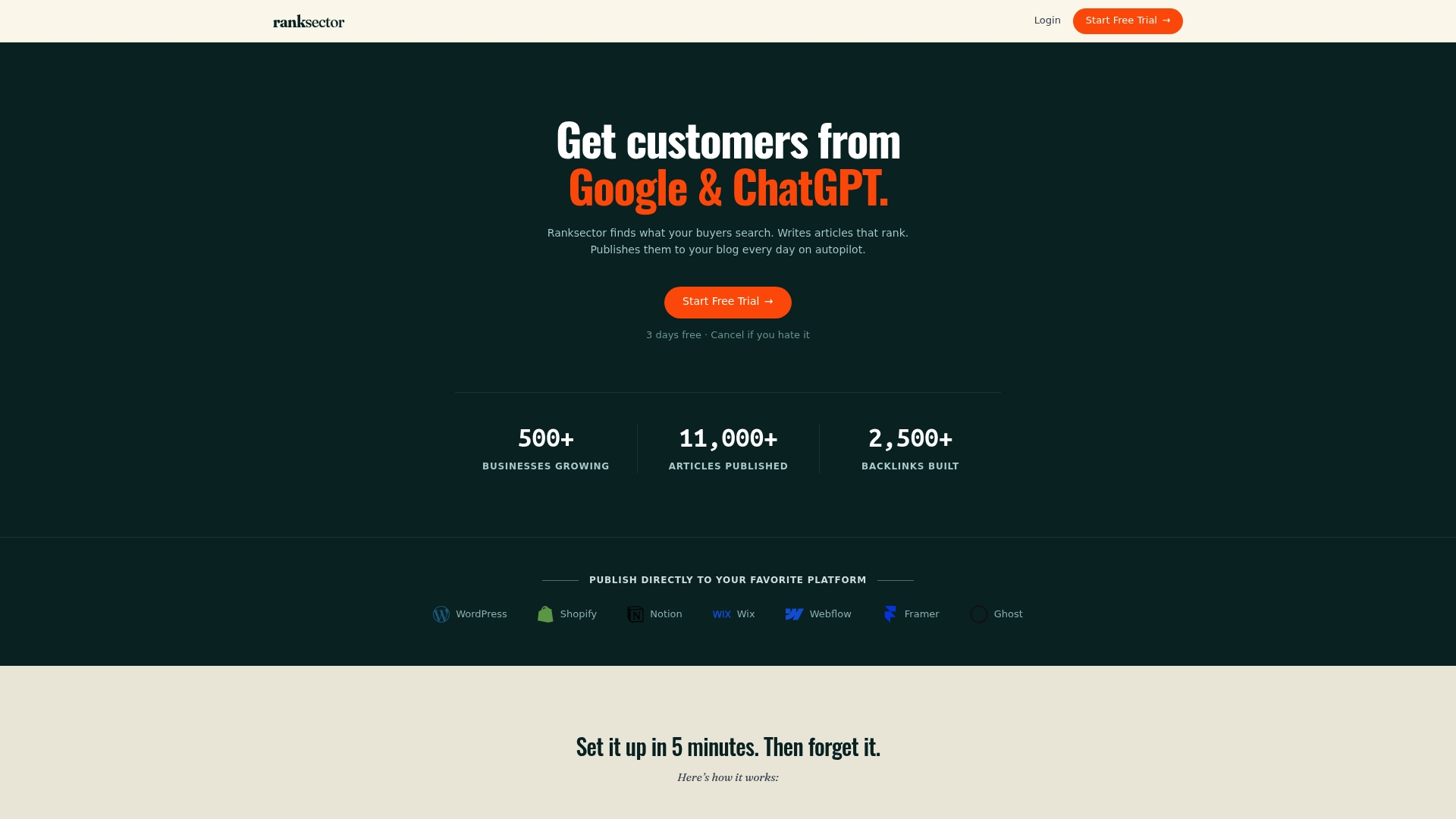
Test how Ranksector automates content creation and backlink building at a fixed monthly cost. Review your options and start improving your domain rating without the variable fees of traditional agencies.
FAQ
How does Ranksector manage content production?
Ranksector automates the end-to-end content pipeline and offers a flat pricing model of $99/month for unlimited articles and backlinks. This model allows teams to focus on strategy rather than publishing tasks, making it an excellent option for solo founders.
What is the difference between FlyRank and Ranksector?
FlyRank excels in providing a supervised content workflow that combines AI agents with human editors to create and publish content at scale. Ranksector, on the other hand, is ideal for those seeking a straightforward flat-rate option for unlimited articles and backlinks, serving teams that publish regularly without the need for extensive human oversight.
Can I use Ranksector if I have limited technical resources?
Yes, Ranksector simplifies the content publishing process, making it accessible even for teams with limited technical skills. It integrates with various CMS platforms and offers a user-friendly experience that reduces the need for complex setups.
Which platform is best for agencies?
While theStacc offers high-volume content and white-label options for agencies, Ranksector’s flat-rate pricing and unlimited outputs make it attractive for agencies looking to simplify client billing and ensure consistent content delivery.
How does Ranksector support SEO?
Ranksector runs competitor-driven keyword research to generate article briefs based on what prospective buyers search for. This ensures content is optimized for search engines while removing the burden of manual keyword mapping for teams.