
Free SEO Tools for Entrepreneurs: 2026 Guide
Free SEO tools give entrepreneurs professional-grade capabilities, including site audits, keyword research, and performance tracking, without any cost or signup barrier. The industry term for this practice is “organic search optimization,” and free tools now cover the full spectrum of it. Google Search Console is the mandatory starting point, providing first-party traffic and ranking data at no charge. Platforms like seoscore.tools run 260+ checks covering traditional SEO, Answer Engine Optimization (AEO), and Generative Engine Optimization (GEO) in under 8 seconds. For entrepreneurs and small business owners, these free SEO tools represent a real competitive advantage, not a compromise.
What types of free SEO tools are essential for entrepreneurs?
Free SEO tools fall into five clear categories. Each one addresses a different part of your search visibility, and you need at least one from each to build a working foundation.
- Site audit tools crawl your website and flag technical problems like broken links, missing title tags, slow load times, and crawlability errors. Tools in this category can audit up to 25 pages in minutes without requiring a credit card or account.
- Keyword research platforms identify search terms your audience actually uses, show monthly search volume, and reveal gaps your content does not yet cover. Free tiers on well-known platforms give you enough data to plan a full content calendar.
- Performance measurement tools track impressions, clicks, average position, and Core Web Vitals. Google Search Console is the essential free tool in this category and provides data no third-party platform can replicate.
- Schema markup validators check whether your structured data is correctly formatted, which directly affects rich results in search.
- Browser extensions let you run page-level SEO checks without leaving your content editor. Browser-based SEO extensions are recommended for faster edits during content creation, eliminating the need to switch between dashboards.
Pro Tip: Start with one tool from each category before adding more. A five-tool stack covering audits, keywords, performance, schema, and in-browser checks gives you complete coverage without creating data overload.
The emerging category worth tracking is GEO. As AI-powered search engines like ChatGPT and Perplexity gain users, your content needs to satisfy their ranking signals, not just Google’s. Free tools now increasingly include GEO readiness checks, which is a meaningful shift from even two years ago.

How to use free SEO audit tools to improve rankings
A site audit is the fastest way to find problems that are actively hurting your rankings. The process is straightforward when you follow a clear sequence.
- Run your first audit without signing up. Free audit platforms perform comprehensive technical checks covering crawlability, page speed, meta structure, HTTPS status, and mobile friendliness. Enter your URL and let the tool generate a report.
- Read the prioritized fix list, not just the score. Audit scores are a summary, not a strategy. Focus on the specific issues flagged as high impact. Missing title tags and H1 headers influence rankings more than auxiliary metadata, so fix those first.
- Work through technical fixes before content fixes. HTTPS, mobile responsiveness, and page speed affect every page on your site. Fixing them once produces site-wide gains. Content fixes are page-specific and take longer to compound.
- Re-audit after each round of fixes. Run the same tool on the same URL after you make changes. This confirms the fix worked and shows your score improving over time.
- Expand to deeper content audits. Once technical health is solid, use audit results to guide on-page improvements: heading structure, internal linking, and keyword placement.
| Audit priority | Issue type | Why it matters |
|---|---|---|
| High | Missing title tags | Direct ranking signal for every page |
| High | Missing H1 headers | Signals page topic to search engines |
| High | HTTPS not enabled | Trust signal; Google penalizes HTTP pages |
| Medium | Slow page speed | Affects Core Web Vitals and user experience |
| Medium | Missing meta descriptions | Influences click-through rate from search results |
| Low | Duplicate meta tags | Creates confusion about canonical pages |
Pro Tip: Schedule a monthly audit using the same free tool. Tracking your score over three months shows whether your fixes are holding and reveals new issues introduced by site updates.
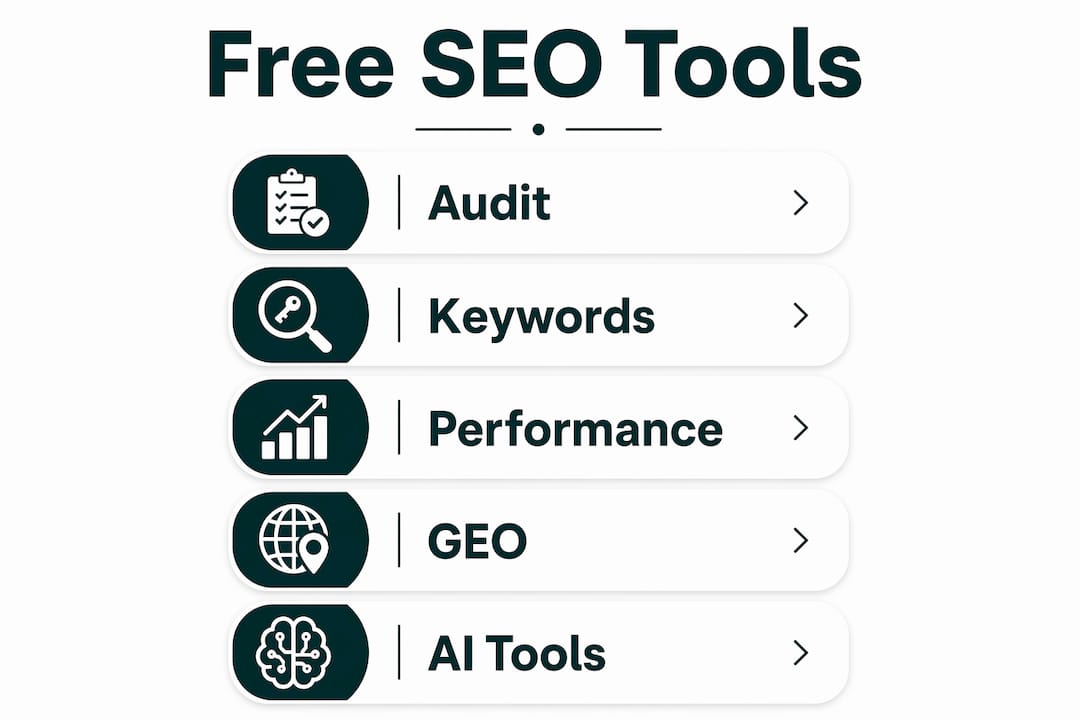
The practical value of free audit tools is that they present fixes in plain language with clear scoring. You do not need a technical background to act on the results. That accessibility is what makes them genuinely useful for small business owners managing SEO without a dedicated team.
What are proven strategies for keyword research using free tools?
Keyword research with free tools works best when you treat it as a three-step process: find terms, analyze intent, and cluster for content.
- Find terms without signup barriers. Google Trends shows rising search interest by topic and geography at no cost. Google’s autocomplete and “People also ask” boxes surface real user language directly from search behavior. These zero-cost signals are often more current than paid keyword databases.
- Analyze search intent before writing. A keyword like “SEO audit” could mean someone wants to run one, buy one, or understand what one is. Look at the top-ranking pages for your target term. Their format (guide, tool page, listicle) tells you what Google believes the searcher wants.
- Use AI-powered clustering for content planning. Free AI tools can group related keywords into topic clusters, which helps you plan content that covers a subject thoroughly rather than targeting isolated terms. Thorough topic coverage is a strong signal for keyword gap identification and topical authority.
- Validate schema markup after optimizing content. Google’s Rich Results Test is free and shows whether your structured data qualifies for enhanced search features like FAQ snippets or review stars. Schema markup does not require paid tools to implement or validate.
The most underused free resource for keyword research is your own Google Search Console data. The “Queries” report shows exactly which search terms already bring people to your site. Sorting by impressions with low clicks reveals pages that rank but fail to attract clicks, which is a direct signal to improve your title tags and meta descriptions.
How can entrepreneurs measure SEO performance with free tools?
Performance measurement is where free tools deliver their clearest value. Google Search Console gives you first-party data directly from Google, which no third-party tool can match for accuracy.
- Track impressions, clicks, and average position for every page and query. Impressions tell you how often your pages appear in search. Clicks tell you how often people choose them. The gap between the two reveals where your titles and descriptions need work.
- Monitor Core Web Vitals through the Search Console “Experience” report. Google uses these speed and stability metrics as ranking signals, and the report flags specific pages that fail the threshold.
- Detect keyword cannibalization by filtering the Queries report for a single keyword across multiple pages. If two pages compete for the same term, consolidate or differentiate them.
- Identify low-hanging fruit by sorting queries by average position between 8 and 20. Pages ranking in that range are close to page one and often need only minor content improvements to move up.
Google Search Console is considered mandatory for monitoring both traditional and AI search performance. That designation matters because it means skipping it leaves a gap no other free tool fills. Pair it with Google Analytics 4 for behavioral data (time on page, bounce rate, conversion paths) and you have a complete free measurement stack.
What common mistakes should entrepreneurs avoid with free SEO tools?
The biggest mistake is tool hopping. Entrepreneurs often install five audit tools, get five slightly different reports, and spend more time reconciling data than fixing problems.
- Start with Google Search Console and stay there until you understand your baseline. Analysis paralysis is a documented risk for SEO beginners, and the antidote is fewer tools, not more.
- Do not chase a perfect audit score. A score of 95 with one unfixed H1 tag beats a score of 72 with ten minor issues resolved. Fix what moves rankings, not what moves the number.
- Account for AI-driven search. Ignoring GEO and AEO signals is a growing mistake. Free GEO readiness checks now exist, and skipping them means your content may be invisible on AI-powered search platforms even if it ranks well on Google.
- Recognize what free tools cannot do. The primary gap between free and paid SEO tools is data scope. Free tools excel at technical and on-page audits while paid tools dominate backlink analysis and historical rank tracking. Know the boundary so you do not expect free tools to do what they were not built for.
The most productive SEO workflow is not the one with the most tools. It is the one where every tool you open produces a fix you can implement the same day.
Key takeaways
Free SEO tools cover technical audits, keyword research, and performance measurement with no cost, making them the right starting point for every entrepreneur.
| Point | Details |
|---|---|
| Start with Google Search Console | It provides first-party ranking data no third-party free tool can replicate. |
| Audit before optimizing content | Fix technical issues site-wide before addressing page-level content gaps. |
| Prioritize by impact, not score | Missing title tags and H1s affect rankings more than low-weight metadata issues. |
| Account for AI search signals | Free GEO and AEO audit checks now exist and should be part of your routine. |
| Know the free tool ceiling | Backlink analysis and historical rank tracking require paid tools; free tools cover the rest. |
Why I think most entrepreneurs overcomplicate their free SEO tool stack
After working with dozens of founders on their SEO setups, the pattern is consistent. They start with Google Search Console, feel like it is not enough, and add six more tools within a month. Then they spend their limited time reading dashboards instead of publishing content or fixing the three issues that actually matter.
My honest take: free vs. paid tool decisions are rarely about capability. They are about discipline. The free tools available in 2026 are genuinely powerful. A comprehensive audit in under 8 seconds, GEO readiness checks, Core Web Vitals monitoring, and keyword gap analysis are all available at no cost. The gap between free and paid is real but narrow for most small business use cases.
What I have found actually works is treating browser-based SEO extensions as your daily driver and reserving audit platforms for monthly reviews. Integrating browser tools into your content creation workflow means you catch issues as you write, not three weeks later when a scheduled audit runs. That habit alone eliminates most of the technical debt that accumulates on small business sites.
The one area where I tell founders to consider a paid upgrade early is backlink analysis. Free tools simply do not have the data depth for competitive link research. Everything else, including audits, keyword research, performance tracking, and schema validation, is well covered by free options. Build your free stack first, use it consistently for 90 days, and then decide what paid tool solves a specific gap you have actually experienced.
— Savannah
Ranksector’s free AI SEO tools for entrepreneurs
Entrepreneurs who want to go beyond manual audits and keyword checks can use Ranksector’s free tools to run AI-powered SEO audits and generate content briefs without a paid subscription.
Ranksector combines technical audit capabilities with AI-driven content creation, which means you get site health data and a clear path to fixing it in one place. The platform requires no agency budget and no large team. It is built for founders who need results without dedicating hours to SEO management. Ranksector has published over 11,000 SEO-optimized articles for B2B businesses, and its AI audit tool surfaces the same insights that typically require a paid platform. If you are ready to move from manual free tools to an integrated system, Ranksector is the practical next step.
FAQ
What are the best free SEO tools for small businesses?
Google Search Console is the single most important free SEO tool for any small business. Pair it with a free audit platform like seoscore.tools for technical checks and Google Analytics 4 for behavioral data.
Do free SEO tools require signup or a credit card?
Most professional-grade free audit tools require no signup or credit card. Platforms performing 260+ checks deliver full reports instantly with only a URL input.
What is the difference between free and paid SEO tools?
Free tools excel at technical and on-page audits, while paid tools provide deeper backlink data and historical rank tracking. For most entrepreneurs, free tools cover the majority of daily SEO needs.
What is Generative Engine Optimization (GEO)?
GEO is the practice of optimizing content for AI-powered search engines like ChatGPT and Perplexity, which use different ranking signals than traditional search engines. Free audit tools now include GEO readiness checks to help entrepreneurs stay visible across both search types.
How often should entrepreneurs run a free SEO audit?
A monthly audit is the practical standard for most small business owners. Re-auditing after each round of fixes confirms changes worked and catches new issues introduced by site updates.
Recommended
- Ranksector — AI-powered SEO content creation and publishing
- Technical SEO Basics for Entrepreneurs: 2026 Guide · Ranksector Blog — Ranksector
- Rank for Competitor Traffic Keywords: 2026 SaaS Guide · Ranksector Blog — Ranksector
- Best AI SEO Content Tools for Solo Founders: What to Use in 2026 · Ranksector Blog — Ranksector