
Content Syndication SEO: When Republishing Helps or Hurts
Yes, content syndication can support SEO and reach, but only when publishers preserve indexing and link signals. That means noindex or a correct canonical, a visible link back to the original, and tracking that proves it worked.
Before you send a single article out for republishing, lock in three safeguards:
- Require the partner set noindex on the republished copy, or at minimum a cross-domain canonical pointing to your URL.
- Confirm a visible, followed link to the original article sits in the byline or body.
- Add UTM parameters so referral traffic shows up cleanly in your analytics.
Pro Tip: Google has published explicit guidance favoring noindex over canonical for syndicated copies. Treat that as the standard your partners have to meet, not a nice-to-have.
Key Takeaways
Content syndication improves SEO reach and backlink profiles only when publishers apply noindex or canonical tags, preserve a visible link, and you track referral traffic separately from organic.
| Point | Details |
|---|---|
| Demand noindex first | Ask partners for noindex on republished pages; treat canonical as a fallback, not the goal. |
| Verify before trusting | Check page source, Search Console index status, and search a unique sentence to confirm the setup worked. |
| Choose partners on overlap | Prioritize audience overlap and editorial quality over raw domain authority alone. |
| Track four KPIs | Watch referral sessions, backlink quality, assisted conversions, and original-URL ranking together. |
| Automate the repeatable parts | Ranksector’s daily publishing and backlink exchange handle cadence and authority growth while you manage partner relationships. |
Table of Contents
- What Is Content Syndication SEO and What Are the Main Types?
- How Does Content Syndication Affect SEO Rankings?
- What Technical Controls Should You Require from Syndication Partners?
- Which Syndication Partners Are Worth Your Time?
- How Do You Implement a Content Syndication Strategy Step by Step?
- What KPIs Prove Content Syndication Is Working?
- What Should You Do When Syndication Hurts Your Rankings?
- Legal and Copyright Considerations in Content Syndication
- How Does Syndication Affect Brand Authority and Reader Perception?
- When Should You Actually Syndicate Your Content?
- How Ranksector Automates a Safe Syndication Workflow
- Sources
What Is Content Syndication SEO and What Are the Main Types?
Content syndication means republishing content you already own, with permission, on a third-party site. It is not guest posting. Guest posts are written for someone else’s site; syndicated posts already exist on yours and get a second life elsewhere.
Three channel types cover most real-world programs:
- Free partner syndication: an editorial site republishes your piece, usually crediting you and linking back.
- Paid distribution: recommendation networks like Outbrain or Taboola push your content in front of new readers for a fee, though HubSpot notes this route rarely carries the same SEO weight as editorial placements because publisher-side signals and link practices differ.
- Owned republish: you post the piece yourself on Medium, LinkedIn, or a smaller feed you control, which sidesteps negotiation entirely.
Each type solves a different problem. Free syndication builds authority. Paid distribution buys eyeballs. Owned channels buy control.
How Does Content Syndication Affect SEO Rankings?
Done well, syndication puts your work in front of readers who never would have found your domain otherwise, and some of them link back on their own. It also feeds a newer kind of visibility: AI-driven search tools pull from broad citation pools, and appearing across multiple trusted publishers increases your odds of being one of the sources cited in an AI-generated answer.
The risk sits right next to the benefit. When a partner republishes your article without safeguards, search engines see two identical pages and have to guess which one matters more. Sometimes they guess wrong.
A syndicated copy on a higher-authority domain can outrank the original post, especially when the partner site has stronger backlink profiles or faster crawl priority. This is the single most common syndication failure marketing teams report.
Case data backs the upside when partners are chosen carefully. Cience’s research on syndication benefits points to meaningful lead volume gains and backlink growth from well-run B2B programs. The gap between a program that works and one that quietly cannibalizes your rankings almost always comes down to whether those technical controls were in place before publish day, not after.
What Technical Controls Should You Require from Syndication Partners?
Google’s own guidance is unambiguous here: partners should apply noindex to the republished page. A cross-domain canonical is an acceptable fallback, but it is a weaker signal that search systems sometimes ignore, which is why noindex is the safer default whenever a partner will agree to it.
Before you approve any syndication deal, get these four items in writing:
- Noindex tag on the republished page, or a canonical link to your original URL if noindex isn’t possible.
- A visible, followed link to the source article, placed in the intro or byline where readers will actually see it.
- Preserved metadata and structured data where the CMS allows it.
- A confirmed publish date so you can track indexing behavior afterward.
Once the piece is live, verify it yourself. Check the page source for the noindex tag or canonical URL, run the URL through Google Search Console’s URL inspection tool, and search a unique sentence from the article in quotes to see which version ranks. HubSpot’s syndication guide recommends this exact three-step check as standard practice, and it takes under five minutes per partner.
Which Syndication Partners Are Worth Your Time?
Not every offer to republish your work is worth taking. The partners worth pursuing share a few traits: editorial standards that match your brand, an audience that actually overlaps with your buyers, a domain authority that adds real weight, and a track record of applying tags correctly without being asked twice.
Watch for these red flags before you sign anything:
- Templated “syndicated content” sections that read like a dumping ground rather than an editorial page.
- Partners who strip your byline link during a redesign and never restore it.
- Any site that flatly refuses to apply noindex or a canonical tag.
Before committing, search a few of the partner’s recent syndicated posts to see how links and tags actually behave in practice, and ask for current audience metrics rather than trusting a stale media kit.
How Do You Implement a Content Syndication Strategy Step by Step?
Start with content, not partners. Pick evergreen posts that already rank reasonably well, carry solid internal links, and answer a question your buyers ask repeatedly. Syndicating a weak page just multiplies a weak page.
- Select the content. Prioritize posts with existing organic traffic and strong on-page SEO. A post that’s already earning impressions gives you a baseline to protect.
- Build the outreach template. Every pitch to a partner should request noindex or canonical, a visible link placement, and permission to add UTM parameters. Put this in writing every time, not just for your first few partners.
- Publish and verify. Once live, check index status in Search Console, confirm the backlink registered in a backlink tool, and watch referral sessions in your analytics for the first two weeks.
- Monitor rankings. Track your original URL’s position for its target keyword for 30 days post-publish. A sudden drop is your signal to investigate immediately.
- Iterate. Cut partners who don’t deliver referral traffic or backlink value; scale up with the ones who do.
Pro Tip: Run your first syndication deal on a mid-tier page, not your best performer. If something breaks, you’ll catch it on a post that isn’t carrying your most valuable rankings.
Repeat this cycle monthly, and you build a shortlist of proven partners instead of gambling on a new one every time.
What KPIs Prove Content Syndication Is Working?
Four metrics tell you whether a syndication program is paying off: referral sessions from the partner domain, the quality of backlinks earned, assisted conversions tied to that referral traffic, and any ranking movement on the original URL.
- Pull referral and assisted-conversion data from GA4, segmented by source so syndication traffic doesn’t blur into general referral noise.
- Use Google Search Console to confirm the original URL’s index status hasn’t changed and to catch impression drops early.
- Run a backlink checker monthly to confirm the syndicated link is still live. Partners redesign sites, and links vanish.
- Tag every syndicated link with UTM parameters before it goes live. Case data from B2B syndication programs shows lead volume gains are only provable when attribution is set up in advance, not reconstructed after the fact.
Compare referral traffic against your organic baseline from the month before publish. If organic traffic to the same URL dips right as referral traffic rises, you likely have a cannibalization problem worth investigating with a look at how keyword cannibalization affects rankings.
What Should You Do When Syndication Hurts Your Rankings?
If your original post drops in rankings shortly after a syndication deal goes live, run these checks in order:
- Confirm the syndicated copy’s index status. If it isn’t noindexed and has no canonical tag, that’s your likely cause.
- Verify the link back to your original still exists and hasn’t been stripped in a site update.
- If the partner won’t fix a missing tag or link within a reasonable window, request removal of the syndicated copy entirely.
- Strengthen the original post itself, more internal links, updated data, better structure, so it holds its ground even against a well-optimized copy.
Prevent repeat problems by putting tag and link requirements into a written agreement before the next post goes out, and run a pre-publication checklist every time.
Legal and Copyright Considerations in Content Syndication
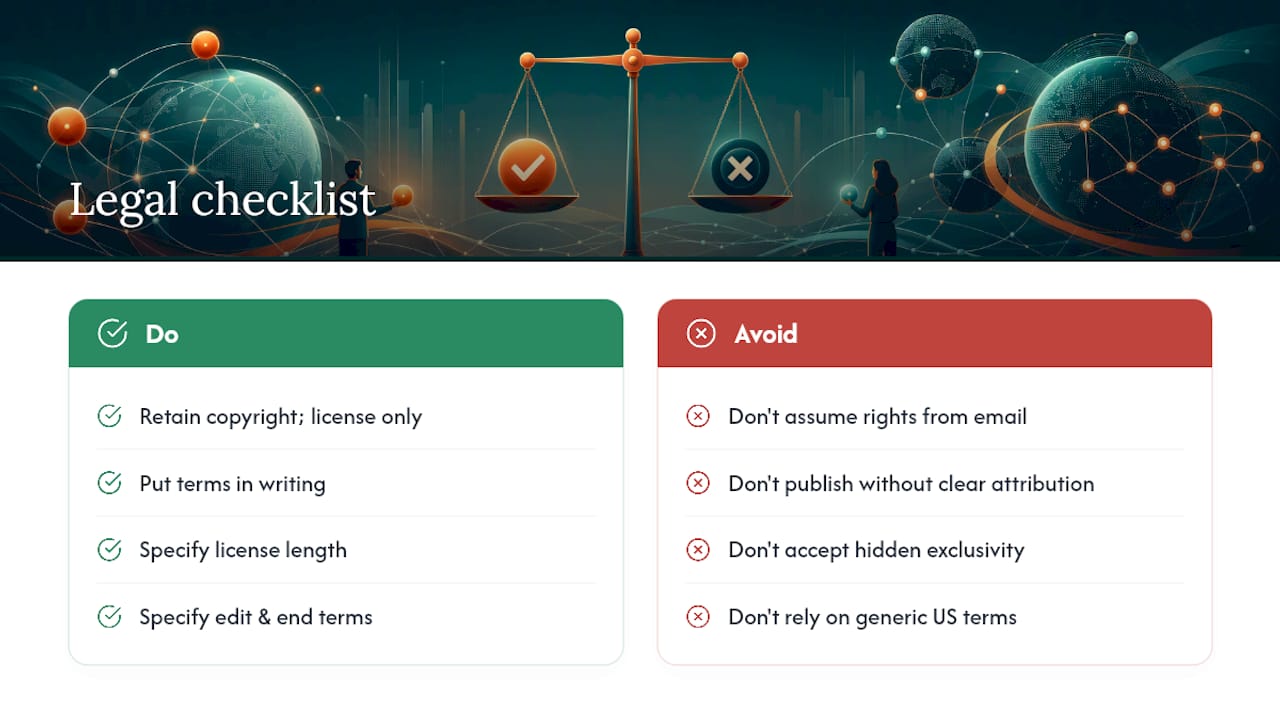
Syndication involves granting a license, not surrendering ownership. You retain copyright over your content the moment you write it; what a partner gets is permission to republish, and that permission should be spelled out clearly rather than assumed from a friendly email exchange.
Put the terms in writing every time, even for small partners. A syndication agreement should specify what content is covered, how long the license lasts, whether the partner can edit the piece, and what happens if the relationship ends. Without this, you have no leverage if a partner later claims broader rights than you intended to grant, or refuses to take a piece down when you ask.
Attribution matters legally, not just editorially. A visible byline and link back to your original source is standard practice and protects you if a dispute over authorship ever comes up. Some partners will try to publish syndicated content without clear attribution; that’s a signal to walk away, not negotiate harder.
Watch for exclusivity clauses buried in partner contracts. Some recommendation networks or content aggregators include language that limits where else you can distribute the same piece. Read those terms before signing, because an exclusivity clause you didn’t notice can quietly block your next partnership.
If you syndicate internationally, be aware that copyright enforcement and fair-use standards vary by jurisdiction. A generic U.S.-style permission agreement doesn’t automatically protect you the same way everywhere a partner operates, so keep agreements specific to the actual publishing relationship rather than relying on boilerplate.
How Does Syndication Affect Brand Authority and Reader Perception?
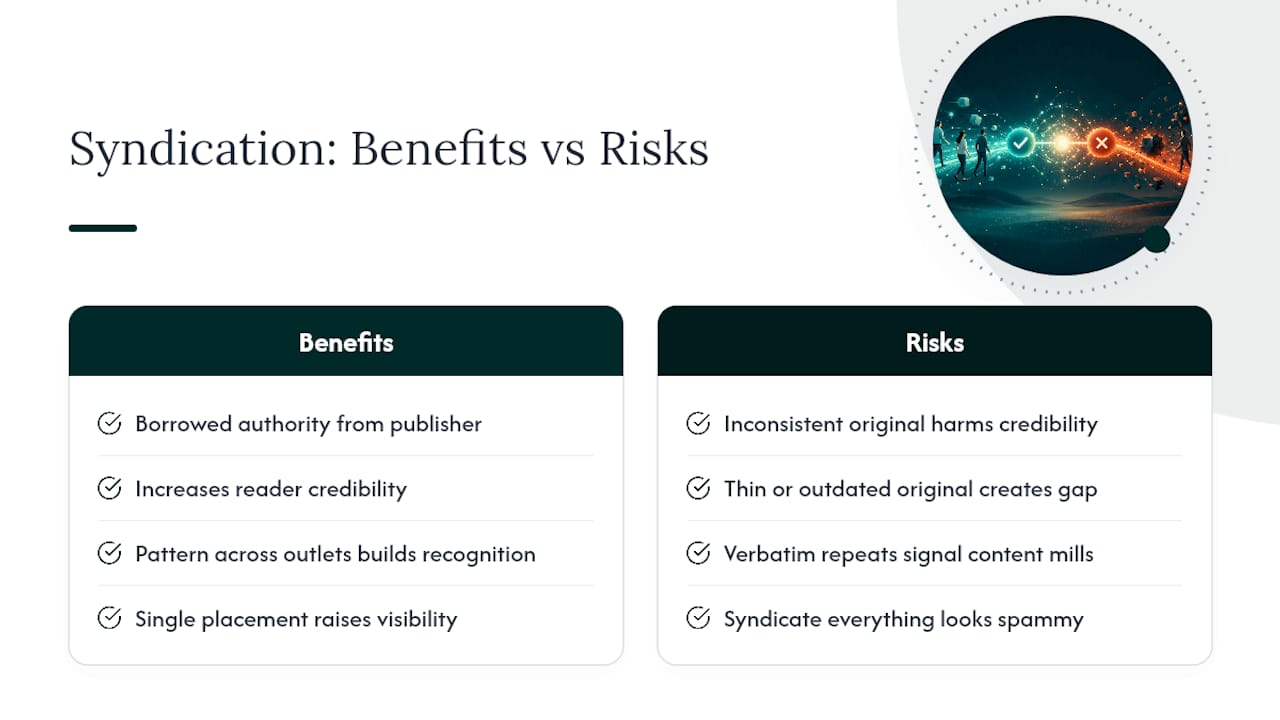
Appearing on a respected industry publication does more for your credibility than almost any other single SEO tactic, because readers transfer some of their trust in that publisher to you. A founder whose article runs on a recognized trade site gains a kind of borrowed authority that a blog post alone rarely produces on its own.
That effect cuts both ways. Readers who encounter your work first on someone else’s site, and later visit your domain, expect consistency. A byline that reads well on the partner site but leads to a thin or outdated original page creates a credibility gap that undercuts the exposure you just earned.
Frequency matters too. A single syndicated placement is a nice mention. A pattern of your name appearing across several respected outlets over months builds the kind of recognition that makes prospects trust you before they’ve read a word of your own site’s content, which is part of why consistent publishing cadence matters as much as any individual placement.
There’s a subtler perception risk worth naming: readers increasingly notice when the same article appears verbatim across multiple sites, and some read that as a sign of a thin, automated content mill rather than a thoughtful publisher. Syndicating occasionally, with strong partners and clear attribution, reads as strategic. Syndicating everything you publish, everywhere that will take it, starts to look like the opposite.
When Should You Actually Syndicate Your Content?
Syndicate when you need audience reach beyond your existing domain and you can secure real safeguards from the partner. Skip it when a page’s ranking is fragile or still climbing. A post sitting at position 8 has more to lose than a well-established page 1 fixture.
My practical rule: pilot with two or three pages, require noindex before anything else, and only scale the program once you’ve measured a real referral and backlink lift.
— Savannah
How Ranksector Automates a Safe Syndication Workflow
Running syndication safely at scale means checking canonical tags, tracking backlinks, and keeping a publishing cadence, week after week. Ranksector’s automated publishing and audit tools build that discipline into a daily workflow instead of a manual chore your team squeezes in when there’s time.
Here’s the concrete advantage: Ranksector publishes SEO-optimized articles on a daily cadence with over 11,000 already live across customer sites, then runs those same domains through a contextual backlink exchange network so authority grows without you chasing individual syndication partners one email at a time. The platform’s keyword research draws on competitor analysis, so the content going out is already positioned to earn the kind of organic traction that makes syndication partners want to run your work in the first place. Customers report meaningfully faster domain rating gains than manual content programs typically produce.
If your team is small and syndication outreach keeps sliding down the priority list, start a trial and see what a daily-publishing, backlink-building workflow looks like when it runs itself.
Sources
- Google Details Guidance For Syndication Partners
- Content distribution and SEO
- Content Syndication: What it is & how to do it successfully
- 7 Powerful Benefits of Content Syndication (2026)
Recommended
- How Blog Publishing Frequency Affects Your Rankings · Ranksector Blog · Ranksector
- How Keyword Cannibalization Affects Rankings in 2026 · Ranksector Blog — Ranksector
- Why Content Silos Hurt SEO: A Practical Guide for SEOs · Ranksector Blog · Ranksector
- Content Hubs SEO: A Practical Hub-and-Spoke Strategy · Ranksector Blog · Ranksector