
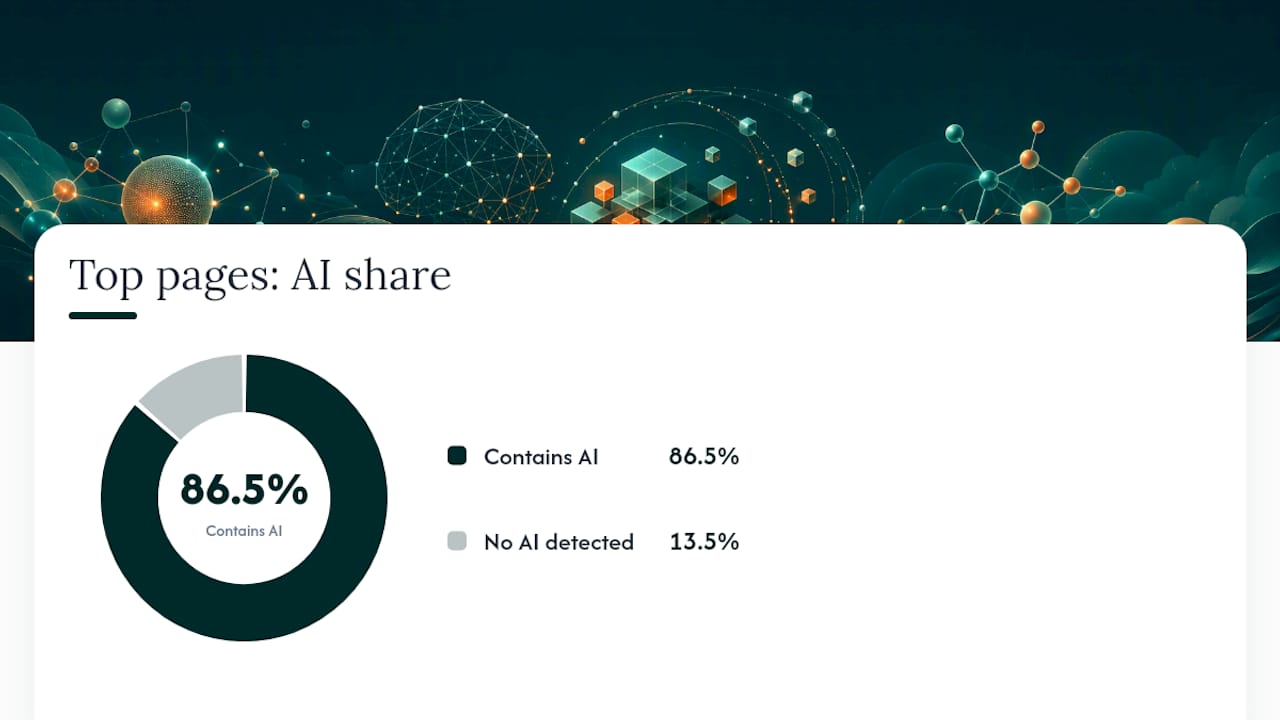
86.5% of Top Pages Use AI: How SEOs Avoid AI Content Penalties
Google does not penalize content for being AI-generated. It penalizes content that is thin, duplicated, or published at scale to game rankings, regardless of who or what wrote it. The nuance that matters for 2026: the target has always been scaled, low-quality output, not the tool used to produce it. Read on for the policy language, the data, and the exact workflow that keeps AI-assisted publishing on the safe side of that line.
TL;DR:
- Google’s penalties focus on scaled, low-quality content that manipulates rankings, not on AI generation itself, provided the content’s purpose is helpful.
- The primary signals Google monitors include sudden publishing volume, high content similarity, lack of originality, and minimal editorial oversight.
- Most sites with AI content rankings are not penalized but may experience algorithmic devaluation if producing thin or duplicate pages at scale.
- An effective editorial workflow involves fact-checking, adding unique insights, and ensuring clear author signals, not avoiding AI use altogether.
- Traffic recoveries depend on improving page quality, pruning weak content, and addressing site-wide quality signals, not on editing tools or detection systems.
Table of Contents
- What Google’s Search Central Guidance Actually Says About AI Content
- What Google Actually Penalizes: Scaled Content Abuse in Practice
- Signals and Detection: What Google’s Systems Are Actually Watching
- What the Data and Case Studies Actually Show
- The Editorial Workflow That Keeps AI-Assisted Publishing Safe
- If Traffic Dropped: The Triage and Recovery Playbook
- Ranksector’s Approach to Safe, Scaled AI Publishing
- Legal and Ethical Considerations Around AI-Generated Content
- Where AI Content Policy Is Headed
- Editorial Take: What This Evidence Actually Supports
- Sources
What Google’s Search Central Guidance Actually Says About AI Content
Google’s own statement on this is more permissive than most SEOs assume. The Google Search Central blog post on AI content says automation, including AI, is fine when it helps users. It becomes a problem only when the primary purpose is manipulating search rankings. That single sentence has shaped every policy update since.
Google’s own examples of acceptable automation include sports scores, weather data, and transcripts. None of that is new. What changed is the scale at which anyone can now generate publishable text, which is why Google leaned harder on intent as the deciding factor rather than production method.
Enforcement runs through two different systems, and mixing them up leads to the wrong fix. A manual action is a human reviewer at Google flagging a specific site for a policy violation, usually visible as a message in Search Console. Algorithmic suppression is automatic, driven by systems like SpamBrain and the site-wide quality classifiers baked into core updates. Most sites that lose traffic after publishing a lot of AI content were never manually penalized. They got quietly deprioritized by an algorithm that decided the page, or the whole site, wasn’t worth ranking as highly.
That distinction changes how you diagnose a traffic drop, which the recovery section below covers in detail.
A few things worth internalizing from Google’s own language:
- Quality and usefulness are evaluated independently of how the content was produced.
- “Primary purpose to manipulate rankings” is the actual violation, not “used AI.”
- SpamBrain operates continuously and doesn’t require a human to flag a site first.
- Site-level quality signals mean a batch of weak pages can drag down pages that are genuinely good.
- There’s no published “AI detector” penalty; Google has repeatedly said as much, including in community threads addressing this directly.
What Google Actually Penalizes: Scaled Content Abuse in Practice
“Scaled content abuse” is Google’s term for generating many pages, by any method, with the primary goal of manipulating search results rather than serving readers. AI didn’t invent this problem. Content farms were doing it with human writers in 2011. AI just lowered the cost of doing it badly at a much larger volume.
The behaviors that actually trigger a penalty or an algorithmic demotion tend to cluster around a few patterns:
- High-volume near-duplicate pages built off the same template with swapped city names, product names, or keywords, and nothing else distinct.
- Doorway pages designed to funnel several search queries to one destination, adding no unique value per page.
- Scraped or lightly rephrased content pulled from competitors or existing sources and republished with minor edits.
- Keyword stuffing where phrases are repeated unnaturally to chase rankings instead of clarity.
- Zero or minimal editorial oversight, meaning nobody fact-checked, verified, or added anything a reader couldn’t get elsewhere in thirty seconds.
Any one of these, done occasionally, probably won’t sink a site. Done at volume, across hundreds or thousands of URLs, it becomes exactly the pattern SpamBrain and the helpful content systems were built to catch.
Getting the diagnosis right matters because the fix is different depending on the cause. A manual action requires a reconsideration request after cleanup. Algorithmic suppression requires no request at all. You just need to actually fix the quality problem and wait for recrawling and reevaluation. Site owners who file reconsideration requests for what is really an algorithmic issue waste weeks waiting on a process that was never going to help them.
Signals and Detection: What Google’s Systems Are Actually Watching
Google doesn’t have a single “is this AI” switch. It watches for patterns that correlate with low-value mass production, whether AI touched the page or not.
Behavioral signals show up first, often before rankings move:
- A sudden spike in publishing volume, especially hundreds of URLs added in a short window.
- Unusual crawl or indexation patterns, like Search Console showing far more “discovered, not indexed” pages than usual.
- Engagement metrics that drop sharply, including bounce rate and time on page, on newly published content.
Content-level signals are where things get more specific:
- High similarity scores between pages on the same site, or between your pages and competitors’ pages covering the same topic.
- Absence of original evidence: no first-party data, no unique examples, nothing that couldn’t have been written by looking at the top five existing results.
- Missing author expertise signals, meaning no bylines, no credentials, no indication a real person with relevant knowledge stands behind the page.
A useful audit combines a few practical checks: run a sample of your URLs through a duplicate content or similarity tool, review Search Console’s Coverage and Performance reports for sudden shifts, and pull crawl stats to see whether Googlebot’s behavior on your site changed after a publishing spike.
One data point worth sitting with: a large-scale analysis of 600,000 top-ranking pages found that 86.5% contained some AI-generated content, and the correlation between AI content percentage and ranking position was 0.011, effectively zero. AI involvement alone tells you almost nothing about whether a page will rank. What separates winners from casualties is everything layered on top of the draft.
For a deeper look at the exact patterns that tend to draw scrutiny, Ranksector’s breakdown of AI content signals walks through specific red flags page by page.
What the Data and Case Studies Actually Show
The fear that “AI content gets penalized” doesn’t hold up against the numbers, but the full picture has real edges worth respecting.
Start with the Ahrefs analysis again: 86.5% of top-ranking pages carry some AI involvement, with essentially no relationship between AI content share and ranking position. That single figure has probably done more to calm nervous content teams than any Google statement, because it’s independently measured at scale rather than a policy claim.
A related Ahrefs analysis adds a layer of nuance: pages with a higher percentage of AI content showed slightly lower indexation rates and impressions in aggregate, even though plenty of heavily AI-assisted pages still ranked and generated traffic. Indexing and ranking still happen for AI-assisted content. The averages just tilt slightly against pages that lean hardest on unedited AI output.
Then there’s the pattern documented across multiple case-study analyses of sites that mass-published unedited AI content: a fast traffic run-up followed by a steep collapse tied to core updates targeting scaled content abuse. This boom-then-bust shape shows up repeatedly enough to treat it as a real risk curve, not a coincidence.
A few caveats worth keeping in mind before you draw conclusions from any of this:
- Correlation isn’t causation. Sites that mass-publish carelessly likely share other weaknesses (thin editorial process, weak internal linking) that compound the risk.
- Selection bias matters. Studies looking at top-ranking pages are, by definition, looking at survivors. They can’t fully capture how many AI-heavy pages never made it into the top results at all.
- Aggregate numbers hide individual outcomes. A 0.011 correlation coefficient describes the dataset, not your specific page.
The Editorial Workflow That Keeps AI-Assisted Publishing Safe
If the goal is to publish more without triggering the scaled-abuse systems, the fix isn’t avoiding AI. It’s building an editorial sequence that treats the AI draft as a starting point, not a finished product.
- Generate the draft with AI. Use it for structure, first-pass research synthesis, and getting words on the page fast. This is where AI actually saves time.
- Fact-check every claim. Verify statistics, dates, names, and any technical detail against a primary source before it goes further. AI models still fabricate specifics confidently.
- Add something the model couldn’t have written. A first-party data point, a specific example from real experience, an opinion grounded in evidence. This is the single highest-leverage step in the whole sequence.
- Edit for voice and E-E-A-T. Make sure the piece sounds like a person who knows the topic, not a summary of the top five search results. Attach a real author with relevant background.
- Publish with correct metadata and author signals. Bylines, author bio pages, and structured data all reinforce that a real person stands behind the page.
Beyond the per-article sequence, site-level habits matter just as much:
- Keep publishing cadence sustainable relative to your editorial capacity. A ten-article-a-day pace with a two-person team is a warning sign, not an achievement.
- Build topical depth around clusters instead of scattering thin pages across unrelated keywords.
- Maintain internal linking that connects related pages logically, which also happens to help Google understand topical authority.
- Run periodic sample audits, pulling ten or twenty recent pages and checking them against the same similarity and originality standards you’d apply to a competitor’s content.
Watch specific metrics rather than vanity numbers. Click-through rate, impressions, and dwell time tell you far more about whether a page is actually serving readers than word count or publishing frequency ever will. If you’re assigning roles across a small team, someone needs explicit ownership of the fact-check and originality step. Skipping that step is where most AI-content risk actually lives.
For teams building out the surrounding process, Ranksector’s guide to generative engine optimization covers how to structure AI-assisted content so it holds up in both traditional rankings and AI-generated answer boxes. And on the tooling side, AmmarAI’s rundown of using AI for SEO offers a complementary look at where automation fits without cutting corners on quality.
Pro Tip: Set a hard rule that no AI draft publishes without at least one fact a human added that wasn’t in the original prompt output. It’s a small habit that catches most of the risky patterns before they ever go live.
If Traffic Dropped: The Triage and Recovery Playbook
Start by checking Search Console’s Security & Manual Actions report. If it’s empty, you’re dealing with algorithmic suppression, not a manual penalty, which changes your entire approach. No reconsideration request will fix an algorithmic ranking drop; only actual quality improvement will.
From there, work through pages in priority order:
- Audit and rank pages by traffic and business value. Pull a full URL list with historical performance data before deciding what to touch.
- Prune or noindex the lowest-value pages first. If a page gets no traffic, has no unique value, and duplicates content elsewhere on your site, removing it from the index helps your overall quality density more than leaving it up ever will.
- Merge thin sibling pages that target overlapping queries into one stronger, more complete page rather than leaving three weak versions competing with each other.
- Rewrite your highest-potential pages with original data, direct examples, and visible author expertise, rather than starting over from scratch.
Site-wide quality classifiers mean a batch of weak pages can suppress pages that are genuinely strong, so pruning often lifts the pages you never touched. Recovery isn’t instant. Expect Google to need real time to recrawl affected URLs, and don’t read early ranking fluctuations as failure. A structured audit process makes this whole triage faster to run and easier to repeat every quarter instead of only after a crisis.
Ranksector’s Approach to Safe, Scaled AI Publishing
This workflow can be integrated into an automated publishing platform where AI handles the draft and keyword research pulled from competitor analysis, while editorial structure and E-E-A-T signals are built into article templates rather than bolted on afterward. Backlink exchange and analytics dashboards, tied into tools like Google Search Console, provide small teams with ways to monitor engagement signals without hiring a dedicated analyst.
This piece is written from that same editorial discipline. For more on structuring content around the trust signals search engines actually reward, see Ranksector’s guide to E-E-A-T.
Legal and Ethical Considerations Around AI-Generated Content
Copyright questions around AI training data remain unsettled in courts across multiple jurisdictions, and that uncertainty extends to published output built on those models. Disclosure is the area moving fastest: some publishers, industries, and even individual clients now expect explicit labeling of AI involvement, particularly in finance, health, and legal content where accuracy carries real consequences for readers.
Plagiarism risk deserves separate attention from SEO risk. A page can avoid every Google penalty and still cross an ethical line if it reproduces another writer’s structure or phrasing closely enough to constitute unattributed copying. That’s a reputational and potentially legal problem independent of how Google ranks the page.
Attribution norms are still forming across the industry. Some sites disclose AI assistance in bylines or footnotes; others don’t, and there’s no universal standard yet. What’s consistent is that publishing false or harmful information at scale carries the same liability whether a human or a model wrote the sentence. Google’s rankings are one consequence. Advertiser trust, legal exposure, and reader harm are separate risks that don’t disappear just because a page happens to rank well.
Where AI Content Policy Is Headed
Expect Google’s enforcement to keep drifting toward finer-grained, site-level quality signals rather than binary “AI or not AI” detection, because that detection was never technically reliable enough to be the actual mechanism. The direction has been consistent since the original 2023 guidance: judge the output, not the tool.
Watch for tighter integration between helpful content systems and SpamBrain, meaning quality classifiers increasingly operate across a whole site rather than page by page. That raises the cost of publishing a handful of weak pages, since they can now drag down pages that would otherwise perform well on their own.
Regulatory pressure is a separate track worth monitoring. Disclosure requirements for AI-assisted content are more likely to come from advertising standards bodies, platform policies, or regional data and consumer protection law than from Google directly. Google has shown no sign of building a labeling requirement into ranking itself, but that could shift if regulatory pressure elsewhere in the industry forces the issue.
The practical takeaway for anyone publishing at scale: the compliance bar isn’t “avoid AI.” It’s “keep proving the page is worth a person’s time,” and that bar tends to rise, not fall, with each core update.
Editorial Take: What This Evidence Actually Supports
The conventional advice in most AI content guides overcorrects. Writers either treat AI as radioactive, avoiding it entirely, or treat “no AI penalty exists” as a green light to skip editorial oversight altogether. Neither position survives contact with the data. An 86.5% AI-content share among top-ranking pages proves AI involvement isn’t disqualifying. The boom-then-bust pattern among sites that skipped editing proves volume without oversight is still a losing bet.
What gets underrated is how much the fix has nothing to do with AI detection and everything to do with basic editorial discipline that good publishers have always practiced: fact-check, add something original, put a real name behind the work. That’s not a new standard invented for the AI era. It’s the same standard that separated good content sites from content farms a decade ago, just applied to a faster production method.
If you take one thing from this: prioritize the fact-check and original-insight step above everything else on the workflow list. Publishing speed without it is exactly the pattern that shows up in every case study of sites that lost traffic.
— Savannah
Sources
- Google Search Central Blog — Google Search and AI content
- Ahrefs study finds no evidence Google penalizes AI content (reported by Search Engine Journal)
- Does Google Penalize AI Content? Policy vs Data (2026) — Metric37