
What Is an AI Content Audit and How Do You Run One?
An AI content audit is a staged review that checks whether your pages still rank and whether answer engines like ChatGPT, Perplexity, and Google’s AI Overviews can find and quote them. That second part is new, and it’s the part most teams skip.
The framework has five stages, and you can run all five without buying new software:
- Inventory — pull every published URL from your sitemap or CMS export into one sheet.
- Metrics — layer in performance data: impressions, clicks, conversions, backlinks.
- AI-citability check — test whether each page gives an answer engine something quotable.
- Buyer mapping — tag each page to where it sits in the buying decision.
- Action — assign a verdict: Keep, Update, Consolidate, or Retire.
Most content teams still audit for rankings alone. That misses how AI engines now synthesize answers instead of just indexing keywords, which means a page can rank on page one and still never get cited by an assistant a buyer is actually asking.
Your one action right now: export your full URL list from Google Search Console or your CMS, sort by impressions, and pull the top 50. That’s your starting inventory. Everything else in this guide builds on that single spreadsheet.
Key Takeaways
An effective AI content audit combines traditional performance metrics with a direct AI-citability check, then routes every page to a Keep, Update, Consolidate, or Retire verdict.
| Point | Details |
|---|---|
| Definition anchor | An AI content audit checks whether pages rank and whether answer engines can quote a clear answer from them. |
| Follow the five stages | Inventory, metrics, AI-citability check, buyer mapping, and verdict assignment, run in that order. |
| Answer-shape is testable | State the direct answer in the first two or three sentences, ideally under a question-phrased heading. |
| Entity clarity prevents drop-off | Keep brand and product names identical across pages, schema, and canonical URLs to avoid citation loss. |
| Audit cadence | Run a full audit once or twice yearly, backed by monthly sweeps of your highest-impression pages. |
| Ranksector supports the loop | Daily automated publishing and competitor-driven keyword research keep new content audit-ready from launch. |
Table of Contents
- Why AI Content Audits Matter Now: AEO vs. Classic SEO
- The 5-Stage AI Content Audit Process and How to Run It
- AI-Citability Checks: Answer-Shape, Schema, and Entity Clarity
- The Minimum Tool Stack for Running These Audits
- Triage and Prioritization: Applying Keep, Update, Consolidate, or Retire
- How Often to Audit and What to Measure
- How Ranksector Scales Audit Loops for Small Teams
- The Part of This Process Most Teams Get Backward
- Get Your Content Audit-Ready Without Adding Headcount
- Sources
Why AI Content Audits Matter Now: AEO vs. Classic SEO
Classic SEO optimizes for a ranking algorithm that returns ten blue links and lets the reader pick. Answer engine optimization, or AEO, optimizes for a model that reads your page, decides whether it contains a clean answer, and either quotes you or moves on to a competitor. Those are different games with different scoring rules, and running an audit built for the first one tells you almost nothing about your standing in the second.

The mechanics matter here. A search engine indexes keywords and matches query intent to a page. An answer engine synthesizes a response by pulling fragments from multiple sources and deciding, page by page, whether the content is structured clearly enough to extract. A content audit today has to check both: can this page rank, and can a model actually lift a clean answer out of it.
The business risk shows up fast once you look for it. A pricing page written two years ago with an outdated figure doesn’t just mislead a human reader who catches the error. It gets quoted verbatim by an assistant that has no way to flag it as stale, and that quote reaches a buyer who never visits your site to see the correction. Nobody clicks through to verify a number an AI states with confidence.
Citation share of voice is becoming a real commercial metric. If a competitor’s outdated blog post gets cited by an assistant answering “best project management tool for remote teams” and yours doesn’t, you’ve lost a buyer who never saw your homepage, your pricing, or your product.
That’s the shift auditors need to internalize. Ranking share of voice measured how often you showed up in search results. Citation share of voice measures how often a model chooses to repeat your claim, your number, or your framing when a buyer asks a direct question. The two overlap, but they’re not the same metric, and a page can win one while losing the other.
Three things tie citation visibility directly to revenue:
- Buyers increasingly ask assistants comparison and decision questions before they ever type a query into Google.
- A citation from an AI assistant carries implicit trust that a search snippet doesn’t, because the model appears to have already vetted the source.
- Pages that get cited repeatedly tend to also earn more direct traffic, because assistants often name the source even without a clickable link.
Auditing for AI-citability isn’t a defensive move to protect against stale content. It’s an offensive play to capture buyers at the exact moment they’re asking the questions your content already answers, if the page is built to be quoted.
The 5-Stage AI Content Audit Process and How to Run It
Running this process end to end takes a few days for a site under 200 pages, longer for anything bigger. The order matters because each stage feeds the next.
- Build the inventory. Pull URLs from your sitemap.xml, cross-check against a CMS export, and reconcile the two lists in a spreadsheet. Sites with staging pages, orphaned drafts, or old subdomains almost always find URLs in one list that are missing from the other.
- Pull performance metrics on a consistent window. Use the same 90 or 180 day window for every page: impressions, clicks, click-through rate, average position, and conversions from Google Search Console, plus referring domains from a backlink tool. Mixing timeframes across pages makes the whole dataset unreliable.
- Run the AI-citability check. For each priority page, ask: does this page answer the target query in the first 40 to 60 words, in plain sentences a model could lift directly? Record a pass or fail, along with what schema markup is present.
- Map buyer intent. Tag each page as top-of-funnel, comparison-stage, or decision-stage, based on the query it targets and the language it uses.
- Assign a verdict. Based on the metrics and the citability check, mark each page Keep, Update, Consolidate, or Retire.
This five-stage sequence is the pattern that shows up across the most detailed audit guides available, and it works because each stage produces a concrete input for the next one rather than a vague impression.
Pro Tip: Run the AI-citability check before you touch performance data emotionally. It’s tempting to protect a page with strong traffic from a harsh verdict, but a page that ranks well and still fails the citability check is exactly the page most exposed to a competitor stealing the answer engine citation out from under it.
Expect the output of a full pass to be a scored spreadsheet, not a narrative report. Every row should carry a URL, a metrics summary, a citability pass/fail, an intent tag, and a verdict. That structure is what makes the next stage, triage, fast instead of another meeting.
AI-Citability Checks: Answer-Shape, Schema, and Entity Clarity
Answer-shape is the single most testable signal in this whole process, and it’s the one most existing content fails. A page has good answer-shape when it states a direct answer to the implied question within the first two or three sentences, ideally under a heading phrased as that question, before it explains context or nuance. A page that opens with three paragraphs of background before it gets to the actual number or recommendation is structurally invisible to a model scanning for extractable answers.
Schema markup gives the model a second, structured path to the same information. FAQ schema, Article schema, and Product schema each tag specific fields (a question, an answer, a price, a rating) so an extraction system doesn’t have to infer them from prose. Pages without any schema force the model to parse unstructured text, which is slower and less reliable, and it’s the first thing to check when a page with strong content still isn’t getting cited.

Bot access is a purely mechanical check, and it fails more often than it should. Open your robots.txt file and confirm it isn’t blocking GPTBot, ClaudeBot, or other AI crawlers, either by name or by an overly broad disallow rule written years ago for a different purpose. A single misplaced line in robots.txt can make an entire content library invisible to every major AI crawler while the site still ranks fine in Google.
Entity clarity ties all three together. Inconsistent naming and missing structured data are the biggest reason models drop a brand or product from citations, even on a site with strong domain authority and solid backlinks. If your product is called one thing on the homepage, a slightly different thing in a blog post, and a third variation in your schema markup, the model has no reliable way to connect those mentions into a single entity it can cite with confidence.
Run these four checks on every priority page:
- Does the page state a direct answer within the first two or three sentences?
- Is relevant schema present and does it validate without errors?
- Does robots.txt allow the major AI crawlers, and does a live fetch test confirm access?
- Is the brand or product name written identically across the page, the schema, and the canonical URL?
A page can pass a traditional SEO audit completely and fail all four of these, which is exactly why the two audits can’t be the same document.
The Minimum Tool Stack for Running These Audits
You don’t need a large budget to run this properly, but you do need four categories covered, and skipping any one of them leaves a blind spot in the audit.
- A crawler. Screaming Frog is the standard here, and it’s what most SEO teams already own. Use it to pull the technical inventory: titles, headers, canonical tags, and robots directives across every URL.
- Google Search Console. This is your only reliable source for impressions, clicks, average position, and query-level data tied to actual search performance rather than estimated traffic.
- A spreadsheet or BI tool. Google Sheets works fine for most teams under a few hundred pages. The point isn’t the tool, it’s normalizing every metric to the same date range before you compare pages.
- An AI-visibility tracker. This is the newest layer, and it’s the one most audit stacks are still missing: a tool that monitors whether and how often your pages get cited across ChatGPT, Perplexity, and similar assistants.
Beyond that minimum, a few optional additions speed things up considerably. Schema validators catch markup errors before they cost you a citation. Agent-run crawls can automate the answer-shape check across hundreds of pages instead of doing it manually. And running an LLM check against your own brand voice guidelines catches drift in tone that creeps in when multiple writers or an automated tool contribute to a large content library over time.
Normalize five fields for every URL before you move to triage: impressions, click-through rate, backlink count, conversions, and the last-updated date. That last field gets overlooked constantly, and it’s often the single best predictor of which pages are quietly accumulating stale claims that a model might repeat as current fact.
Triage and Prioritization: Applying Keep, Update, Consolidate, or Retire
Once every page carries metrics and a citability verdict, the actual decision is usually fast. The taxonomy itself is simple:
- Keep — strong performance, passes the citability check, no action needed beyond monitoring. A well-performing comparison page that already states a direct answer and carries valid schema belongs here.
- Update — good potential (decent impressions or strong backlinks) but fails answer-shape or has a stale claim. This is usually your biggest bucket, and it’s where a rewritten intro paragraph or added schema can move a page from invisible to cited within weeks.
- Consolidate — multiple thin or overlapping pages targeting the same query, cannibalizing each other’s authority. Merge them into one stronger page and redirect the rest; this is the same instinct behind spotting keyword cannibalization before it splits your ranking signal across three weak pages instead of one strong one.
- Retire — no traffic, no backlinks, no strategic value, and no realistic path to citability. Redirect or remove it rather than letting it dilute your crawl budget.
Prioritize by impressions first: a page with 10,000 monthly impressions and a failing citability check outranks a zero-traffic page every time, regardless of how outdated the low-traffic page looks. After that, weight strategically important pages (pricing, comparison, category pages) above lower-funnel blog content, since those are the pages buyers and models both lean on most heavily for decision-stage answers.
Consolidate when the overlap is about audience and query, not just topic. Rewrite instead when a single strong page just needs updated facts, better answer-shape, or fresh schema. And treat a robots.txt block on AI crawlers, or a factually wrong statistic, as an urgent fix regardless of where the page otherwise ranks in your backlog.
How Often to Audit and What to Measure
A full audit once or twice a year fits most sites, supplemented by a lighter monthly sweep of your highest-impression pages to catch drift before it compounds. Run an unscheduled audit before any migration, and again shortly after any major update to how a search engine or AI platform ranks and cites content.
Three metrics matter more than traffic alone once AI-citability enters the picture:
- Citation share of voice — how often your brand gets named when an assistant answers a query in your category, tracked against named competitors.
- Engine-specific citation rate — citation frequency broken out by platform, since a page can perform well in one assistant and poorly in another.
- AEO-to-conversion — the downstream conversion rate tied to pages that get cited, which tells you whether citations are actually translating into pipeline.
Set alerts for two specific regressions: a robots.txt change that newly blocks an AI crawler, and any statistic or claim on a high-traffic page that’s aged past its usual refresh window. Both are silent failures that don’t show up in a standard rank tracker.
To justify audit resources to leadership, report the before-and-after citation rate on the pages you updated, not just traffic. A page that moves from zero citations to regular citations across two or three assistants is a concrete, defensible number that a rankings graph alone doesn’t capture.
How Ranksector Scales Audit Loops for Small Teams
Small marketing teams rarely have a spare week to run a full manual audit, let alone repeat it monthly. Ranksector was built around that constraint: its keyword research draws on competitor analysis, its backlink exchange network builds domain authority in the background, and it has already published over 11,000 articles across customer sites without requiring a dedicated content hire.
That volume only works with governance built in. Treating automation as a workflow problem, not a model problem, matches what Ranksector does in practice: every publishing cycle runs against documented voice guidelines, and human review checkpoints catch drift before anything goes live.
Where teams see the clearest time savings:
- Keyword research and competitor gap analysis run continuously instead of as a quarterly project.
- New articles publish daily, which keeps the inventory stage of future audits smaller and less overdue.
- The AI-citability groundwork gets built into new content from the start, rather than retrofitted during a painful annual cleanup.
Pro Tip: If you’re evaluating any automated publishing tool, ask specifically how it handles entity consistency across articles. That’s the single biggest pitfall in AI-driven content programs, and it’s worth confirming before volume becomes a liability instead of an asset.
The Part of This Process Most Teams Get Backward
Most teams treat the AI-citability check as an add-on step at the end of a traditional audit, something to glance at after the real work of pulling traffic numbers is done. That ordering is backward. If a page can’t be quoted by an answer engine, its traffic ceiling is already capped, no matter how strong its backlink profile looks. Citability isn’t a bonus signal. It’s closer to a gate.
The conventional advice to “just update your top pages annually” also undersells how fast staleness compounds once assistants start repeating your numbers to buyers who never click through to verify them. A pricing figure that’s wrong for two months might cost you a handful of confused prospects. The same figure quoted by an assistant for two months can quietly misinform every buyer who asks that exact question, with no correction mechanism in between.
What I’d prioritize first, before any tooling purchase: get one person accountable for entity consistency across your site. Names, schema, and canonical structure. That single fix prevents more lost citations than any crawler upgrade, and it’s usually a documentation problem, not a technical one.
— Savannah
Get Your Content Audit-Ready Without Adding Headcount
Ranksector is the practical route to running this entire audit cycle without hiring a content team to do it manually. Instead of a one-off consulting engagement that leaves you back where you started in six months, Ranksector builds daily article publishing, competitor-driven keyword research, and a backlink exchange network into one subscription, so audit-ready structure (clean schema, consistent entity naming, answer-first formatting) gets built into new content instead of bolted on during a painful annual cleanup.
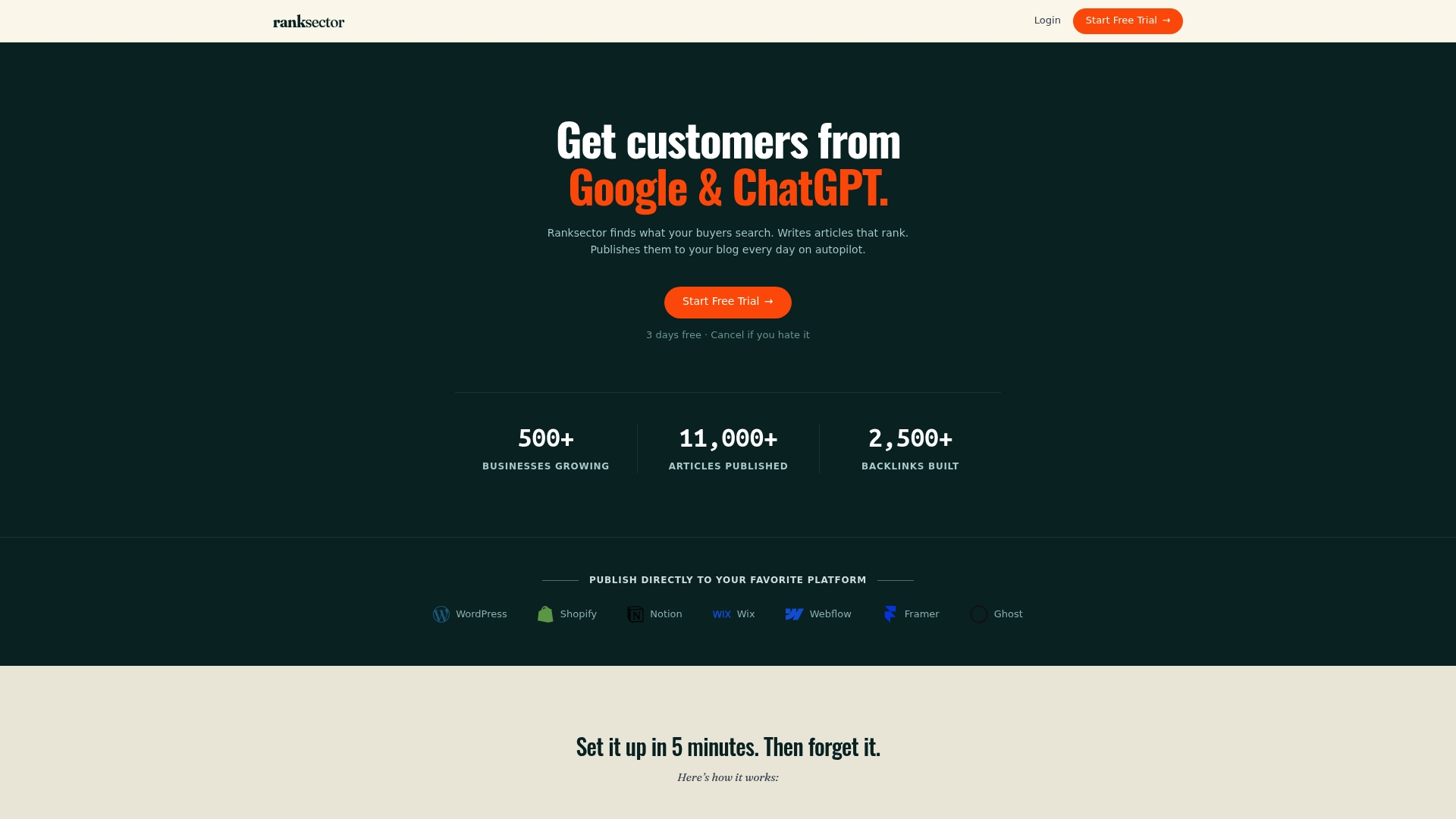
This fits B2B SaaS founders and small marketing teams best, the readers who don’t have a spare content hire but still need their pricing pages, comparison content, and category pages showing up in both search results and AI assistant answers. If you want to see where your current content stands on AI-citability, start with the free audit tools to run a quick check on your top pages, or go straight to the AI content audit product page to see how the full automated workflow runs end to end. Teams managing multiple client sites can look at the agency option for scaled, white-label publishing.
Sources
A handful of resources go deeper on the mechanics covered here, useful if you’re building out an audit template or briefing a contractor on the process.
- How To Run An AI Content Audit | Yotpo
- Content Audit: What It Is & How to Run One (2026)
- AI Content Strategy In 2026: We Built A System That Runs Itself