
7 Step Generative Engine Optimization for Marketers: Win AI Citations
Generative engine optimization is the practice of structuring content so AI systems like ChatGPT, Perplexity, and Google’s AI Overviews cite it directly in their answers. The goal shifts from ranking for clicks to earning citations and mentions inside AI-generated responses. Your first move: audit your top pages for extractable, self-contained passages an engine can lift and quote.
TL;DR:
- Optimizing for citation frequency requires creating self-contained, highly extractable passages that include concrete data and quotes within the content.
- Technical setup should focus on ensuring crucial text loads in the initial HTML through server-side rendering or minimal JavaScript reliance for AI crawler visibility.
- Improving GEO performance involves auditing existing pages, fixing technical issues, rewriting for extractability, and actively seeking earned media and multi-format content.
- Measuring success depends on tracking citation rates inside AI responses, conducting manual engine checks, and pairing these metrics with conversion data.
- Starting with quick wins like rewriting top pages and fixing technical blockers yields faster results before pursuing slower, high-impact earned media outreach.
Table of Contents
- What Does Generative Engine Optimization Actually Cover?
- How Is GEO Different From Traditional SEO?
- What Core GEO Strategies Should Marketers Prioritize?
- What Technical Setup Do AI Crawlers Need?
- How Do You Measure GEO Performance?
- A 7-Step GEO Action Plan for This Quarter
- How Ranksector Puts GEO Into Practice at Scale
- Where Should You Invest First for the Fastest Wins?
- Let Ranksector Handle Your GEO Execution
- Sources
What Does Generative Engine Optimization Actually Cover?
Generative engine optimization, often shortened to GEO and sometimes called AEO (answer engine optimization) or LLMO (large language model optimization), describes how you shape content so AI systems select it as source material. These terms circulate somewhat interchangeably, but GEO is now the term practitioners and researchers use most.
Here’s the mechanism: most generative engines use retrieval-augmented generation, pulling relevant passages from indexed pages, then synthesizing an answer and often citing where the information came from. Your content isn’t competing for a blue link. It’s competing to become a quoted fragment inside someone else’s answer.
That changes what “visibility” means. GEO covers three overlapping areas:
- Getting cited as a named source inside an AI-generated answer
- Writing passages structured so an engine can extract them cleanly, without needing the surrounding page for context
- Maintaining a presence across multiple platforms, not just your own domain, since engines pull from forums, video transcripts, and third-party sites too
How Is GEO Different From Traditional SEO?
Traditional SEO chases rankings and click-through rate. GEO chases citation frequency, meaning how often an engine names your brand or links your page as it answers a question. Those are related goals but not the same scoreboard, and optimizing for one doesn’t automatically win you the other.
Query behavior diverges too. Search queries average roughly four words. AI search queries run far longer, averaging around 23 words, because people phrase them like actual questions rather than keyword fragments. “Best CRM” becomes “what CRM works best for a five-person sales team switching from spreadsheets.” Content written for keyword matching doesn’t answer that kind of question well.
What carries over from SEO, and what needs to change:
- Stays essential: crawlability, technical health, genuinely useful content, page quality signals
- Gets reprioritized: extractability of individual passages, earned mentions from third parties, conversational phrasing that mirrors how people actually ask questions
- Gets deprioritized: exact-match keyword density, chasing position one for short-tail terms in isolation
The practical upshot: your existing SEO foundation isn’t wasted, but it isn’t sufficient on its own anymore.
What Core GEO Strategies Should Marketers Prioritize?
Structure comes first. Engines favor paragraphs that make sense when lifted out of context, which means front-loading the answer in the first sentence and keeping supporting detail in the same block rather than scattered across a page. A Search Engine Land analysis of GEO practices found this self-contained structure consistently outperforms buried, multi-paragraph explanations.
Beyond structure, four moves matter most:
- Add citation-ready material. Statistics, direct quotations, and named sources give an engine something concrete to reference. GEO-bench testing found that adding citations, quotes, and statistics improved visibility in generative engine responses by 30 to 40 percent relative to unstructured content.
- Pursue earned media aggressively. Engines show a measurable bias toward third-party, earned coverage over brand-owned pages, so a mention in an industry publication often outweighs a dozen blog posts you wrote yourself, according to ACM/arXiv research on generative engine behavior.
- Build co-citation networks. Guest posts, user-generated content, and community discussion on forums like Reddit all feed the pool engines draw from.
- Seed multiple formats. Video transcripts, Wikipedia-adjacent presence, and UGC platforms all show up as sources in generative answers, not just your own website.
Pro Tip: Rewrite your highest-converting page’s opening paragraph as if it will be read aloud with zero surrounding context. If it still makes sense and answers the question fully, it’s extraction-ready.
What Technical Setup Do AI Crawlers Need?
AI crawlers need to actually see your text, which sounds obvious until you check how much content on a modern site loads only after JavaScript executes. Some AI crawlers struggle with heavy client-side rendering, so content dependent on JS to appear can go invisible to them entirely, a pattern flagged in GEO-bench’s crawler analysis. Server-side rendering, or at minimum ensuring critical text exists in the initial HTML, removes that risk.

Google’s own guidance is refreshingly unglamorous here: skip the special AI-only files. You don’t need a separate llms.txt setup or a parallel content pipeline. Google’s developer guidance for generative AI features recommends the same fundamentals that have mattered for years, just applied more rigorously.
That checklist looks like this:
- Descriptive, hierarchical headings that map to actual questions
- Accessible images with real captions, not decorative alt text
- Structured data where it genuinely clarifies content type, used selectively rather than everywhere
- Fast load times, HTTPS, and mobile usability as baseline requirements, not extras
- Clean, crawlable HTML with no critical text locked behind interaction
Nail the boring technical layer before chasing exotic tactics. It’s the ceiling on everything else you do.
How Do You Measure GEO Performance?
The core metric is reference rate, sometimes called citation frequency: how often an AI engine names your brand or links your content while answering a relevant query. Think of it as your share of voice inside AI-generated answers rather than a page-one ranking.

By the numbers: structured content with clear citations and statistics saw 30 to 40 percent stronger position-adjusted visibility in controlled GEO-bench testing, a gap wide enough to justify rewriting your priority pages around it.
Track it using a mix of sources:
- Google Search Console’s generative AI reporting, where available
- Bing Webmaster Tools’ AI-related reporting
- Manual spot-checks by running your target questions directly through Perplexity, Gemini, and ChatGPT and logging whether you’re cited
- Third-party GEO tracking tools as they mature
Don’t stop at citation counts. Pair GEO metrics with downstream conversion data, since AI-referred visitors tend to arrive further along the buying journey than typical search traffic, which means a smaller volume of AI-sourced visits can still outperform on revenue per visit.
A 7-Step GEO Action Plan for This Quarter
Move in this order rather than tackling everything at once:
- Audit your top 20 pages for extractable passages and check which ones already get cited using manual engine tests.
- Fix technical blockers first: server-side rendering gaps, JS-hidden text, slow load times.
- Rewrite priority pages so the opening paragraph stands alone, backed by a real statistic or quote.
- Pursue earned mentions through targeted outreach to publications and communities your buyers actually read.
- Seed multi-platform assets: a video transcript, a Wikipedia-adjacent presence, active participation in relevant forums.
- Set up measurement, combining Search Console data, manual engine testing, and conversion tracking.
- Iterate with variants, testing slightly different phrasings of the same core passage to see which one engines favor, since engine behavior differs enough that no single format wins everywhere.
Seven steps, one quarter, and a feedback loop that keeps improving instead of a one-time project you check off and forget.
How Ranksector Puts GEO Into Practice at Scale
Executing that seven-step plan manually across dozens of pages is exactly where most small teams stall out. Ranksector has published more than 11,000 articles for B2B SaaS and small business clients, and its content automation is built around the extractability principles this guide covers, not just word count.
Here’s what that looks like in practice:
- Daily article publishing means priority pages get GEO-structured revisions on a continuous cadence, not a once-a-year rewrite
- Competitor-driven keyword research feeds directly into which conversational, long-tail questions get targeted first
- A contextual backlink exchange network builds the earned-mention signal that AI engines weigh heavily
- Built-in audit tools flag technical blockers, like JS-dependent content, before they cost you crawler visibility
For a solo founder or a two-person marketing team, this closes the gap between knowing the GEO checklist and actually shipping against it every week.
Where Should You Invest First for the Fastest Wins?
Start with the highest-impact, lowest-effort move: auditing and rewriting your already-ranking pages for extractability. That’s cheaper than chasing earned mentions and shows results faster, since you’re improving assets that already have some authority behind them.
Fix technical blockers next; a JS-hidden paragraph is invisible no matter how well it’s written. Save earned-media outreach for after your own house is in order. It’s the slowest lever to pull, but it’s also the one competitors are least likely to have already worked.
— Savannah
Let Ranksector Handle Your GEO Execution
If you’ve read this far, you already know the problem: GEO adds real work on top of an SEO workload most small teams were already stretched thin managing. Ranksector is built for exactly this gap. It’s an automated alternative to hiring an agency or building an in-house content team from scratch, and it applies the extraction-ready structure, sourced statistics, and citation-friendly formatting this guide describes to every article it publishes.
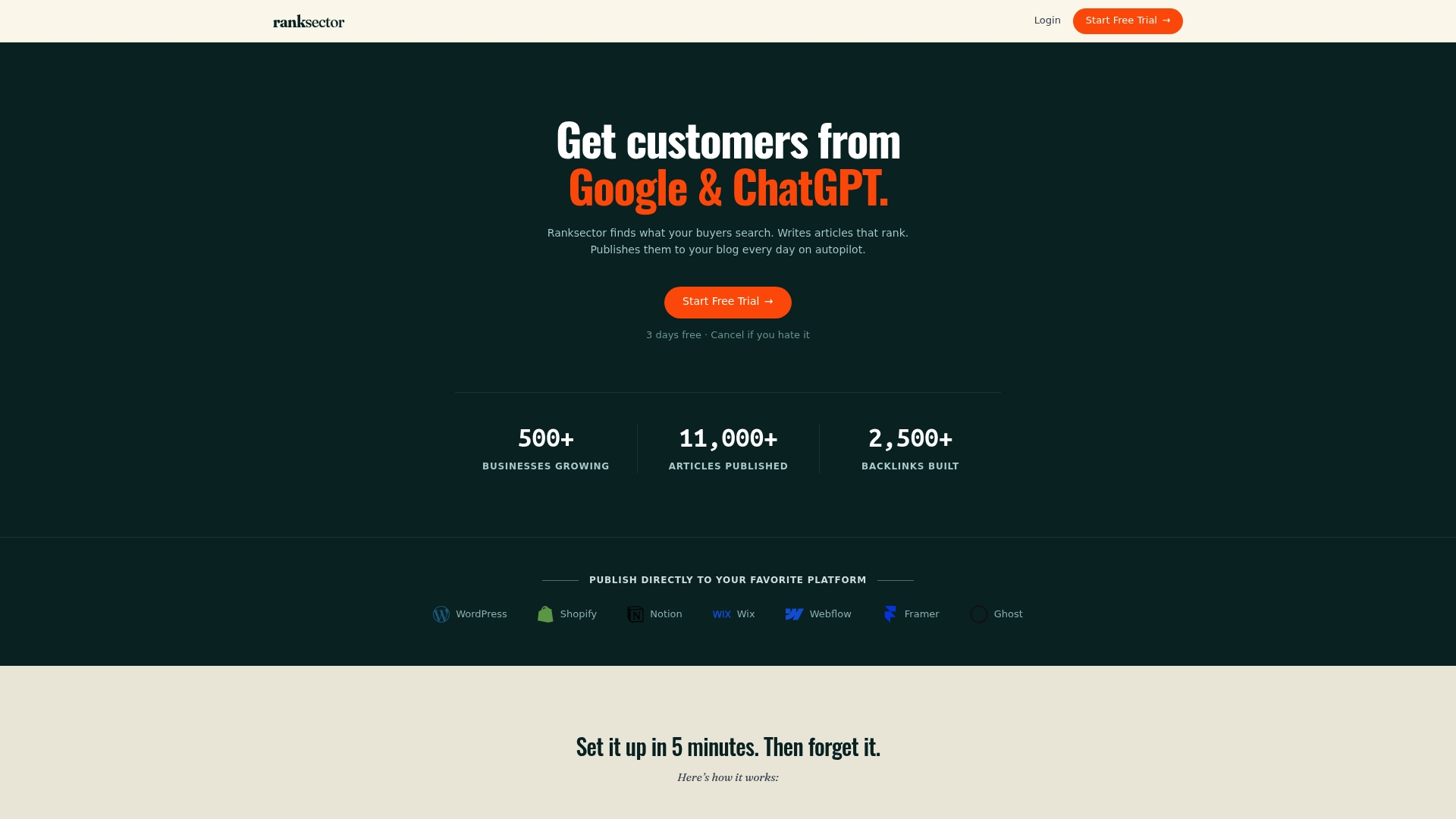
For B2B SaaS founders and small marketing teams, that means daily article production without a writer on payroll, competitor-driven keyword research baked into the pipeline, and a backlink exchange network working in the background to build the earned-mention signal generative engines favor. You don’t have to choose between shipping GEO-ready content and running the rest of your business.
Run a free technical and GEO readiness check on your site to see exactly which pages are extraction-ready today and which ones are invisible to AI crawlers right now.
Sources
- A Multi-Factor Brand-Recognition Audit for AI Answer Engines (GEO-bench)
- Optimizing your website for generative AI features on Google Search — Google Developers
- a16z — GEO over SEO