
Measure First: How Research, Marketing, and SEO Teams Earn AI Citations
An AI citation is a source a generative answer names, usually attached to one verifiable sentence rather than a whole page. The single highest-leverage move you can make is writing content that’s cheap to verify and easy to lift: clear facts, one source per claim, dates that make freshness obvious. Before you do anything else, run 20 to 30 prompts your buyers actually type and see whether your pages show up at all.
TL;DR:
- AI citations typically reference specific claims rather than the entire page, meaning ranking alone is less relevant for visibility.
- Many AI citations source content from page two or lower in search results, and citations often include sources not appearing in top organic listings.
- Citation inaccuracies are common, with frequent mismatches in URLs, dates, or quotes, requiring ongoing monitoring and validation.
- Improving citation chances involves clear, standalone factual sentences, up-to-date sources, structured data, and one citation per claim.
- Regular, systematic measurement and targeted updates to high-revenue pages are essential for tracking citation effectiveness and refining strategies.
Table of Contents
- What Are AI Citations in Search, and How Do They Differ From Links?
- Why Are Some AI Citations Wrong or Misleading?
- How Do You Measure and Track AI Citations Across Platforms?
- What Tactics Actually Increase Your Chance of Being Cited?
- A 30 to 60 Day Roadmap for Researchers and SEOs
- The Gap Between Citation Advice and Citation Reality
- Where Automated Publishing Fits Into a Citation Strategy
- Sources
What Are AI Citations in Search, and How Do They Differ From Links?
AI citations attach to a sentence or span the model can check, not to a page’s overall rank. That’s the core shift researchers and SEOs need to internalize: a generative engine doesn’t care that your page ranks third for a keyword. It cares whether one specific claim on that page can be matched against something it retrieved and confirmed.
This changes how visibility gets counted. A single AI Overview or Perplexity answer often cites four, six, sometimes ten different sources in one response, and plenty of those sources never appeared in the top 10 organic results for the query that triggered them. The mechanism making this possible is retrieval-augmented generation, or RAG: instead of answering purely from training data, the model pulls a set of documents at query time, then writes sentences grounded in what it found.
A few things follow from that:
- Page-level SEO rank and citation eligibility are related but not the same metric.
- One answer can cite multiple competing sources, so “winning” the answer doesn’t require beating everyone else.
- Content buried on page two of Google can still get cited if it’s the cleanest match for a sub-question the engine generated internally.
Ranking well still helps. It just isn’t the whole game anymore.
Why Are Some AI Citations Wrong or Misleading?
Citation systems get it wrong more often than most teams assume, and the failure modes aren’t random.
The most counterintuitive finding in this space comes from an audit of Google AI Overviews, which found that AI-generated documents got cited more frequently than human-authored ones, even after controlling for retrieval rank, according to the audit’s published methodology. That’s not what you’d expect if citation were purely a quality filter. It suggests engines sometimes favor content that’s structurally easy to parse over content that’s simply more authoritative, which is worth sitting with if you’re deciding how to format your own pages.
Watch for these signs when you audit citations pointing at your own site or a competitor’s:
- A cited URL that’s paywalled or blocked from the crawler that supposedly retrieved it.
- A publication date attached to the citation that doesn’t match the actual page.
- A quote in the AI answer that doesn’t appear anywhere on the cited page, word for word or in substance.
Pro Tip: Screenshot every citation you find pointing at your domain, including the exact sentence the engine generated. If the wording drifts from your source page over a few weeks, that’s a sign the model is paraphrasing loosely rather than grounding tightly, and it’s worth flagging in your own quality notes.
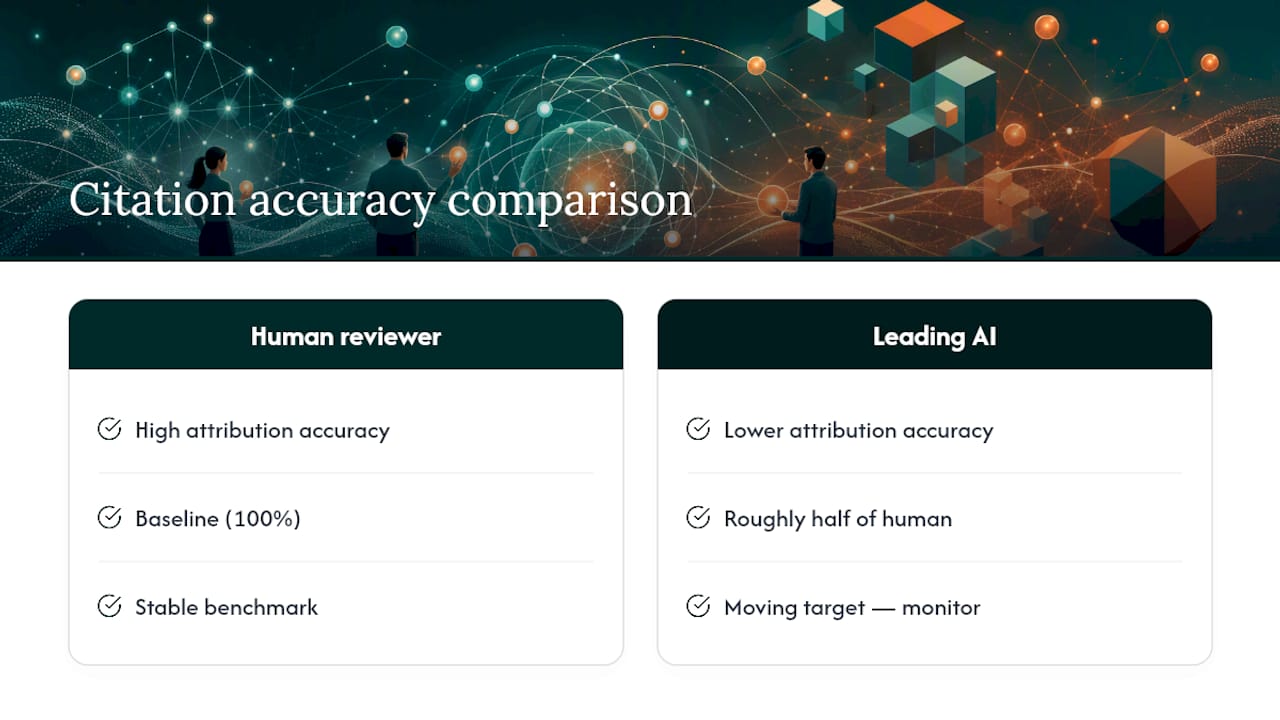
Part of this is a hard technical ceiling. On the CiteME benchmark, a leading LM-based citation agent scored notably lower accuracy than humans in citation attribution tasks., according to the CiteAgent benchmark results. Attribution is still a genuinely hard machine learning problem, not just a formatting issue you can fix with better schema.
How Do You Measure and Track AI Citations Across Platforms?
Treat this like a recurring audit, not a one-time check. The tools and platforms differ enough that a monthly cadence catches drift you’d otherwise miss.
- Build a fixed prompt set. Pick 20 to 50 queries that map to your actual buyer questions, not just your target keywords, and keep the wording identical every time you test.
- Run the same prompts across platforms monthly. Test Perplexity, ChatGPT with web browsing enabled, and Gemini or Google’s AI Overviews side by side, since citation behavior varies meaningfully between them.
- Log the exact URL and sentence cited, not just whether your domain appeared somewhere in the answer.
- Filter your analytics for AI referral traffic where your platform supports it, and cross-check against your prompt log to confirm the citation actually drove a click.
- Maintain a baseline spreadsheet or dashboard tracking three separate metrics: citation presence, citation accuracy (did it cite the right thing), and description accuracy (did it describe your content correctly).
Platform differences matter more than most teams expect going in. Perplexity commonly cites five to ten sources per answer and shows its sources openly, while ChatGPT tends toward three to five and is less transparent about them, per comparative platform analysis. Start your measurement work on Perplexity specifically, since its visible sourcing makes it far easier to reverse-engineer what earns a citation before you generalize that pattern to less transparent engines. Ranksector’s ai search visibility tracking guidance walks through building this kind of dashboard if you’re starting from scratch.
What Tactics Actually Increase Your Chance of Being Cited?
None of this requires reinventing your content operation. It requires being deliberate about a handful of structural choices most sites get wrong by default.
- Open with entity definitions and one-line factual sentences. A sentence like “Ranksector publishes daily SEO articles for B2B SaaS teams” is trivially quotable. A sentence buried in three subordinate clauses is not.
- Add citable statistics with inline sources and visible last-reviewed dates. Freshness signals matter enough that practitioner guidance from Semrush’s AI search optimization research lists them among the highest-impact tactics available.
- Expose machine-readable markup. Article, Person, and FAQ JSON-LD schema help, and Google’s own documentation confirms these features run on the same core systems as traditional Search, requiring standard crawlability and indexability rather than any special file, per Google’s generative AI optimization guide. You don’t need an llms.txt file; you need pages Googlebot can actually reach.
- Write short Q/A blocks under your headings that answer the sub-questions a fan-out process would likely generate, not just your primary keyword.
- Use exactly one outbound citation per factual claim. This makes verification cheap for the retrieval system and, not coincidentally, makes your writing more credible for human readers too.
Pro Tip: Pull up your top 10 revenue-driving pages and check whether each one contains at least three standalone, quotable sentences with no pronouns requiring outside context. If a sentence only makes sense next to the one before it, a verification system can’t isolate and confirm it.
Ranksector’s generative engine optimization checklist breaks these tactics into an implementation sequence, and the featured snippet writing guide has concrete before-and-after sentence examples worth studying if extractability is new territory for your team.
A 30 to 60 Day Roadmap for Researchers and SEOs
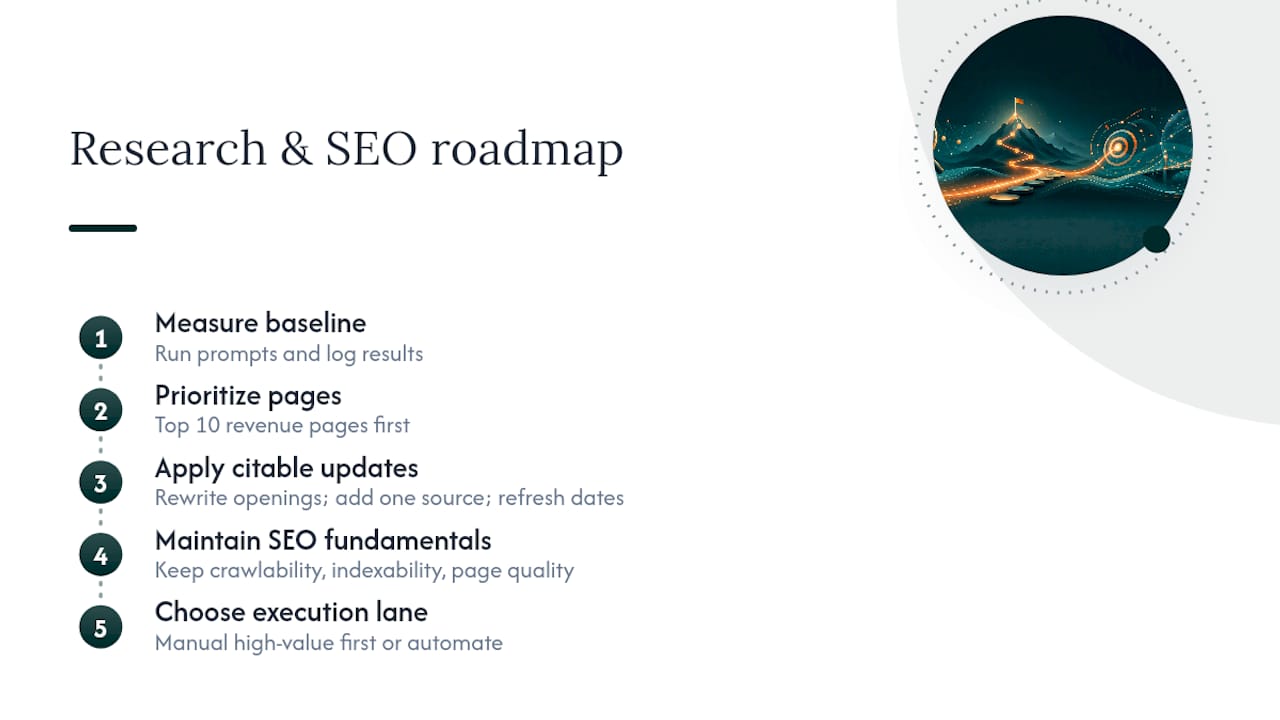
Start with measurement, not tactics. You can’t tell whether a change worked if you never established what “before” looked like, so week one is entirely about running your prompt set and logging results.
Once you have a baseline, apply the highest-leverage citable updates to your top 10 revenue pages before touching anything else. Rewrite the opening sentences to be standalone-quotable, add one source per claim, and refresh the dates. Don’t abandon classical SEO fundamentals while you do this. Crawlability, indexability, and page quality remain the foundation generative features are built on, not a separate track you can skip.
If your team is small, automation covers the ground manual updates can’t. If you have the bandwidth, a manual, highest-value-page-first approach gets you cleaner results faster, because you understand each page’s context better than any tool will.
Pick one lane deliberately rather than drifting into both half-heartedly.
The Gap Between Citation Advice and Citation Reality
Most guidance on this topic treats AI citations like a checklist problem: add schema, write FAQs, done. The research doesn’t support that level of confidence. A leading citation-attribution system still scores roughly half the accuracy of a human reviewer, and audits keep finding AI-generated pages outperforming human-written ones on citation frequency for reasons nobody’s fully explained yet. That’s not a solved system you optimize once. It’s a moving target you monitor.
Where conventional advice falls short is treating GEO tactics as a replacement for SEO fundamentals rather than a layer on top of them. Google has been explicit that generative features run on core Search infrastructure, which means a page that can’t be crawled or indexed properly has no shot at citation regardless of how quotable its sentences are.
If you take one thing from this, prioritize measurement before tactics. Teams that skip straight to schema markup and citable statistics without first establishing a baseline have no way to know whether their changes moved anything. Run the prompts first. Then fix the pages that are actually failing, not the ones you assume are failing.
— Savannah
Where Automated Publishing Fits Into a Citation Strategy
An alternative to hiring a full content team is using software that helps keep dozens of pages fresh, structured, and quotable at once. Manually rewriting opening sentences and refreshing dates across a large site takes real hours every month. Some platforms automate the daily production of SEO-optimized long-form articles, format them with entity definitions and structured headings that verification systems favor, and publish directly to CMS platforms without manual intervention.

The platform’s AI visibility audit checks your existing pages for extractability gaps before you commit to a rewrite schedule, which matters if you’re not sure yet whether your content problem is structural or just a freshness issue. Teams evaluating whether automation fits their workflow can start with the free tools to see the output quality firsthand, or look at the agency-tier product if you’re managing citation-readiness across multiple client sites at once. If your team lacks the bandwidth for a manual, page-by-page overhaul, this is the practical way to keep pace at scale.
Sources
The path from a typed question to a cited source runs through three distinct stages, and each one is something you can influence if you understand what it’s doing.
- Google: Guide to optimizing for generative AI features on Google Search
- Auditing citation behavior in AI-generated search summaries: a framework and case study of Google AI Overviews
- How to optimize for AI search results in 2026 — Semrush
- CiteME / CiteAgent citation attribution benchmark (NeurIPS proceedings)
One industry review found that An industry review found that most AI Mode citations in a sample didn’t appear in the top 10 organic results for the triggering query, per the same grounding pipeline analysis., per the same grounding pipeline analysis. That single figure should reframe how you think about content strategy: optimizing only for the blue links leaves most of the citation opportunity on the table.
The practical implication is straightforward. Cover the sub-questions a fan-out process would generate, not just the head query, and write sentences plainly enough that a verification pass can confirm them in isolation.