
What Is Content Marketing Burnout for SaaS Teams
Content marketing burnout is a structural state of severe mental, emotional, and creative exhaustion caused by sustained, unsustainable pressure to publish high-volume SEO content. It is not a bad week. It is a systematic depletion that erodes creative capacity, team morale, and ultimately your brand’s credibility with buyers. If your team is publishing daily but sales can’t point to a single piece that moved a deal, you are already in the danger zone.
Three things to do in the next 72 hours: pause all nonessential publishing, audit which assets your sales team actually uses in conversations, and block protected creative time on your calendar before the next brief goes out. These actions buy you space to diagnose the real problem without letting the pipeline collapse.
Table of Contents
- How to recognize content marketing burnout in your team and output
- Why burnout happens in modern SEO-driven publishing workflows
- What burnout costs your brand, funnel, and people
- How to build a sustainable content machine that prevents burnout
- KPIs and early-warning signals that show whether your process is healthy
- A practical recovery plan: immediate triage through long-term redesign
- Ready-to-use templates for editorial governance
- Why this guidance is credible
- Key Takeaways
- The real lesson most SaaS teams miss about burnout
- Daily publishing without the burnout: how Ranksector fits
How to recognize content marketing burnout in your team and output
Burnout rarely announces itself. It shows up in patterns that look like performance problems until you trace them back to the system.
Team-level signals to watch:
- Chronic missed deadlines that weren’t a problem six months ago
- Revision cycles climbing without a clear quality reason
- Writers going quiet in Slack, skipping optional team calls, or producing work that feels mechanical
- Rising turnover intent: informal comments about workload, requests for role changes, or sudden interest in “exploring options”
Output signals that confirm the diagnosis:
- Topics repeating across articles with slightly different titles
- Edit counts per article increasing while word count stays the same
- Sales reporting they never use the content being produced
- Declining originality: pieces that read like they were assembled from a template rather than written from a point of view
Quick 15-minute diagnostic for leaders: Ask your managing editor how many briefs are in flight versus how many were completed last month. Ask a writer what piece they’re most proud of from the last quarter. Ask a sales rep which content they sent to a prospect last week. If the answers are vague, the numbers are lopsided, or the sales rep draws a blank, you have a systemic problem, not an individual one.
Why burnout happens in modern SEO-driven publishing workflows
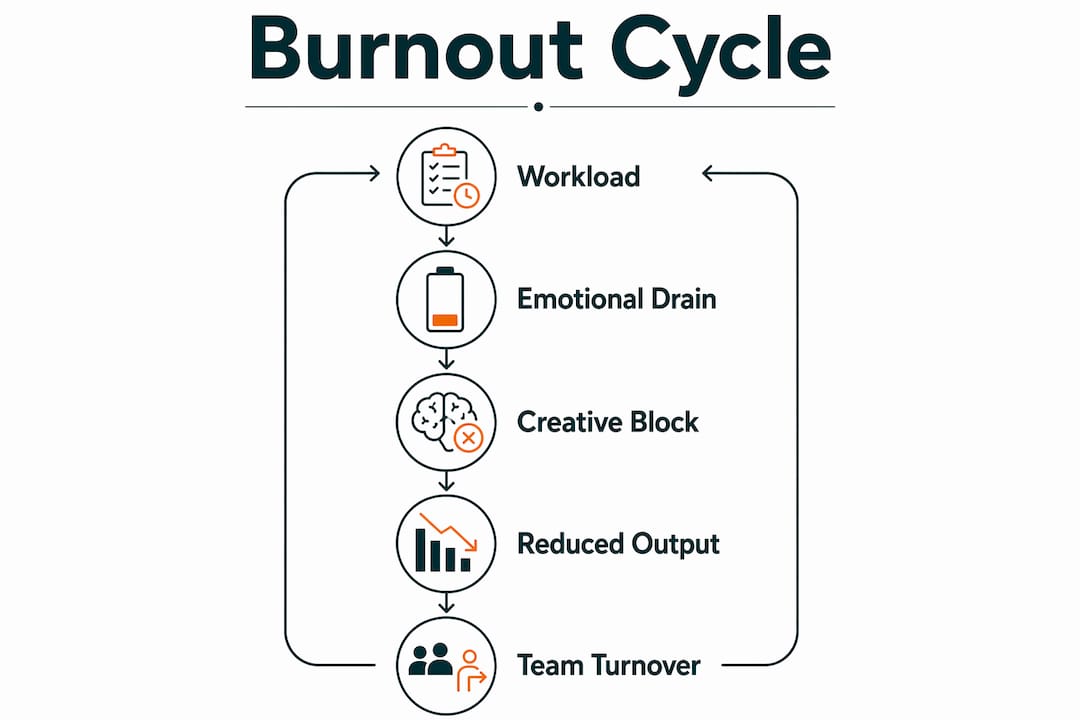
The root cause is almost never laziness. Burnout is a systems failure, and the system that most SaaS teams are running is designed to produce it.

Volume KPIs are the primary accelerant. When success is measured in posts per week or words per month, writers become production clerks for algorithms. The incentive is to ship, not to think. Deep research, original framing, and buyer-specific insight get cut because they slow the line down.
Automation failure compounds the problem in two specific ways. First, the “content treadmill”: teams use AI to generate more content faster, but more content doesn’t improve sales outcomes when it isn’t grounded in real buyer conversations. The calendar fills up, the team feels busy, and pipeline stays flat. Second, the “repurposing rabbit hole”: one weak idea gets multiplied into many low-value assets across formats, none of which carry enough original insight to move a buyer.
Pro Tip: Before adding any new content to the calendar, ask: “Does sales have a conversation where this piece would help?” If no one can name a specific scenario, the brief should not exist yet.
A boardroom KPI that mandates daily posts without a corresponding investment in research time is the single most common structural cause of burnout in B2B SaaS content teams. The fix is not to publish less. It is to publish with a different intent.
What burnout costs your brand, funnel, and people
The business costs are concrete. Buyers increasingly recognize generic, automated content, and when they do, credibility drops at exactly the moment you need it most: the purchase decision. Lower lead quality follows, deal velocity slows, and your team has spent real budget producing assets that sales ignores.
Team costs compound over time. Replacing a mid-level content strategist typically costs a significant portion of their annual salary when you factor in recruiting, onboarding, and the ramp period before they’re producing independently. Institutional knowledge, including the buyer language, objection patterns, and editorial voice your best writers carry, walks out with them.
The metrics that signal this damage are often misread. Engagement that doesn’t convert, time-per-article rising while output drops, and a sales usage rate near zero are all burnout indicators hiding inside standard dashboards. Nearly half of content leaders report high-to-extreme burnout, and the primary driver is being asked to cover reach and revenue simultaneously with no clear priority assigned between them.
How to build a sustainable content machine that prevents burnout
Sustainable publishing is not about slowing down. It is about designing a system where speed and quality reinforce each other instead of competing.
Operational checklist for leaders:
- Shift KPIs from volume to influence: measure sales usage rate, content-to-deal influence, and deal acceleration, not posts per month
- Define role boundaries clearly: who writes, who edits, who approves, and who owns the brief
- Institute protected “strategic white space”: at least one day per sprint where no new content ships and writers can research, read, or think
- Build a content library of buyer phrases, real sales objections, and internal case data so repurposing draws from genuine insight rather than recycling thin ideas
- Set automation governance rules: define what can be templated and auto-published versus what requires human review before it goes live
Governance items that reduce decision fatigue:
- Approval SLAs: no piece waits more than 48 hours for a review response
- Repurposing limits: no asset gets repurposed more than three times without new primary research added
- Quality sampling: a random 20% of auto-published content reviewed by a human editor each week
Structured workflows and editorial calendars are not bureaucracy. They are the infrastructure that lets small teams publish consistently without burning out.
Pro Tip: Map your cadence matrix before your next planning cycle: list each channel, who owns it, how often it publishes, and what the recovery buffer is if a writer goes out sick. If any channel has no buffer, that’s your first fire to put out.
KPIs and early-warning signals that show whether your process is healthy
| KPI | Worrying Trend | Escalation Action | Owner |
|---|---|---|---|
| Sales usage rate | Below 20% of published assets used in deals | Pause new briefs; run a sales-content audit | Content lead + Sales lead |
| Revision count per article | Up 30%+ quarter-over-quarter | Halt new briefs; run a quality audit on last 30 pieces | Managing editor |
| Time-to-publish (cycle time) | Rising without increased article length or complexity | Review brief quality and approval SLAs | Project manager |
| Editor workload | Editors reviewing more than 8 pieces per week solo | Add contract editorial support or reduce cadence | Content director |
| Voluntary attrition | Any writer or editor departure citing workload | Immediate 1:1s with remaining team; KPI review | People lead + Content lead |
| Content-to-deal influence | Flat or declining over two quarters | Rebuild content strategy around sales conversation data | Content lead + Revenue lead |
Review this table monthly, not quarterly. Problems that look minor at 30 days become expensive at 90.
A practical recovery plan: immediate triage through long-term redesign
-
Days 0–7 (triage): Pause all nonessential publishing. Identify the five to ten pieces sales actually uses and protect those. Create a stop-gap content bank by pulling evergreen assets from your archive that can be refreshed rather than replaced.
-
Days 8–30 (stabilize): Restructure KPIs away from volume. Run a content-use audit with your sales team: sit in on two to three calls and note which assets come up organically. Rebuild editorial briefs around those conversations. If capacity is genuinely short, bring in contract writers for defined deliverables rather than open-ended retainers.
-
Days 31–90 (redesign): Set a sustainable cadence based on what your team can produce at high quality, not at maximum speed. Embed human-in-the-loop automation so AI handles templated, low-value publishing tasks while your writers own research, framing, and buyer-specific insight. Budget explicitly for research time: at least 20% of each writer’s week should be protected for reading, interviewing customers, or reviewing sales call recordings.
-
Long-term (90+ days): Build strategic white space into the annual calendar. Plan two to four fallow weeks per year where no new content ships and the team focuses on strategy, audits, or skill development. Cost considerations: slowing cadence by 30% typically costs less than replacing one burned-out senior writer.
Ready-to-use templates for editorial governance
Editorial policy outline:
- Audience: who this content is written for and what decision it supports
- Purpose: what the reader should be able to do or decide after reading
- Usage rules: which sales stages this asset fits
- Approval flow: brief owner → writer → editor → legal (if needed) → publish
Cadence matrix structure:
| Channel | Owner | Frequency | Recovery Buffer |
|---|---|---|---|
| Blog | Content lead | 3x/week | 1 week banked drafts |
| Social manager | — | 2 weeks scheduled | |
| Newsletter | Editor | 1x/week | 2 issues pre-written |
| Case studies | Content strategist | 1x/month | 1 in draft at all times |
Automation governance checklist:
- ✅ Auto-publish: templated product update posts, changelog summaries, and syndicated evergreen content
- ✅ Human review required: thought leadership, buyer-stage content, anything citing internal data
- ✅ Repurposing limit: three formats per source piece maximum, with new data or quotes added each time
- ✅ Quality sampling: human editor reviews 20% of auto-published content weekly
For repurposing without the rabbit hole, anchor every derivative piece to a specific buyer question from your content library, not to the original article’s structure.
Why this guidance is credible
Ranksector has published over 11,000 SEO-optimized articles for B2B SaaS teams and small businesses, operating a platform that combines AI-driven content generation with human editorial governance. The platform’s design reflects the human-in-the-loop principle at the center of this guide: automation handles the templated, low-value publishing work while human judgment governs quality, buyer relevance, and brand voice.
The structural framing in this article draws on 2026 practitioner research, including analysis from Tunheim on the content treadmill, Joyce Ndinda’s systems-failure framework, and Kristen Rocco’s survey data on content leader burnout rates. The prevention and recovery frameworks reflect patterns observed across SaaS content operations where volume pressure and misaligned KPIs are the dominant failure modes.
Author: Savannah, senior editorial writer and SEO strategist.
Key Takeaways
Content marketing burnout is a structural problem, not a personal one. Fixing it requires changing the system, not pushing harder.
| Point | Details |
|---|---|
| Burnout is systemic | Volume KPIs and misaligned incentives cause burnout; shifting to influence metrics is the first fix. |
| Output signals matter | Rising revision counts, low sales usage, and topic repetition are early warnings, not performance issues. |
| Triage before redesign | Pause nonessential publishing within 7 days; audit sales-used assets before rebuilding the calendar. |
| White space is structural | Budget deliberate fallow periods and protect a significant portion of writer time for research each week. |
| Ranksector supports governance | Ranksector’s human-in-the-loop publishing platform automates low-value tasks while preserving editorial control. |
The real lesson most SaaS teams miss about burnout
The conventional wisdom says burnout is a workload problem. Add headcount, reduce the posting schedule, and things will improve. That framing is wrong, and it leads teams to make the wrong fixes.
What actually drives burnout in SaaS content teams is the gap between what the system rewards and what good content actually requires. Volume KPIs reward shipping. Good content requires thinking, researching, and sometimes sitting with a blank screen long enough to find a real angle. When the system punishes that pause, writers learn to skip it. The output degrades, the team disengages, and leaders respond by adding more pressure, which accelerates the cycle.
The fix is not fewer articles. It is a system where the incentive to think is protected as deliberately as the incentive to publish. That means governance, role clarity, and KPIs that sales can actually feel. Automation is not the enemy here. A well-governed automated platform removes the repetitive, low-value publishing work that drains creative energy, freeing writers to do the thinking that machines cannot replicate. The problem is automation deployed as a volume mandate rather than a creative multiplier.
Daily publishing without the burnout: how Ranksector fits
Most of the damage described in this guide comes from treating automation as a replacement for editorial judgment. Ranksector is built on the opposite premise: automation handles the templated, repeatable publishing work so your team’s creative time is protected, not consumed.
With over 11,000 articles published for B2B SaaS teams, Ranksector’s platform covers keyword research, daily article generation, CMS publishing, and backlink exchange, all within a governance structure you control. You set the quality gates. You define what gets auto-published and what gets human review. The AI audit tool helps you identify low-value automated content already in your pipeline before it damages your credibility with buyers. For teams that need higher-touch support during a recovery period, the agency offering provides managed publishing capacity without the overhead of a full hire.
Start with a free tools audit at ranksector.com/free-tools to see where your current content stands before your next brief goes out.
Recommended
- How to Repurpose One Article into 5 LinkedIn Posts Without Burning Out · Ranksector Blog — Ranksector
- SEO Content Types for Small B2B SaaS Teams in 2026 · Ranksector Blog · Ranksector
- How SEO Works Without Paid Ads for B2B SaaS · Ranksector Blog · Ranksector
- AI Blog Publishing for SaaS SEO: Manual Workflow vs Automation · Ranksector Blog — Ranksector