
7 Tested TrySoro.com Alternatives for Small Businesses in 2026
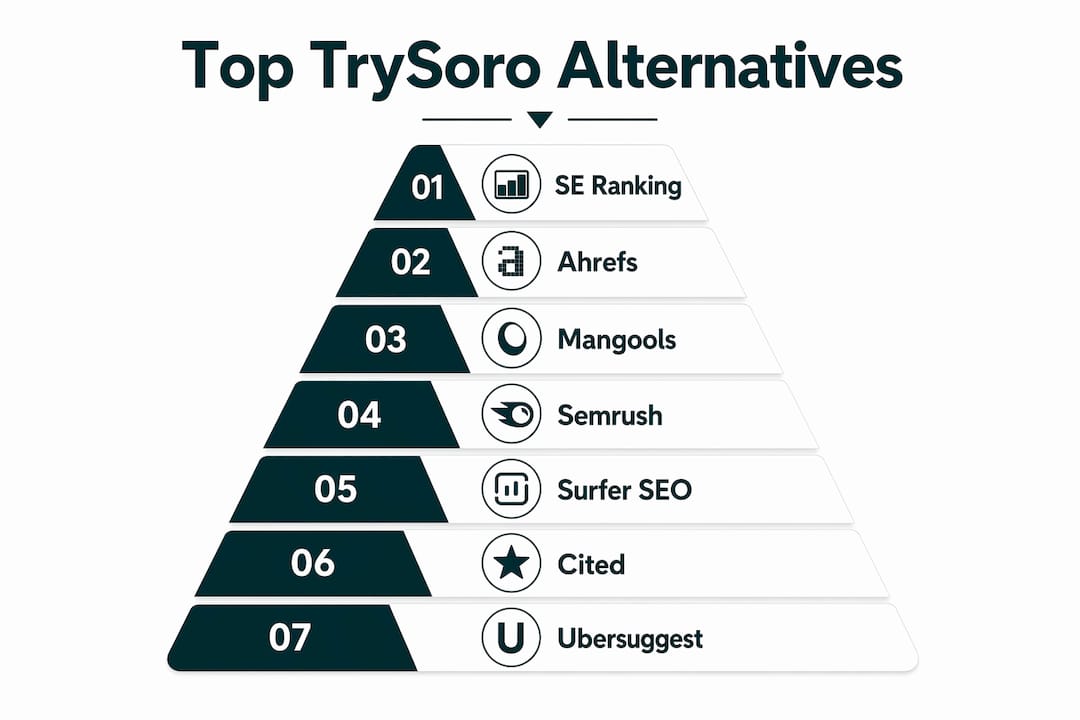
The best TrySoro alternatives for small businesses in 2026 are SE Ranking, Ahrefs, Mangools, Semrush, Surfer SEO, Cited, and the free Google Stack. Each fills a specific gap that TrySoro leaves open, whether that is rank tracking, backlink analysis, or AI citation optimization.
Here is the short version:
- SE Ranking ($52/month): Best all-in-one alternative. Covers rank tracking for 750 keywords, site audits up to 40,000 pages, and backlink analysis in a single dashboard.
- Ahrefs ($29/month, Starter): Best for backlink-first strategies. Its crawler processes over 8 billion pages per day, providing industry-leading competitive link data.
- Mangools ($29/month): Best budget pick. Includes SERPWatcher for rank tracking and LinkMiner for backlink checking at the lowest paid price point.
- Semrush ($139.95/month): Best for large-scale competitive research. The most data-rich suite on this list.
- Surfer SEO ($99/month): Best for manual on-page optimization. Scores your content against top-ranking pages with NLP analysis.
- Cited ($99/month): Best for automated, AI-citable content. Publishes directly to WordPress, Wix, Webflow, and Framer.
- Free Google Stack ($0): Google Search Console, Google Analytics, and Keyword Planner combined. Viable for early-stage sites with no budget.
The core reason people look for trysoro.com alternatives is simple: TrySoro automates content production but lacks rank tracking, backlink analysis, and site auditing entirely. If your SEO strategy needs those capabilities, you need a different tool, or a second one running alongside it.
How these alternatives were evaluated
Every tool on this list was assessed against the same set of criteria, focused specifically on what small business owners and solo founders actually need in 2026.
Evaluation criteria:
- Rank tracking: Does the tool monitor keyword positions over time, with historical data and competitor comparisons?
- Backlink analysis: Does it include a dedicated backlink index or checker?
- Content automation: Can it research, write, and publish content without manual intervention?
- Site audit depth: Does it crawl your site for technical SEO issues?
- Ease of use: Can a non-technical founder operate it without a steep learning curve?
- Pricing and value: Does the price reflect the feature set for a small team budget?
- Integration capabilities: Does it connect to WordPress, Shopify, Webflow, or other common platforms?
- Trial availability: Can you test it before committing to a paid plan?
- 2026 relevance: Does the tool address AI citation signals and modern search behavior, not just traditional keyword rankings?
Tools were excluded if they serve a fundamentally different use case (general AI writing, social media copy) or if they are not available to US-based businesses. Pricing reflects monthly billing as of june 2026; annual plans typically reduce costs by 15–20%.
Detailed reviews of the top TrySoro alternatives
Every tool below addresses at least one capability TrySoro does not offer. The comparison table covers the core dimensions side by side, followed by individual profiles for each.
| Tool | Best For | Pricing | Backlink Index | Content Automation | Ease of Use | Free Tier |
|---|---|---|---|---|---|---|
| SE Ranking | All-in-one small business SEO | $52/month | Mid-size | No | Medium | Trial only |
| Ahrefs | Backlink analysis and competitive intel | $29/month (Starter) | Industry-leading | No | Medium | Trial only |
| Mangools | Budget rank tracking and backlinks | $29/month | Dedicated (LinkMiner) | No | High | Trial only |
| Semrush | Large-scale competitive research | $139.95/month | Large | No | Medium | Trial only |
| Surfer SEO | Manual on-page content optimization | $99/month | None | No | Medium | Trial only |
| Cited | Automated AI-citable content | $99/month | None | Yes | High | No |
| Ubersuggest | Budget beginners | $12/month | Small | No | High | Limited |
| Free Stack | Zero-budget early-stage sites | $0 | None | No | High | Yes |
## 1. SE Ranking: best all-in-one alternative for small businesses
SE Ranking at $52/month delivers the strongest feature-per-dollar ratio of any paid alternative on this list. You get rank tracking for 750 keywords, a site audit covering up to 40,000 pages, and a backlink checker, all inside one dashboard. That combination directly fills the three gaps TrySoro leaves open.

The platform suits small business owners who want a single tool rather than a stack. Rank tracking includes historical data and competitor position monitoring, which matters when you are trying to measure whether your content is actually moving the needle. The site audit catches technical issues like broken links, missing meta tags, and crawl errors that automated content tools never surface.
SE Ranking also integrates with Google Search Console and Google Analytics, so you can pull traffic data alongside rank data without switching tabs. For a solo founder managing SEO without a dedicated team, that kind of multi-tool workflow consolidation saves real time.
Standout features:
- Rank tracking for 750 keywords with daily updates
- Site audit up to 40,000 pages
- Backlink checker with referring domain analysis
- Competitor keyword gap tool
- Google Search Console and Analytics integration
## 2. Ahrefs: best for backlink-first strategies
Ahrefs is the strongest choice when backlink analysis is your primary use case. Its crawler processes over 8 billion pages per day, giving it the largest and most frequently updated backlink index of any tool on this list. If you need to understand who is linking to your competitors and why, no other platform comes close at the Starter price point.
The $29/month Starter plan is a meaningful entry point, though it limits the number of projects and keyword tracking slots compared to higher tiers. For a small business focused on link building and competitive research rather than daily rank monitoring across hundreds of keywords, the Starter plan covers the essentials.
Where Ahrefs falls short relative to TrySoro is obvious: it does not write, optimize, or publish content. It is a research and analysis tool. Think of it as the diagnostic layer of your SEO strategy, not the execution layer.
Standout features:
- Industry-leading backlink index updated continuously
- Site Explorer for competitor link and traffic analysis
- Keyword Explorer with search volume and difficulty scores
- Content Gap tool to find keywords competitors rank for that you do not
- Rank Tracker with historical position data
## 3. Mangools: best budget option with backlink capability
Mangools at $29/month is the cheapest paid alternative that includes a dedicated backlink checker. The SERPWatcher module handles rank tracking, and LinkMiner covers backlink analysis. For solo operators who need both capabilities without spending more than $30, this is the clearest path.
The interface is genuinely beginner-friendly. Where Ahrefs and Semrush can feel dense with data, Mangools presents information cleanly. That matters when you are running a business and SEO is one of ten things on your plate, not your full-time job.
The tradeoff is data depth. Mangools’ backlink index is smaller than Ahrefs’, and its keyword database is less comprehensive than Semrush’s. For most small businesses doing local or niche SEO, that gap rarely matters in practice.
Standout features:
- SERPWatcher for rank tracking with daily updates
- LinkMiner for backlink analysis
- KWFinder for keyword research with difficulty scores
- SERPChecker for SERP analysis
- Clean, approachable interface suited to non-technical users
## 4. Semrush: best for large-scale competitive research
Semrush at $139.95/month is the most expensive option here, and it earns that price with the most comprehensive data set on the market. Keyword research, backlink analysis, site auditing, competitive traffic analysis, and content tools all live under one roof. For businesses running multi-channel digital marketing, the breadth of Semrush’s data is genuinely hard to replicate elsewhere.
The platform is not the right fit for every small business. If you are a solo founder tracking 50 keywords and checking backlinks monthly, you are paying for capabilities you will not use. But if you are managing SEO for multiple clients or running a content-heavy site in a competitive niche, Semrush’s data depth justifies the cost.
Standout features:
- Keyword Magic Tool with over 25 billion keywords
- Backlink Analytics with a large crawled index
- Site Audit with technical SEO issue prioritization
- Traffic Analytics for competitor website estimates
- Content Marketing Toolkit for topic research and brief creation
## 5. Surfer SEO: best for manual on-page optimization
Surfer SEO occupies a specific niche: it tells you exactly how to optimize a piece of content to rank, using NLP analysis of the top-ranking pages for your target keyword. You get a content score, recommended word count, suggested terms to include, and a structural outline. For content teams that write their own articles and want data to guide the process, Surfer is genuinely useful.
The limitation is architectural. Surfer analyzes and scores content; it does not write or publish anything. You bring the writer, the strategy, and the publishing workflow. For a solo founder who needs things to run automatically, that setup adds friction rather than removing it.
At $99/month, Surfer sits at the same price point as Cited, which does automate the full pipeline. The choice between them comes down to whether you want control over the writing process or want to hand it off entirely.
Standout features:
- Content Editor with real-time NLP scoring
- SERP Analyzer for competitive on-page benchmarking
- Keyword Research with clustering
- Audit tool for existing content optimization
- Integration with Google Docs and WordPress
## 6. Cited: best for automated, AI-citable content
Cited at $99/month takes a different approach than every other tool on this list. Rather than helping you research or optimize content manually, it automates the entire publishing pipeline and specifically targets content designed to be cited by AI systems like ChatGPT and Google AI Overviews. That is a meaningful distinction from TrySoro, which optimizes for content volume rather than AI citation signals.
The platform integrates directly with WordPress, Wix, Webflow, and Framer for fully automated publishing. For small teams and solo founders building topical authority without a marketing team, the single-price model is straightforward to evaluate. You pay $99/month and content goes live without manual intervention.
The tradeoff is that Cited includes no rank tracking, backlink analysis, or site auditing. Like TrySoro, it is a content production tool. The difference is the quality and citation-optimization focus of what it produces. For B2B service businesses and local companies trying to appear in AI search results, that focus on AI citation rate rather than keyword volume is worth considering seriously.
Standout features:
- Fully automated content research, writing, and publishing
- Content engineered for AI citation signals
- Direct CMS integration with WordPress, Wix, Webflow, and Framer
- Designed for local and B2B service businesses
- Single all-inclusive pricing with no per-article fees
## 7. Ubersuggest: best for budget beginners
Ubersuggest at $12/month is the lowest-cost paid option on this list. It covers basic keyword research, limited backlink data, and rank tracking at a price point that removes the financial barrier for businesses just starting with SEO. The interface is clean and the learning curve is minimal.
The data depth is limited compared to every other paid tool here. The backlink index is small, and keyword data lacks the granularity of SE Ranking or Semrush. For a business that has never used an SEO tool and wants to understand the basics before committing to a larger platform, Ubersuggest is a reasonable starting point.
## 8. Free Google Stack: Google Search Console, Google Analytics, and Keyword Planner
The free stack covers the fundamentals at zero cost. Google Search Console shows which queries your site ranks for and flags indexing issues. Google Analytics 4 tracks traffic, user behavior, and conversions. Keyword Planner provides search volume estimates for keyword research. Together, they give you a working picture of your site’s organic performance without spending anything.
The gaps are significant. There is no backlink analysis, no competitor data, no site audit, and no content automation. Everything requires manual effort. For early-stage sites or businesses not yet ready to invest in paid tools, the free stack is a viable starting point, but it does not replace TrySoro’s content pipeline or the technical SEO capabilities of SE Ranking or Ahrefs.
How TrySoro compares to its top alternatives in features and value
TrySoro’s core strength is full-cycle content automation. It handles keyword research, writing, on-page optimization, internal linking, and publishing to platforms like WordPress, Shopify, and Webflow, all from one dashboard, without manual intervention. Starting at $39/month, it is priced below most full-featured SEO suites.
The gaps are not partial implementations. TrySoro has no rank tracking, no backlink analysis, and no technical site audit. These are complete feature absences. For businesses whose primary bottleneck is content production, that is fine. For businesses that need to understand their competitive position, fix crawl errors, or build a link profile, TrySoro requires a second tool to cover those needs.
The most common pattern among growing sites is combining an automated content tool with a separate SEO suite. TrySoro handles the publishing pipeline; SE Ranking or Ahrefs handles the technical and competitive layer. That two-tool approach costs more but covers the full SEO stack.
| Dimension | TrySoro | SE Ranking | Ahrefs | Cited | Free Stack |
|---|---|---|---|---|---|
| Content automation | Full pipeline | No | No | Full pipeline | No |
| Rank tracking | No | Yes (750 keywords) | Yes | No | Partial (GSC) |
| Backlink analysis | No | Yes | Yes (industry-leading) | No | No |
| Site audit | No | Yes (40,000 pages) | Yes | No | Partial (GSC) |
| AI citation focus | No | No | No | Yes | No |
| Starting price | $39/month | $52/month | $29/month | $99/month | $0 |
| Best for | Content volume | All-in-one SEO | Backlink research | AI-citable content | Zero budget |
The table makes the tradeoff clear. TrySoro and Cited both automate content creation with different focuses: one on publishing volume and the other on AI citation signals. SE Ranking and Ahrefs cover technical and competitive research, complementing content tools rather than substituting them.
Pro Tip: If you are running TrySoro and finding that your content is publishing but rankings are not moving, the missing piece is almost always rank tracking and backlink data. Adding SE Ranking at $52/month alongside TrySoro gives you the diagnostic layer without replacing the automation you already have.
Matching TrySoro alternatives to your specific business needs
The right tool depends on where your SEO workflow breaks down. Before choosing, identify your primary bottleneck.
If your main problem is content production volume:
- TrySoro or Cited handle this directly. TrySoro prioritizes publishing velocity; Cited prioritizes AI citation quality. Both automate the full pipeline.
- For affordable automation tools under $50/month, TrySoro at $39/month is the strongest option in this category.
If your main problem is rank tracking and competitive analysis:
- SE Ranking at $52/month is the best value for small businesses. It covers rank tracking, site auditing, and backlink analysis in one platform.
- Mangools at $29/month works if budget is the primary constraint and you need rank tracking plus basic backlink data.
If your main problem is backlink analysis specifically:
- Ahrefs at $29/month (Starter) is the most direct solution. Its backlink index is larger and more current than any other tool at that price.
If you are managing a large site or multiple clients:
- Semrush at $139.95/month provides the data depth and multi-project management that smaller tools cannot match.
If you have no budget at all:
- The free Google Stack covers the basics. It will not replace competitive analysis or automation, but it gives you real data on your own site’s performance.
If AI citation rate is a priority for your 2026 strategy:
- Cited is the only tool on this list built specifically around that goal. For B2B SaaS companies and local service businesses trying to appear in ChatGPT and Google AI Overviews, that focus is worth the $99/month.
Business size and SEO maturity also shape the decision:
- Early-stage sites (under 6 months, fewer than 20 indexed pages) should start with the free stack or a single focused tool rather than full automation.
- Growing sites with an established content base benefit most from adding rank tracking and backlink analysis alongside whatever content tool they already use.
- Mature sites with dedicated marketing resources can justify Semrush or the Ahrefs Standard plan for deeper competitive intelligence.
Is the free Google Stack a viable TrySoro alternative?
The short answer is: viable for early-stage sites, insufficient for anything beyond the basics.
Google Search Console gives you real data on which queries trigger your pages, how often they appear in search results, and whether Google can crawl and index your site correctly. That is genuinely useful information, especially for diagnosing why pages are not ranking. Google Analytics 4 adds the traffic and behavior layer, showing you what happens after someone lands on your site. Keyword Planner provides search volume ranges for keyword research, though the data is less granular than paid tools.
What the free stack does well:
- Shows your own site’s rank impressions and click-through rates
- Flags indexing errors and crawl issues in Search Console
- Tracks traffic sources, sessions, and conversions in GA4
- Provides keyword volume estimates for planning content
What it cannot do:
- No competitor backlink data or link analysis of any kind
- No rank tracking for competitors
- No automated content creation or publishing
- No site audit beyond what Search Console surfaces
- Keyword Planner shows volume ranges, not exact figures, and is designed for paid search advertisers
The free stack requires significant manual effort to extract value. You are pulling data from three separate interfaces, cross-referencing manually, and doing your own analysis without the workflow tools that paid platforms provide. For a solo founder with limited time, that manual overhead adds up quickly.
For businesses that are not yet ready to invest in paid SEO tools, the free stack is the right starting point. But it is a foundation, not a replacement for TrySoro’s content automation or SE Ranking’s technical SEO capabilities. Once your site has consistent traffic and you are ready to compete more aggressively, the free stack’s limitations become the bottleneck.
What SEO experts say about tool choice and strategy in 2026
The most important shift in 2026 SEO is not about which tool you use. It is about what you are optimizing for. Traditional SEO focused on keyword rankings in Google’s blue-link results. That metric still matters, but AI search assistants now use entity recognition, schema markup, and digital footprint signals to decide which businesses to recommend, creating a second visibility channel that most small businesses are not yet tracking.
“AI search assistants use entity recognition, schema markup, and digital footprint signals to decide which businesses to cite, marking a major evolution from traditional keyword-rank-based SEO. Topical authority, structured data, and consistent digital presence now influence whether your business appears in AI-generated answers, not just in traditional search results.” — Conductor Academy, Topical Authority’s Impact on SEO
The practical implication for tool choice is this: tools that only track keyword rankings are measuring one channel. Tools like Cited that optimize for AI citation signals are measuring a second, increasingly important one. For most small businesses in 2026, the right answer is to track both.
On content volume versus authority:
Publishing more content does not automatically build authority. Sites under six months old or with fewer than 20 indexed pages risk thin content penalties from full automation. The safer approach for new sites is manual, high-quality content first, then scaling with automation once topical authority is established. Using a word processor to manage a database is the wrong tool for the job; similarly, using a volume-focused content tool on a site that has not yet earned topical credibility accelerates the wrong outcomes.
On tool fatigue:
Small business owners who adopt separate tools for content creation, rank tracking, backlink analysis, and site auditing often find themselves managing four dashboards instead of running their business. The most effective approach is to identify your primary bottleneck first, solve that with one tool, and only add a second tool when the first one’s gap becomes the new constraint. Content production bottleneck points to TrySoro or Cited. Technical SEO bottleneck points to SE Ranking, Ahrefs, or Mangools.
On what AI search engines look for:
Understanding what signals AI systems use for citation selection is becoming as important as understanding Google’s ranking algorithm. Entity recognition, structured data, and content that directly answers specific questions all factor into whether your business gets recommended by ChatGPT or Google AI Overviews. Tools that ignore this layer are optimizing for a search landscape that is already changing.
Ranksector takes a different approach to SEO content and authority growth
Most tools on this list solve one piece of the puzzle. SE Ranking tracks your rankings. Ahrefs maps your backlinks. Cited automates your content. Ranksector combines automated content publishing with a built-in backlink exchange system, which means you are building domain authority and publishing volume at the same time, without managing two separate tools or two separate budgets.
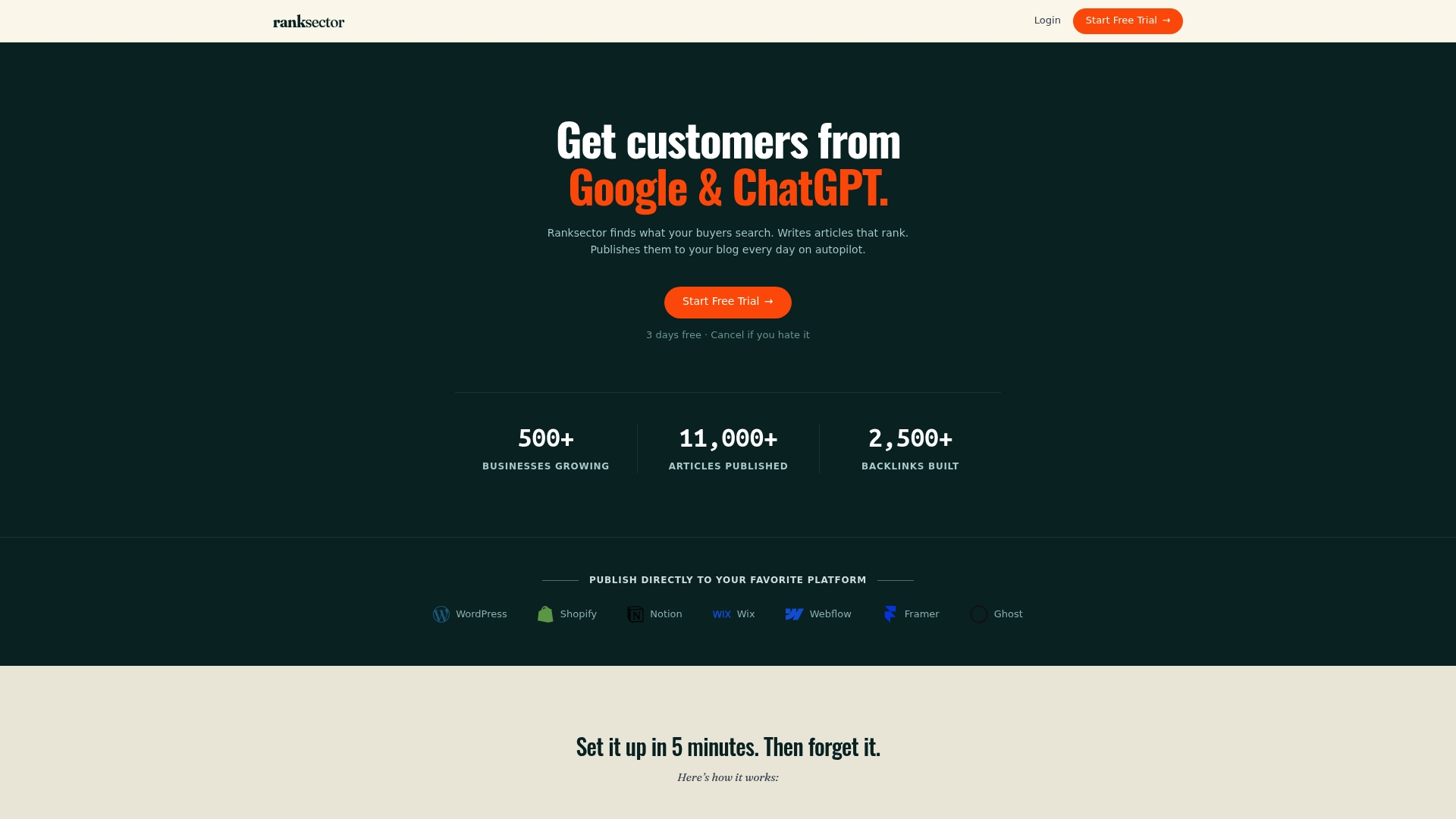
For B2B SaaS companies and small teams that cannot dedicate hours each week to content marketing, Ranksector publishes daily SEO-optimized articles tailored to your audience while simultaneously growing your backlink profile through its exchange network. With over 11,000 articles already published and demonstrated domain rating improvements for its clients, the platform is built for the specific situation most solo founders face: needing consistent content and authority growth without the headcount to support either.
If the tools above feel like you are solving a content problem and a backlink problem separately, Ranksector’s free tools are worth exploring as a starting point. For teams ready to go hands-off on the full content and authority pipeline, the agency product covers daily publishing, competitor-driven keyword research, and backlink exchange in one place.
Key Takeaways
SE Ranking at $52/month delivers the best feature-per-dollar ratio for small businesses needing rank tracking, backlink analysis, and site auditing in a single platform, while Mangools at $29/month is the most affordable entry point with dedicated backlink capability.
| Point | Details |
|---|---|
| Match tool to bottleneck | Content production gap points to TrySoro or Cited; technical SEO gap points to SE Ranking, Ahrefs, or Mangools. |
| Best value paid option | SE Ranking at $52/month covers rank tracking (750 keywords), site audit (40,000 pages), and backlinks in one platform. |
| Budget entry point | Mangools at $29/month includes SERPWatcher and LinkMiner, making it the lowest-cost paid option with both rank tracking and backlink checker modules. |
| Free stack limitations | Google Search Console, Analytics, and Keyword Planner cost nothing but lack backlink data, competitor analysis, and automation. |
| Ranksector’s advantage | Ranksector combines automated daily content publishing with a backlink exchange system, addressing both content volume and domain authority growth together. |