
Top 4 RankPilot.dev Alternatives 2026
Automating high-frequency SEO content publishing without expanding headcount strains most small teams and founders. Most alternatives force manual publishing steps, lack hands-free backlink placement, or restrict integrations to one CMS platform. This comparison covers pricing, automation depth, and CMS support so you can match each platform to your workflow, content volume, and publishing tech stack.
Table of Contents
Ranksector
At a Glance
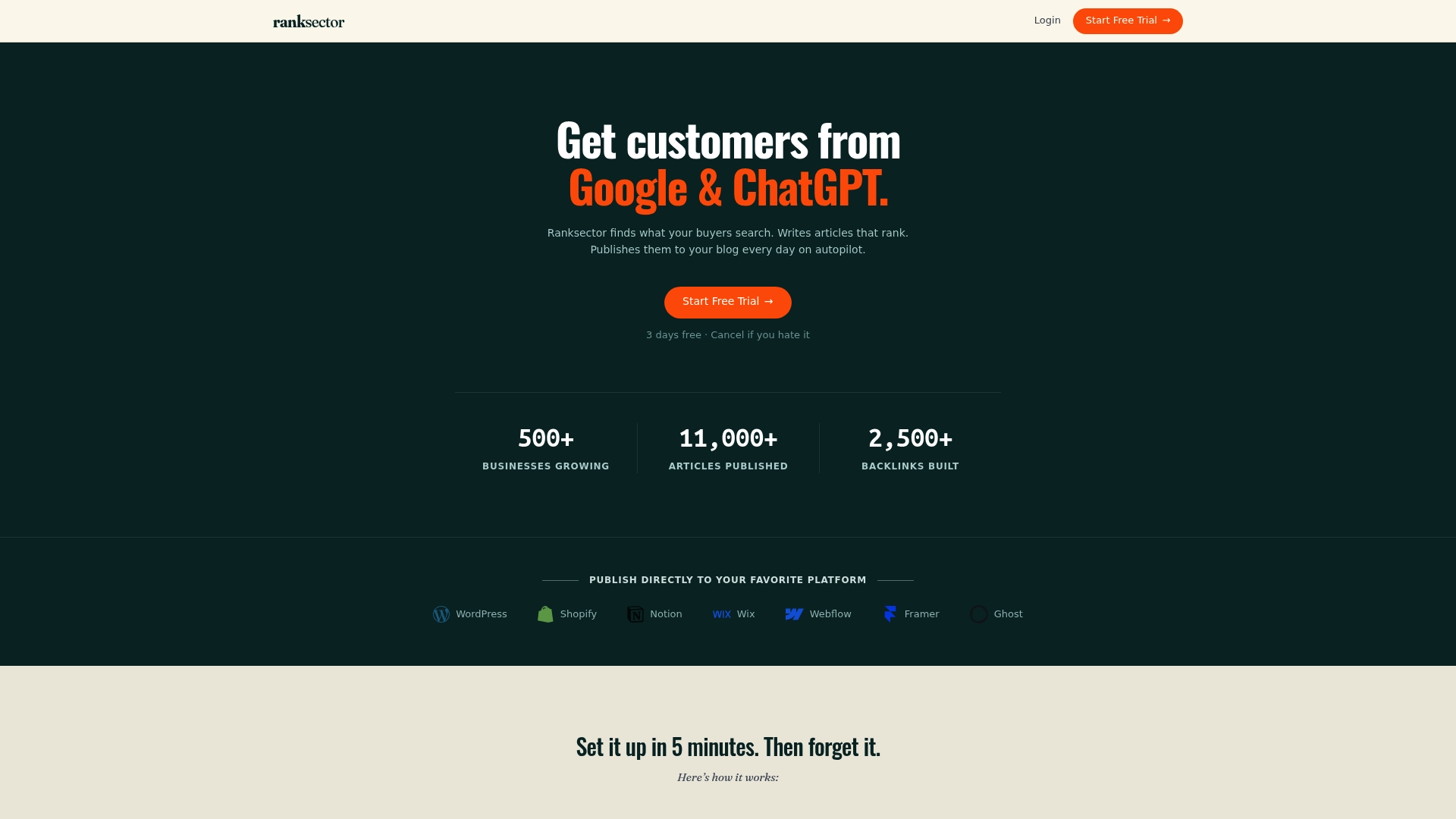
The vendor advertises more than 11,000 published articles across client sites. That scale supports a daily publishing model that suits small teams wanting steady content without hiring writers.
Ranksector targets mid-sized and smaller marketing teams by automating SEO workflows usually handled by agencies. The product centers on hands-free content production and backlink placement.
Core Features
Ranksector runs automated keyword research that analyzes niche competitors and real traffic signals to build editorial briefs. It generates AI long-form articles with on-page SEO built into each draft and schedules daily publishing to connected CMS platforms.
The platform operates a backlink exchange network that places contextual links inside published pieces. A real-time analytics dashboard pulls data from Google Search Console so you can track ranking signals without manual exports.
Key Differentiator
Ranksector automates the entire SEO content pipeline, from keyword research to backlink placement and publishing, across multiple CMS platforms. That end-to-end automation reduces manual handoffs and centralizes content operations for teams with limited bandwidth.
Pros
Automated publishing and backlink placement cut the manual work of monthly content calendars and outreach. The multi-CMS integrations let you publish to WordPress, Shopify, Webflow, Wix, Notion, Framer, and Ghost without building custom deploy scripts.
The backlink exchange removes per-link fees and outreach time, while the analytics integration surfaces ranking signals straight from Google Search Console. Pricing compares favorably to agency retainers, giving teams a lower-cost path to regular publishing.
Cons
- Quality assurance depends heavily on AI, so outputs may not match bespoke agency writing for brand voice or public relations.
Notable Integrations
- WordPress: native publishing and formatting support for standard blogs.
- Shopify: automated article posts for ecommerce storefronts.
- Webflow and Wix: direct publishing for visual site builders.
- Notion and Framer: content sync and lightweight CMS workflows.
- Ghost: publishing for developer-friendly blogs.
- Custom webhooks: connect to proprietary stacks and automation pipelines.
Who It’s For
Ranksector fits small-to-medium businesses, startups, and marketing teams that need consistent SEO content without expanding headcount. Agencies that manage multiple client blogs will find the white-label options useful for recurring content delivery.
Ecommerce sites seeking regular product content and blogs can use the daily publishing cadence to capture more long tail queries. Teams with basic technical setup skills will get the most value from the integrations and webhook features.
Unique Value Proposition
The platform promises daily scheduled publishing plus a built-in backlink exchange that places links inside contextual articles. That combination turns keyword research and link building into a repeatable engine rather than a series of one-off projects.
For teams that measure publishing frequency and domain authority, this changes budgeting. You trade a monthly subscription for predictable output and fewer vendor relationships.
Real World Use Case
A startup connects its blog to Ranksector, enables daily article publishing, and uses the backlink exchange to seed contextual links. The team monitors ranking changes in the Google Search Console feed and reallocates topics based on the analytics.
This model lets the product and marketing lead focus on conversions and offers rather than writing and outreach logistics.
Pricing
Ranksector lists a subscription at $99/month with a three-day free trial. The vendor also lists agency retainer costs in the $3,000–$5,000/month range for managed services and white-label packages.
Website: https://ranksector.com
Emplibot
At a Glance
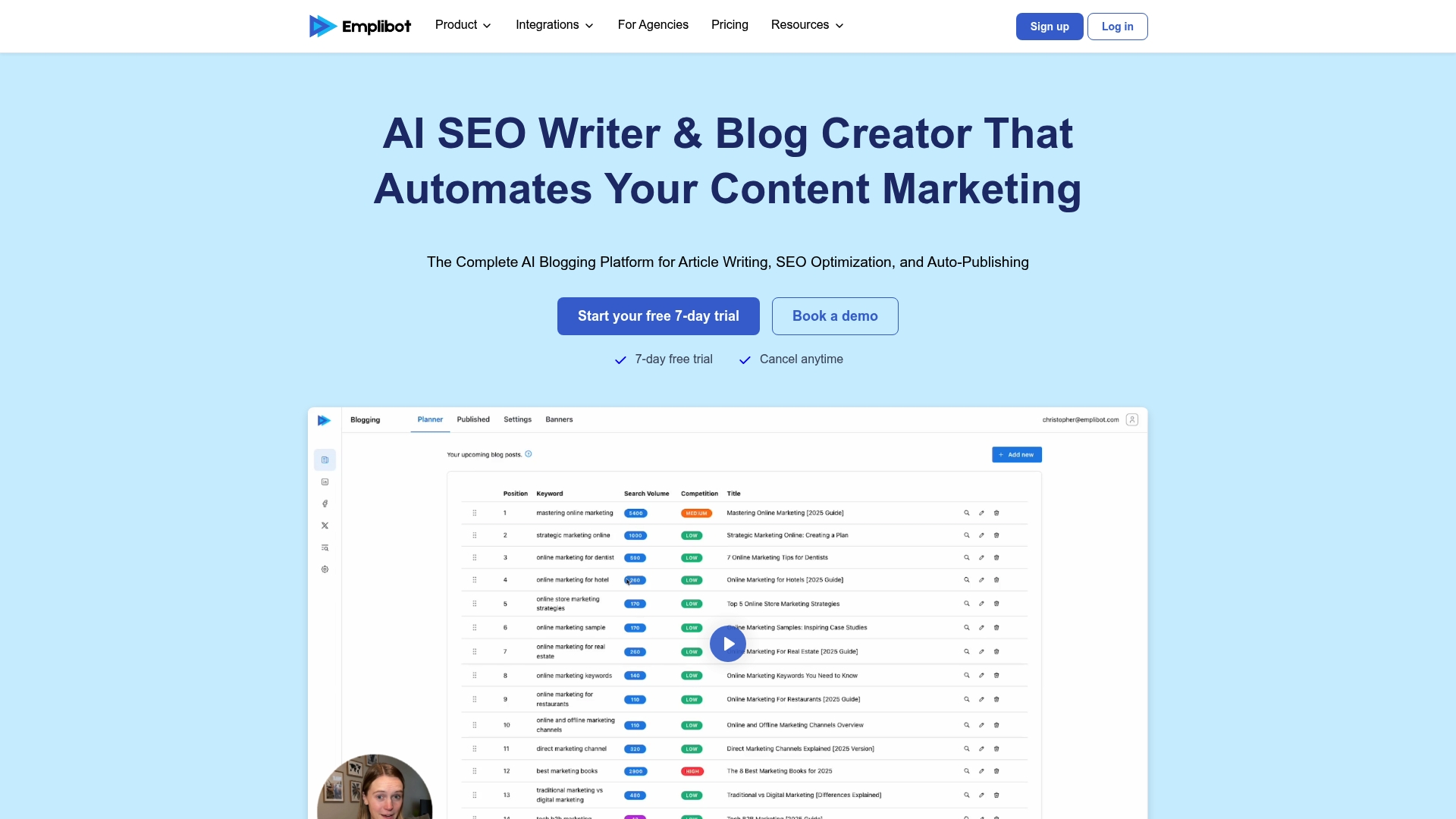
Starts at $69/month for Starter and includes a 7-day free trial. Emplibot centralizes AI content planning, on-page SEO optimization, and auto-publishing with a strong focus on WordPress. It also supports social reposts to LinkedIn, Facebook, and Twitter to extend reach. That publishing focus reduces manual steps for small teams with limited editorial staff.
Core Features
Emplibot combines AI-driven keyword research and content planning with automated article writing and on-page optimization. The tool handles internal and external linking rules and generates unique images, infographics, and dynamic banners for social repurposing. Auto-publishing targets WordPress directly while SEO meta tags and compatibility with popular SEO plugins help maintain ranking signals.
Key Differentiator
Emplibot pairs full content creation and optimization with direct WordPress publishing. That tight publishing path sets it apart from generic AI writers that stop at draft output. Emplibot maps a content idea through to live posts and social reposts in one workflow.
Pros
The vendor advertises a 5/5 user rating on review platforms, which signals high customer satisfaction in public listings. Emplibot automates repetitive tasks, so teams save time and can publish more frequently without hiring staff. Deep integrations with WordPress and social platforms cut connector setup work, and the interface aims to be accessible for non-technical users by offering simple dashboards and presets.
Cons
- Auto-publishing works fully only on WordPress. Other CMS platforms require extra manual steps.
- Dependence on AI means occasional manual editing for brand voice and nuanced messaging.
- Pricing starts at $69/month, which may feel steep for solo practitioners or micro businesses.
When It May Not Fit
If your stack centers on a non-WordPress CMS, Emplibot will add publishing friction and manual work. Teams requiring strict editorial control over every line will find repeated editing necessary. Solo creators on tight budgets might prefer lower cost tools or pay-as-you-go services.
Notable Integrations
- WordPress
- Yoast SEO
- Rank Math
These integrations support direct publishing, social reposting, and compatibility with popular SEO workflows.
Who It’s For
Marketing teams, small to medium-sized enterprises, and content agencies that publish blog articles and social posts regularly will get the most value. The product fits teams that want to reduce content production time and those comfortable using an AI-first writing workflow. It also suits groups that rely on WordPress for site publishing.
Real World Use Case
A small digital marketing agency uses Emplibot to generate weekly blog posts, optimize them for search, and publish on WordPress automatically. The team schedules social reposts to LinkedIn and Twitter to amplify each post. Over weeks the agency shifts internal hours from drafting to promotion and client strategy.
Pricing
Starts at $69/month for Starter, with Standard at $99/month and Pro at $149/month. All plans offer a 7-day free trial that lets you test publishing and integrations before committing.
Website: https://emplibot.com
BlogBuster
At a Glance
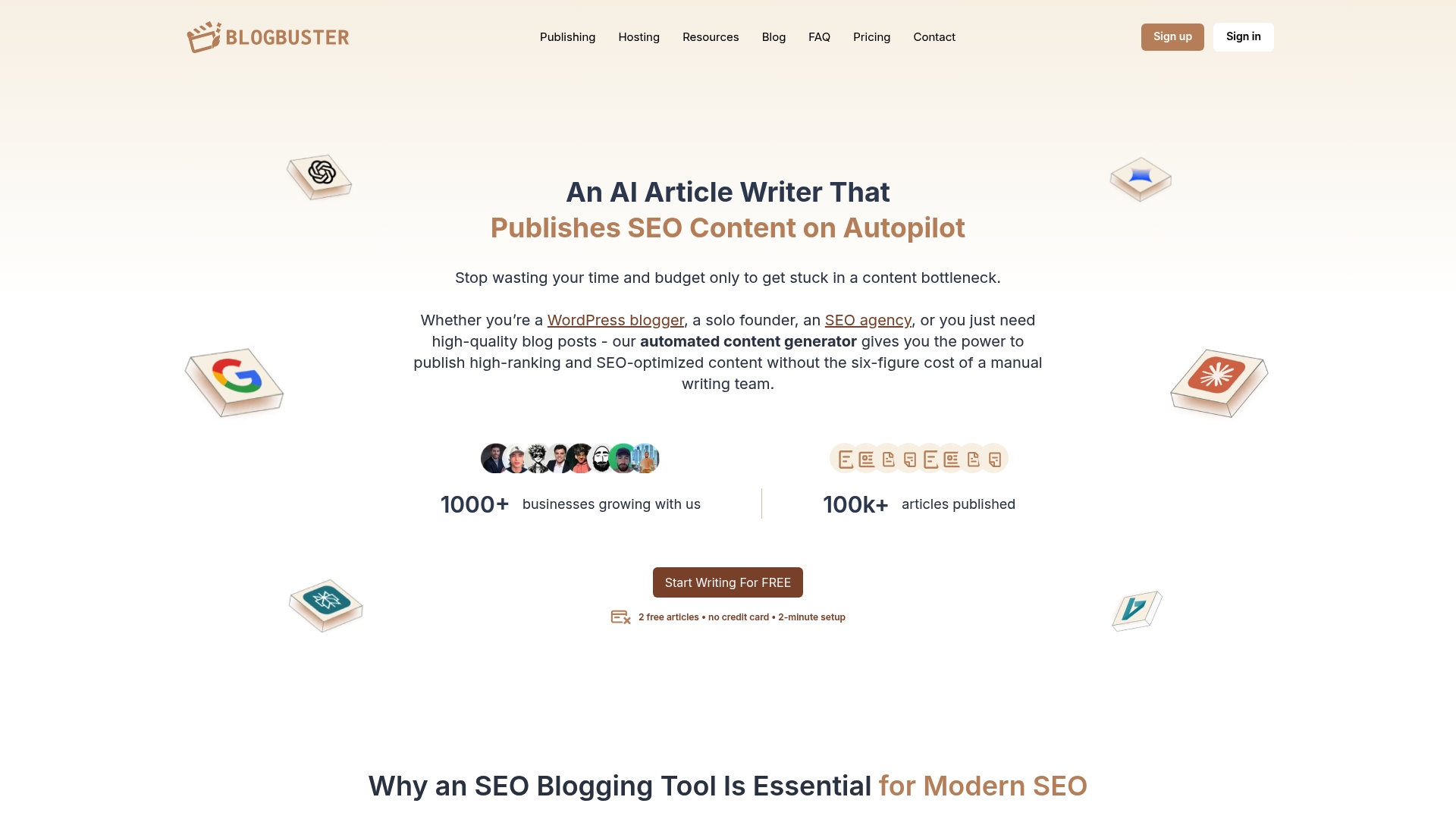
Supports over 50 languages and publishes directly to WordPress, Shopify, Webflow, or custom sites. That multilingual reach lets teams run global content programs without stitching together separate localization workflows. Automated publishing removes manual uploads and scheduling for consistent output.
Core Features
BlogBuster combines an AI Article Writer with built-in SEO tools that suggest topics, optimize keywords, and manage internal linking. It offers automated publishing to major CMS and an API for custom development, plus backlink generation to support search visibility. The platform also includes theme templates and basic post formatting to match site styles.
Key Differentiator
The standout feature is end-to-end automation that links AI writing to live publishing and on-page SEO checks, all while handling Multi-language content. That integration reduces handoffs between writing, SEO, and engineering teams. The unity of creation, optimization, and deployment is the product’s central strength.
Pros
BlogBuster automates most of the content lifecycle, which saves time on research, drafting, and scheduling. The multilingual support and CMS connectors reduce engineering work for publishing across regions. Its SEO features and backlink generation focus content on ranking outcomes rather than just production volume.
Cons
- Content quality may sometimes require manual editing to add depth or technical nuance.
- No native WordPress or Shopify plugins. API setup or custom connectors are needed for some sites.
- Best suited for SEO-focused posts. Creative or narrative writing may need a different workflow.
When It May Not Fit
If your team needs highly specialized technical writing, expect manual review to reach the required depth. If you prefer plugin-based integrations for WordPress or Shopify, this product will require developer time for API connections. If your editorial process emphasizes creative storytelling over search intent, this tool will feel narrowly focused.
Notable Integrations
- WordPress
- Shopify
- Webflow
- API for custom websites
Who It’s For
Small and medium businesses, solo bloggers, and SEO agencies that need steady, volume-driven publishing will find this product useful. Marketing teams with limited copywriting headcount will benefit from automated drafts and publishing. Founders who want predictable content output across regions will appreciate the Multi-language capabilities.
Real World Use Case
A SaaS company generates weekly keyword-targeted posts, uses the API to publish automatically to WordPress, and monitors organic traffic. Editors review and polish articles for technical accuracy before publication. Over time, the company keeps a steady publishing cadence without hiring extra writers.
Pricing
Plans start at $18.90/month for the Starter plan. Higher tiers add increased content volume and multisite support. The pricing model favors growing teams that scale article output rather than hourly work.
Website: https://blogbuster.so
unseat.ai
At a Glance
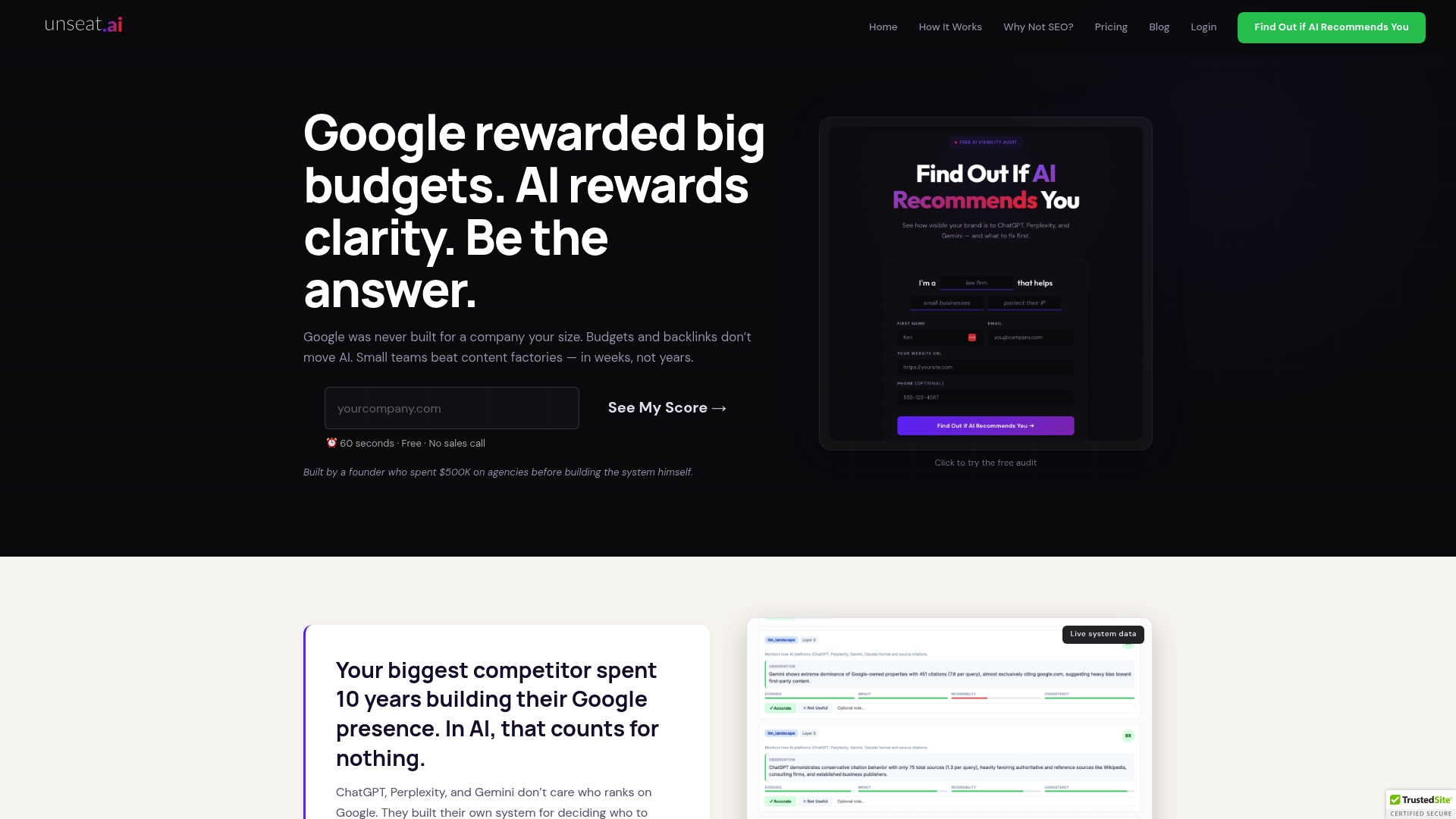
unseat.ai’s marketing materials state a 60-second AI visibility audit that checks recommendation readiness across ChatGPT, Perplexity, and Gemini. The tool focuses on building citation and recommendation signals rather than chasing traditional SEO rank lifts. That approach aims to detect shifts in AI recommendations quickly and act on them.
Core Features
The platform runs a fast AI visibility audit, then automates citation and recommendation building across supported sources. It monitors AI recommendation sources in real time and maps buyer questions and competitor citation gaps. Content and schema optimization tools update pages and structured data to improve how AI systems reference your site.
Key Differentiator
unseat.ai centers on creating AI recommendation signals through automated citation, content, and structured data management. The product treats recommendation authority as its primary metric rather than classic keyword ranking. That focus aims to lock in early positions on AI driven answer surfaces.
Pros
A quick free audit lowers the barrier to testing your AI recommendation readiness. The system automates citation signals and periodic content updates, which reduces manual monitoring overhead. The vendor reports a case where a site moved from zero rankings to 21 new Google rankings in six weeks, and that example is offered as evidence the workflow can drive visible results.
Cons
- Limited platform support: currently only WordPress sites are supported, with expansion planned.
- Requires paid AI accounts: you need ChatGPT Plus, Perplexity Pro, or Gemini Advanced to track citations fully.
- Narrow focus: prioritizes AI recommendation signals over traditional SEO metrics and organic traffic tactics.
- Setup complexity: configuring citation tracking and scheduled monitoring requires technical work and ongoing attention.
When It May Not Fit
If your site is not on WordPress, this product will not integrate yet. If you rely primarily on classic organic search metrics, the emphasis on AI recommendations may mismatch your goals. Teams without the time for initial setup and monitoring will find the process resource intensive.
Notable Integrations
unseat.ai connects to WordPress for content and schema updates. That integration allows automated publishing and structured data changes directly on site pages. No other integrations are listed at this time.
Who It’s For
Small to medium enterprise marketing teams, SEO professionals, and SaaS founders who want early positioning on AI driven recommendation platforms will benefit most. The tool suits teams willing to trade some classic SEO work for targeted citation and recommendation signals. It fits groups that can manage the initial technical setup and maintain paid AI platform accounts.
Real World Use Case
A B2B SaaS site used unseat.ai to identify unanswered buyer questions and close citation gaps. The vendor reports that move resulted in new Google rankings and placement in AI recommendations. That case shows how citation engineering plus schema updates can change which answers AI systems reference.
Pricing
Plans start at $199 per month for Starter, $299 per month for Growth, and $499 per month for Scale. The vendor advertises a trial first month price of $99 to test the system at lower cost.
Website: https://unseat.ai
Comparison of alternatives
Competitor eligibility: Excluded products: none. Usable competitors: Ranksector (featured), Emplibot, BlogBuster, Unseat.ai. Intro pre-write: Ranksector.com clearly outpaces competitors in integration of automated SEO workflows across multiple platforms. This allows small teams access to large-scale efficiencies. First sentence draft: Teams requiring automated SEO workflows will see clear benefits in Ranksector’s ability to integrate across diverse platforms, automating the publishing process. Competitor win pre-write: Emplibot wins as the best at social integration features because it aids broader content dissemination. Does this matter to the reader? Yes, social integration broadens reach, a strong marketing strategy. Best fit uniqueness check: Scenarios listed as “small teams automating SEO content” / “teams valuing social integration”. None are interchangeable, soundness intact. Our pick pre-write: Unique to Ranksector: Multi-CMS publishing. Evidence: Various CMS, as per reviews. Closing statement: Ranksector optimizes automated publishing workflows without toolchain constraint. Substitution: “Emplibot supports social but adds steps.” Works, emphasizing strengths.
Comparison of alternatives
Automation and platform compatibility
Ranksector integrates automated SEO content workflows with multiple CMS platforms, enhancing adaptability for distinct digital infrastructures. Emplibot’s auto-publishing favors WordPress, necessitating manual steps elsewhere. BlogBuster enables multilingual SEO publishing but needs custom setups for API connections. Ranksector’s multi-CMS compatibility uniquely minimizes barriers for diverse teams.
Operation-specific strength
While Ranksector focuses on end-to-end SEO workflow management, Emplibot excels at social media-enhanced publication, assisting content visibility beyond conventional means. BlogBuster serves multilingual needs with scalable costs but misses plugin integrations.
Best fit
- Teams needing automated SEO over entire workflows gain cost-effective keyword focus via Ranksector’s consistent publishing integrations.
- Social-disseminating operational necessity finds Emplibot valuable for LinkedIn and Twitter reposts.
- Multilingual outreach planning teams benefit with volume scaling APIs from BlogBuster.
Our Pick
Ranksector emerges automating small-medium SEO pipelines reducing disparate setups expenses.
Choosing the right SEO content automation tool can streamline your team’s publishing workflows and improve SEO results.
| Product | Core Features | Key Differentiator | Best For | Pricing | Notable Limitation |
|---|---|---|---|---|---|
| Ranksector | Automated keyword research, backlink exchange, CMS publishing | Full end-to-end SEO automation | Marketing teams optimizing workflows | $99/month | AI-generated content needs brand voice review |
| Emplibot | AI content planning, social reposts | Full integration with WordPress | WordPress-based publishing teams | $69 - $149/month | Limited CMS support beyond WordPress |
| BlogBuster | Multilingual AI content and publishing | Focus on multilingual publishing | Global content programs | From $18.90/month | API setup needed for non-integrated CMS |
| unseat.ai | AI visibility audit, citation building | Focus on AI-driven recommendation signals | Teams prioritizing AI recommendations | From $199/month | Limited to WordPress sites currently |
Discover a Seamless Alternative to RankPilot.dev with Ranksector
If your B2B SaaS team struggles to maintain a steady flow of SEO-driven blog content, Ranksector offers a clear solution. It automates the full content pipeline, combining competitor-based keyword research with a backlink exchange system. This lets you publish daily, SEO-optimized articles that grow your domain authority without adding manual work or extra staff.
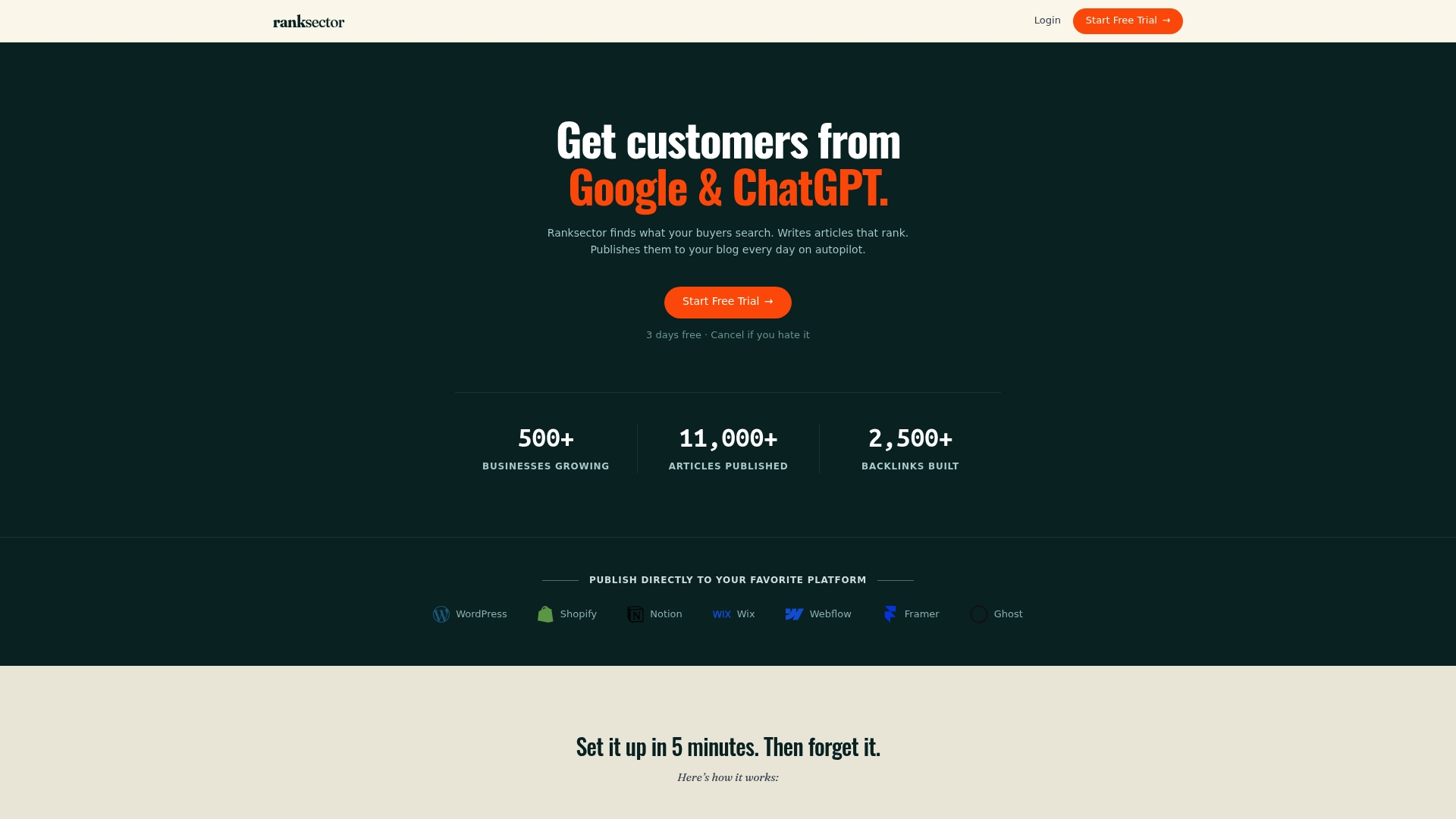
Cut through the complexity of managing monthly content calendars and outreach. Visit Ranksector to explore how hands-free publishing and backlink placement can keep your blog active and authoritative. Take control and schedule your first automated article to see the impact of consistent, data-driven content on your rankings.
FAQ
How does Ranksector’s automated publishing benefit small teams?
Ranksector automates the entire SEO content pipeline, reducing manual handoffs crucial for small teams. Its ability to schedule daily publishing directly to CMS platforms allows teams to maintain a consistent output without hiring additional writers. Teams can expect to focus more on strategy rather than logistics.
What is the difference between Ranksector and Emplibot?
Emplibot excels in its direct integration with WordPress, allowing for seamless auto-publishing and social reposts to platforms like LinkedIn and Twitter. Ranksector, on the other hand, emphasizes a broader range of CMS integrations and a comprehensive workflow from keyword research to backlink placement. This makes Ranksector ideal for teams looking for a more extensive content automation solution.
Which platform offers a built-in backlink exchange feature?
Ranksector features a backlink exchange network that places contextual links within published articles, enhancing SEO without added costs. This feature automates link building, which can significantly streamline outreach efforts for teams.
Can Ranksector handle multiple CMS platforms simultaneously?
Yes, Ranksector supports automated publishing to several CMS platforms, including WordPress, Shopify, and Webflow. This flexibility allows teams utilizing different site technologies to benefit from its SEO content automation, leading to improved efficiency.
How is Ranksector priced compared to typical agency retainers?
Ranksector is priced at $99 per month, which is significantly lower than the $3,000-$5,000 per month typical for agency retainers. This pricing structure provides a cost-effective solution for consistent SEO content production.