
What Is Programmatic SEO? Scaling Pages With Data
Programmatic SEO is the automated, template-driven creation of many web pages from structured data, built to target long-tail keyword variations at a scale manual writing can’t match. It works best for teams that already sit on structured data and have developer resources on hand: SaaS companies, travel sites, real estate platforms, and ecommerce stores. The catch? Google’s helpful content guidelines still apply at scale. If you skip Google Search Console monitoring and defensible value, you’ll publish thousands of pages that rank nowhere. A platform like Ranksector automates the mechanics, but the strategy underneath still has to hold up.
Key Takeaways
Programmatic SEO succeeds when structured data, disciplined templates, and validated pilots come before scale, not after.
| Point | Details |
|---|---|
| Definition | Programmatic SEO automates page creation using templates fed by structured data. |
| Best fit | Teams with structured datasets and developer resources, like SaaS, travel, and ecommerce. |
| Start small | Pilot with 50 to 200 pages and validate CTR and indexation before scaling. |
| Watch the technical basics | Canonicalization, noindex rules, and internal linking prevent index and duplicate content problems. |
| Automation option | Ranksector automates daily publishing and keyword research for teams piloting content at scale. |
Table of Contents
- What Is Programmatic SEO, Exactly?
- How Does Programmatic SEO Work Stage by Stage?
- What Are Real Examples of Programmatic SEO?
- Is Programmatic SEO Right for Your Team?
- How Do You Get Started With a Pilot?
- What Technical Risks Should You Watch For?
- Which Tools Make Up a Programmatic SEO Stack?
- How Do You Measure and Scale Safely?
- What Mistakes Sink Most Programmatic Projects?
- What Does Hands-On Programmatic SEO Look Like?
- Where Automated Publishing Fits Into Your Pilot
- Frequently Asked Questions
- Sources
What Is Programmatic SEO, Exactly?
Programmatic SEO combines three ingredients: a page template, a structured dataset, and an automation layer that stitches them together. Instead of a writer producing one article about “CRM software for real estate agents,” you build one template and feed it a dataset of 200 industries, generating 200 pages automatically. This isn’t a shortcut around content quality. It’s a different production model, one that scales content, rankings, and traffic through consistent structure rather than one-off effort.
What separates it from traditional SEO work:
- Scale: hundreds or thousands of pages instead of dozens
- Templates: a fixed layout with variable fields, not a blank page each time
- A structured data source: a spreadsheet, API, or database, not a writer’s research
- Automation rules: logic that maps data fields to template slots
- Repeatable URL patterns:
/city/[name]or/integrations/[app-name], for instance
Common outputs include city or location landing pages, product variant pages, app or integration directories, and comparison or pricing pages, all of which are common among travel, real estate, and ecommerce sites.
How Does Programmatic SEO Work Stage by Stage?
The process breaks into five repeatable stages, and skipping any one of them is where most implementations go wrong.
- Keyword pattern discovery. Find a query structure that repeats across many entities, like “[software] pricing” or “best [service] in [city].”
- Data collection. Pull structured data from APIs, internal databases, or ethical scraping, whatever feeds the template reliably.
- Template design. Build a flexible page layout with variable fields for the data to populate.
- Automation and publishing. Connect the dataset to the template using tools like Zapier integrations, Webflow CMS, or WP All Import.
- Validation and iteration. Check indexation, click-through rate, and rankings before expanding the page set.
A worked example: a city dataset with population, average rent, and job growth fields maps directly onto a “[city name] cost of living” template, where each field fills a specific slot in the page copy and schema markup.
Pro Tip: Validate search intent before you template anything. Search a sample of your target queries manually and check whether the results are lists, tools, comparisons, or guides. If your planned template doesn’t match that pattern, no amount of automation will save the rankings.
What Are Real Examples of Programmatic SEO?
Nomad List built city pages ranking on cost of living, internet speed, and safety scores pulled from its own proprietary database. That data ownership is the moat. A competitor can copy the page layout but can’t replicate years of crowdsourced city data.

Zapier generates thousands of “connect [App A] with [App B]” pages from its integration directory. Each page targets a specific, high-intent search, and the underlying data (which apps actually integrate) is tied to Zapier’s own product.
Yelp and TripAdvisor run massive networks of city and category listing pages (“best restaurants in Austin”) built from aggregated business and review data that took years to accumulate.
Wise publishes currency conversion and international pricing pages for thousands of currency pairs and country combinations, pulling live exchange-rate data into a consistent template.
What makes each defensible isn’t the template. It’s the data behind it: proprietary datasets, aggregation depth, or interactive tools that competitors can’t easily copy.
Pro Tip: Before building a single template, ask what you have that a competitor would need months or years to replicate. If the honest answer is “nothing,” you’re building thin pages, not a defensible pSEO system.
Is Programmatic SEO Right for Your Team?
Advantages:
- Scales page production far beyond what manual writing allows
- Captures long-tail keyword variations you’d never target one by one
- Compounds ranking gains once templates prove out
Disadvantages:
- Requires developer resources to build and maintain templates
- Carries real index risk if pages read as thin or duplicate
- Demands ongoing data upkeep, since stale fields degrade quality fast
Run this three-question check before committing:
- Do you have structured data covering at least dozens of entities?
- Can your team maintain and update templates over time?
- Do you have developer resources, even part-time, to handle the build?
Two “yes” answers suggest you’re ready for a pilot; three make it an easy call.
How Do You Get Started With a Pilot?
- Define your scope: pick one query pattern and one template.
- Map your data source: confirm the fields exist and are accurate.
- Build a small pilot of 50 to 200 pages, not thousands.
- Set canonical policies and tracking before publishing a single page.
- Publish the batch and submit it through Google Search Console.
- Measure impressions, clicks, and indexation weekly for four to six weeks.
- Iterate: fix underperforming fields, then scale only the templates that work.
Start small on purpose. Experienced practitioners validate one template against real performance data before expanding, because launching thousands of unvalidated pages risks mass deindexation. Watch for stop signals: near-zero impressions after three weeks, a click-through rate under 1%, or Search Console flagging pages as “Discovered, not indexed.” Any of those means pause and fix the template, not add more pages to it.
Pro Tip: Pick your first template based on the query pattern with the clearest, most consistent search intent, not the one with the biggest dataset. A smaller, cleaner pilot beats a sprawling one you can’t debug.
What Technical Risks Should You Watch For?
Programmatic SEO fails technically more often than it fails creatively. Before you scale past a pilot, confirm:
- URL patterns are consistent and human-readable
- A clear canonicalization strategy exists for near-duplicate pages
- Low-value variants carry
noindextags instead of competing for crawl budget - Structured data and schema markup match what’s actually on the page
- Internal linking connects new pages to relevant existing content, not just a sitemap
- Pagination and URL parameters don’t fragment the same content into dozens of indexable versions
Monitor coverage weekly in Google Search Console, and consider a log-file analysis if crawl budget seems constrained. Use noindex for pages with genuinely low search value; reserve canonical tags for true duplicates you still want crawled.
Stale data quietly wrecks rankings. A pricing page showing last year’s numbers or a city page with outdated statistics signals low quality to both users and search engines, and implementation complexity around data integrity is routinely underestimated.
Which Tools Make Up a Programmatic SEO Stack?
Your stack breaks into five categories, and the right choice depends on whether you have developers on staff.
- Headless CMS: Webflow, Contentful, or a custom-built platform
- Templating engines: built into your CMS or handled through custom code
- Data pipelines: APIs, spreadsheets, or ETL tools that feed your dataset in
- Automation and integration tools: Zapier for lighter workflows, custom scripts for complex logic
- Hosting and CDN: whatever supports fast page generation at volume
No-code tools like Zapier get a pilot live fast, but most implementations outgrow them once template logic and data volume increase, at which point developer-first tooling becomes worth the investment. Firms like Ridiculous Engineering build headless CMS platforms specifically for this kind of scale.
How Do You Measure and Scale Safely?
Track these KPIs weekly, not just at the end of a pilot:
- Impressions and organic clicks per page set
- Click-through rate against your average
- Ranking position movement for target keywords
- Pages indexed versus pages published
- Conversion rate by page set, plus average time on page and bounce rate
Give a pilot four to six weeks before judging it. That’s usually enough for Google to index and rank a batch of clean pages if the templates are sound. Scale only when a template clears three guardrails: CTR at or above your site average, stable indexation with no mass drops, and a content freshness process that keeps data current as it grows.
What Mistakes Sink Most Programmatic Projects?
- Publishing thousands of pages before validating one template. Fix: pilot at 50 to 200 pages first.
- Ignoring search intent. Fix: manually check the SERP for your target pattern before templating.
- Weak or duplicate meta tags across pages. Fix: template meta fields dynamically, not statically.
- No internal linking plan. Fix: build linking rules into the template itself.
- Stale data. Fix: schedule data refreshes on a fixed calendar.
What Does Hands-On Programmatic SEO Look Like?
Ranksector has published over 11,000 articles through automated, template-driven workflows, and the lessons hold regardless of the platform you use. Start with a small batch. Enforce data quality before publishing rather than after. Build internal linking rules into the template so new pages support each other automatically, and check Search Console coverage weekly rather than monthly.
The biggest lesson from running automated publishing at scale: the template is never “done.” Every batch of new data reveals an edge case that breaks a field, and catching it early is cheaper than fixing it across a thousand live pages.
Author perspective: programmatic vs. manual content
Lean on programmatic SEO for scalable, structured page types like directories, comparisons, and location pages, and keep manual writing for pages that need real expertise or a distinct point of view. The strongest content strategies I’ve seen run both in parallel: automation for volume, manual work for authority.
Where Automated Publishing Fits Into Your Pilot
Building and maintaining a programmatic template by hand, from data pipeline to publishing schedule, eats developer time most small teams don’t have. Ranksector removes that overhead by handling daily article publishing, keyword research grounded in competitor analysis, and a backlink exchange network in one subscription, so a small SaaS team can run a content pilot without hiring for it.
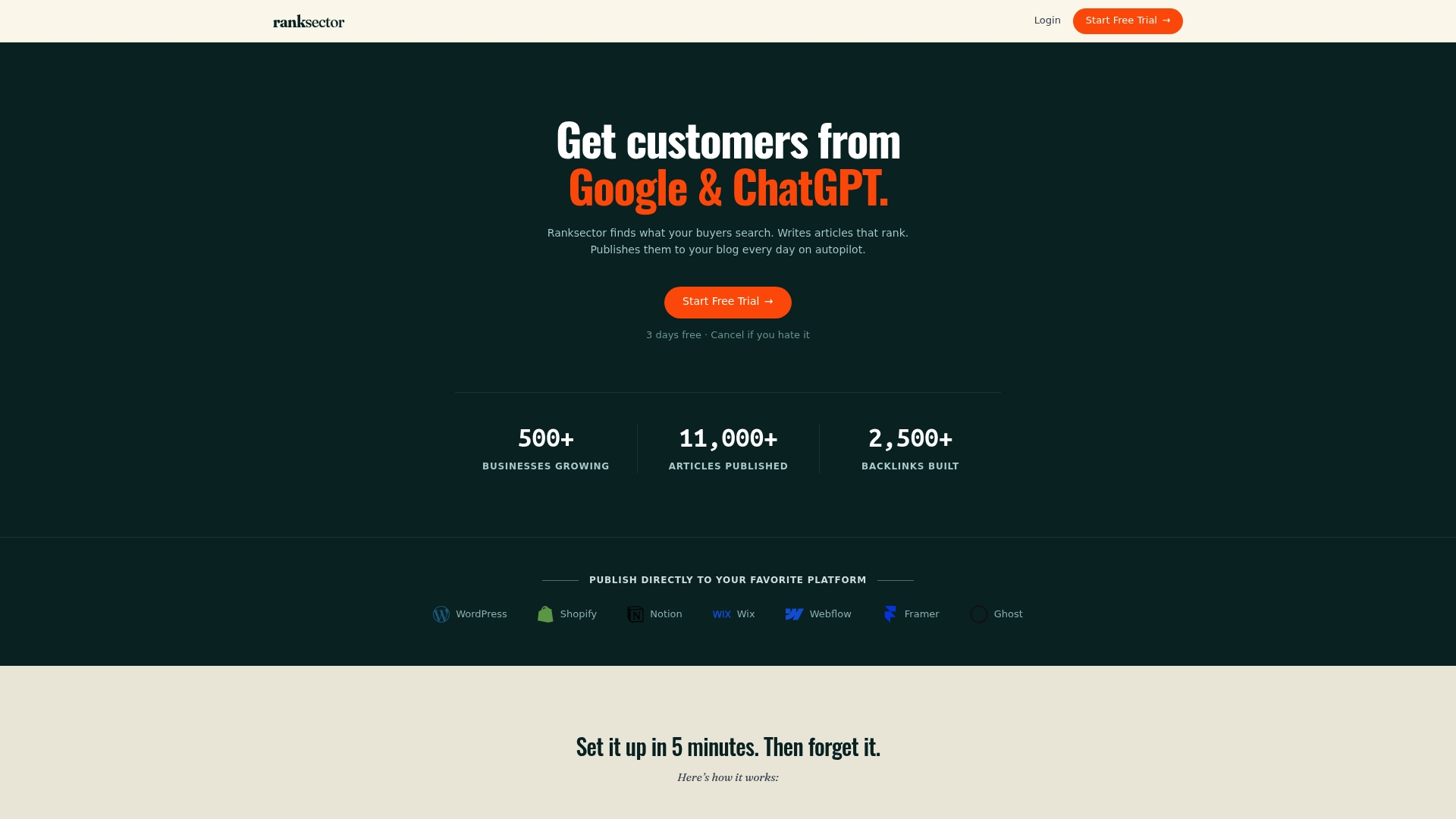
That fit matters most for B2B SaaS founders and small teams who need consistent output but can’t staff a content function. If you’re deciding between a traditional SEO agency and an automated platform, the cost and speed trade-offs usually favor automation once your template strategy is solid. Ranksector also includes an AI visibility audit to catch indexing and structure issues before they scale into a bigger problem. Try the free tools to see how a pilot batch performs before committing to a full rollout.
Frequently Asked Questions
What is programmatic SEO in simple terms? Programmatic SEO is the automated creation of many similar web pages using a template and a structured dataset, built to target long-tail search queries that would take too long to write manually.
How does programmatic SEO differ from regular content marketing? Regular content marketing produces individual, hand-written pages. Programmatic SEO produces many pages from one template, with data filling in the variable details for each version.
Do I need to know how to code to try programmatic SEO? No. Tools like Zapier and no-code CMS connectors let you pilot a small batch, though larger implementations typically require developer support for reliability.
How many pages should a programmatic SEO pilot include? Start with 50 to 200 pages on a single template. That’s enough to gather meaningful click-through rate and indexation data without risking mass thin-content flags.
What’s the biggest risk with programmatic SEO? Publishing too many unvalidated pages at once, which can trigger indexing problems and get large sections of a site treated as low quality under Google’s helpful content guidelines.
Sources
- Programmatic SEO: Scale content, rankings & traffic fast — Search Engine Land
- What Is Programmatic SEO? — Semrush
Useful tooling includes a schema markup validator for checking structured data before publishing, plus a standard meta tag checker for catching duplicate titles and descriptions at scale. Publisher note: source titles above are preserved for reference; live links are inserted where each was originally cited in this article.
Recommended
- Ranking vs Clicks: Why SaaS Pages Need More Than Position · Ranksector Blog — Ranksector
- Scaling Content Production Strategies for Marketing Teams · Ranksector Blog · Ranksector
- How SEO Generates Passive Traffic: A Tool-First Guide · Ranksector Blog · Ranksector
- Ranksector — AI-powered SEO content creation and publishing