
Move Trials in Months with Tiered, Guarded SaaS Link Building
The highest-return approach to SaaS link building in 2026 pairs product-led linkable assets, original data, and integration or co-marketing links with a smaller set of vetted guest and listicle placements, then routes that authority to money pages through deliberate internal linking. Expect the first measurable movement in referring domains within a couple of months, and assisted pipeline lift within a few months thereafter. Track referring domains and assisted pipeline, not raw link counts.
TL;DR:
- Focusing on original research, tools, and integration pages delivers the highest leverage for building relevant backlinks that impact revenue pages.
- Internal linking should prioritize passing authority from linkable assets to conversion-focused pages through a tiered architecture and descriptive anchor text.
- Tracking qualified referring domains and assisted pipeline metrics provides a clearer picture of link-building success than raw link counts alone.
- Prioritizing channels like digital PR, guest posting, and partner links early on, with gradual scaling, minimizes risk and matches existing assets.
- Using a platform like Ranksector supports consistent publishing and backlink exchange, enabling smaller teams to grow authority without extensive outreach efforts.
Table of Contents
- What Is SaaS Link Building, and How Is It Different From Standard Link Building?
- SaaS-Specific Link Building Tactics You Can Start Testing This Week
- How Should You Structure Links to Route Authority to Revenue Pages?
- Which Acquisition Channels Should You Prioritize First?
- How Do You Route Link Equity Internally Without Overdoing It?
- What KPIs Actually Prove Link Building Is Working?
- What Does a 12-Month SaaS Link Building Roadmap Look Like?
- What Proof Points Support This Approach?
- What I’d Prioritize if I Were Running This Program Myself
- How Ranksector Fits Into Your Link Building Program
- Sources
What Is SaaS Link Building, and How Is It Different From Standard Link Building?
SaaS link building is the practice of earning backlinks specifically to support a subscription software company’s growth funnel, which usually means routing authority toward trial signups, pricing pages, and comparison content rather than a homepage or a blog post that never touches revenue. Standard link building often optimizes for domain-wide authority. SaaS link building optimizes for a narrower goal: getting the right pages ranked so a visitor converts to a trial or a demo request.
That distinction changes almost every tactical decision downstream. A local service business might chase links to its homepage and call it done. A SaaS company has to think in tiers, because the pages that attract natural links (data studies, free tools, developer docs) are rarely the pages that make money. Industry playbooks converge on a two-step model: build links to linkable assets first, then use internal linking to push that earned authority toward the pages that actually convert. Skip the second step and you end up with a blog that ranks well while your pricing page sits untouched.
SaaS-Specific Link Building Tactics You Can Start Testing This Week
Not every tactic deserves equal investment. Some need a developer’s afternoon; others need nothing but a spreadsheet and persistence. Here is a practical menu, roughly ordered from highest leverage to more supplementary plays.
- Original research and data reports. Survey your user base or mine your own product data (churn triggers, feature adoption, pricing sensitivity) and publish the findings. This earns links from journalists and other SaaS blogs looking for a citable number. Marketing-only. Time to value: 4 to 8 weeks once the survey closes.
- Free tools and calculators. A pricing calculator, an ROI estimator, or a lightweight version of your core feature attracts links the way a blog post never will, because other sites want to embed or reference a working tool. Needs engineering time upfront, but pays off for years. Time to value: 2 to 4 months.
- Guest posting on topically relevant blogs. Pitch a genuinely useful angle to SaaS or marketing blogs with real traffic. Start by identifying five sites your ideal customer already reads. Marketing-only. Time to value: 3 to 6 weeks per placement.
- Link insertions and niche edits. Find existing articles that already rank for terms you care about and request a contextual link into an existing paragraph. Cheaper and faster than guest posts, but quality varies wildly. Marketing-only. Time to value: 1 to 3 weeks.
- Digital PR built on your own data. Package the research report above into a pitch for trade press and niche newsletters. This is where you get the highest-authority placements, but it also takes the most coordination. Marketing-only. Time to value: 6 to 10 weeks.
- Product listicle placements. Getting included in “best [category] tools” roundups is one of the primary acquisition channels for SaaS, and it doubles as referral traffic. Start by finding roundups where competitors already appear and pitching yourself with a differentiator. Marketing-only. Time to value: 4 to 8 weeks.
- Integration partner pages. If you integrate with other software, most partners maintain a directory of integrations, each with a dedicated page and a link back to you, as explained on the Site & Integrations page from Sonta AI Academy. Needs light engineering coordination to confirm the integration is documented correctly. Time to value: 2 to 6 weeks once the partnership exists.
- Developer docs and open-source contributions. Public API documentation, SDKs, and open-source repositories earn links from developer blogs and Stack Overflow threads almost passively. Needs real engineering investment, but the links are durable and hard for competitors to replicate quickly, since integration pages and developer content are genuinely defensible assets.
- Resource page outreach. Many niches maintain curated “resources” or “tools” pages. Find them via search operators and pitch your tool as an addition. Marketing-only. Time to value: 2 to 4 weeks.
- Broken-link outreach. Find dead links on relevant resource pages and offer your content as the replacement. Slow but nearly free. Marketing-only. Time to value: 4 to 6 weeks.
- HARO and Qwoted-style journalist requests. Respond to reporter queries with a specific, quotable answer, not a pitch. Marketing-only, but requires fast turnaround. Time to value: 1 to 4 weeks per hit.
- Podcast guest appearances. Most podcasts link back to guests from show notes. Target shows your buyer persona actually listens to, not just the biggest audience. Marketing-only. Time to value: 3 to 8 weeks including scheduling.
- Community-driven signals on Reddit and Stack Overflow. Genuine, non-promotional participation in relevant threads builds brand mentions and occasional links, and increasingly feeds AI-generated answers that cite real discussions. Marketing-only. Time to value: ongoing, compounding.
- Software directories and marketplaces. Claiming and optimizing listings on Capterra and similar platforms is a fast, low-effort win most teams underuse. Marketing-only. Time to value: 1 to 2 weeks.
- Co-marketing content with integration partners. Joint webinars, comparison guides, or case studies with a partner company earn a link from their domain and yours simultaneously. Marketing-only. Time to value: 4 to 6 weeks.
- Customer case studies and success stories. Ask happy customers if you can publish their results, then let them share it, which often gets you a link from their own company blog or press page. Marketing-only. Time to value: 3 to 5 weeks.
- Alumni and employee blog mentions. Former or current employees who write on Medium or LinkedIn often link back naturally when covering relevant topics. Marketing-only. Time to value: ongoing.
- Scholarship and sponsorship pages. A niche scholarship or small sponsorship earns links from .edu and community sites, though relevance to a SaaS buyer is thinner than the tactics above. Marketing-only. Time to value: 2 to 3 months.
- Webinar and event co-hosting. Partnering with another company on a live event generates links from both companies’ event pages and often from attendee recap posts. Marketing-only. Time to value: 4 to 8 weeks.
Pro Tip: Run a two-week audit before committing budget anywhere on this list. Pick the three tactics that best match your existing assets (an API, real usage data, an active partner network) instead of starting from zero on all nineteen at once.
How Should You Structure Links to Route Authority to Revenue Pages?
A tiered link architecture keeps you from wasting good backlinks on pages nobody converts on. Think of it as four layers, each feeding the one below it.
- Tier 1: Money pages. Pricing, product, and demo request pages. These almost never earn links directly, so they depend entirely on internal links passed down from Tier 2 and 3.
- Tier 2: Comparison and alternative pages. “X vs Y” and “best alternatives to X” pages capture high-intent search traffic and occasionally earn links from review sites, but their real job is funneling internal link equity straight into Tier 1.
- Tier 3: Pillar and linkable assets. Original research, free tools, and comprehensive guides. These are your primary link magnets, the pages digital PR and guest posts point back to.
- Tier 4: Cluster and support content. Narrower how-to posts and glossary entries that rank for long-tail queries and link upward into Tier 3, reinforcing topical relevance before authority ever reaches Tier 1.
Anchor text should stay mostly descriptive and varied (“this pricing calculator,” “our churn survey”) rather than exact-match commercial terms, which read as manipulative both to readers and to Google. Place internal links naturally within the first two-thirds of an article’s body, where they get the most click-through and crawl attention, and never stack more than two or three links pointing to the same money page within one piece of content.
Which Acquisition Channels Should You Prioritize First?
Different channels suit different company stages, and running all of them at once without a plan is how most in-house teams burn out. Here is how the primary channels break down.
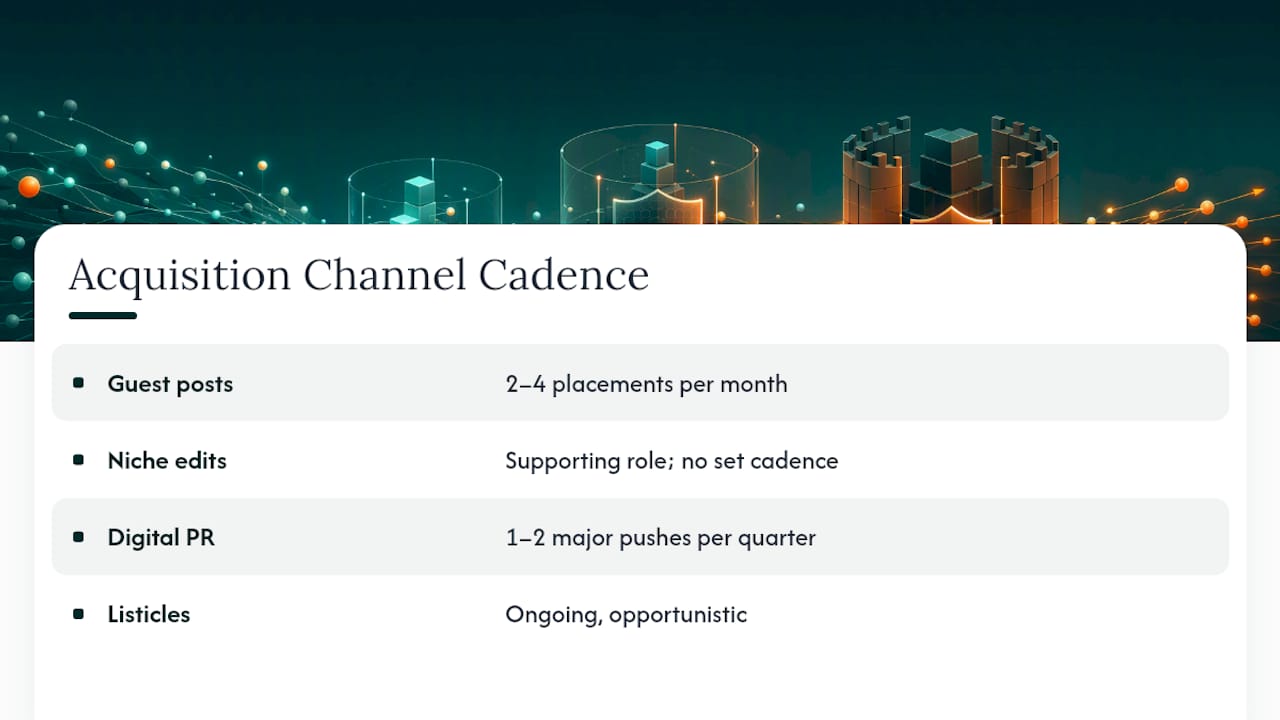
Guest posting. Mechanics: pitch a unique angle to a site your buyer already reads, write to their standards, and negotiate one contextual link. Pros: strong topical relevance and often referral traffic. Cons: slow, and quality sites reject most pitches. Vetting checklist: real organic traffic (check with a free tool like Ubersuggest or Ahrefs’ free version), topical overlap with your product, and evidence of editorial standards (bylines, fact-checking, no obvious link farms). Cost and effort: low cash cost, high time cost. Cadence: two to four placements per month once your pitch process works.
Link insertions and niche edits. Mechanics: identify already-ranking content and request a link added into an existing paragraph. Pros: faster than guest posting, cheaper per link. Cons: easy to overuse, and low-quality vendors sell insertions on irrelevant or spammy sites. Vetting checklist: confirm the page still ranks for a relevant term, check the site’s own backlink profile isn’t dominated by other paid insertions, and insist on placement within genuinely relevant paragraphs. Cadence: keep this channel to a supporting role, not your primary source.
Digital PR built on original data. Mechanics: package proprietary data into a story angle, then pitch journalists and industry newsletters. Pros: this earns the highest-authority links in the entire list and often multiple placements from a single report. Cons: requires real data collection and a coordinated pitch effort, so it’s the most resource-intensive channel. Vetting checklist: make sure the underlying numbers can survive scrutiny; a shaky statistic that gets picked apart publicly does more brand damage than the links are worth. Cadence: one to two major pushes per quarter.
Product listicle placements. Mechanics: find “best [category] tools” roundups where competitors appear and pitch your differentiator directly to the author. Pros: dual benefit of a link and qualified referral traffic. Cons: some roundups charge for inclusion, which strays into gray-hat territory and deserves case-by-case judgment. Vetting checklist: real traffic, genuine editorial independence, and content that gets updated (a roundup last touched in 2022 isn’t worth the effort). Cadence: ongoing, opportunistic.
Partner and integration links. Mechanics: confirm your integration is listed on the partner’s directory or marketplace, request a dedicated page if one doesn’t exist, and check the partner’s own privacy and listing policies before assuming the link is permanent, since platform rules around how integrations display metadata can shift. Pros: highly relevant, durable, and effectively free once the partnership exists. Cons: limited to however many real integrations you actually maintain. Cadence: review quarterly as new integrations ship.
Developer content. Mechanics: maintain public API docs, contribute to relevant open-source projects, and answer technical questions where your product is genuinely the right answer. Pros: earns links passively from developer communities that are hard for competitors to replicate on short notice. Cons: needs consistent engineering buy-in, which marketing can’t manufacture alone. Cadence: ongoing, tied to product releases rather than a marketing calendar.
Pro Tip: When vetting any paid placement or marketplace vendor, ask for the exact URL of three recent client placements before you pay. If they hesitate or send screenshots instead of live links, walk away.
Across every channel, safe velocity matters more than speed. A newer domain that jumps from five referring domains a month to fifty invites scrutiny it can’t yet support. Scale gradually, and weight your effort toward the channels that match your actual assets rather than chasing whatever tactic is trending in a newsletter.
How Do You Route Link Equity Internally Without Overdoing It?
Earning a great backlink to a data report does nothing for revenue if that page never links onward. Internal linking is the mechanism that moves authority from where it lands to where it converts.
- Inside every Tier 3 asset (your research report, your free tool), place one to two contextual links to a relevant Tier 2 comparison page within the first 300 words, where crawlers and readers both pay the most attention.
- From that Tier 2 page, link directly to the matching Tier 1 product or pricing page using descriptive anchor text tied to the benefit, not the brand name repeated verbatim.
- Vary anchor text across every instance. If ten different pages all link to your pricing page using the exact phrase “SaaS pricing plans,” that pattern reads as manipulative to both readers and Google’s spam systems.
- Audit anchor diversity quarterly with a simple spreadsheet: pull every internal link pointing to each money page, and if any single anchor phrase exceeds roughly 30% of the total, rewrite some of them.
- Test naturalness by reading the linking sentence aloud. If it sounds like something a human editor would cut, it probably should be rewritten before publishing.
A workable micro-template: “If you’re comparing options, our breakdown of SaaS SEO strategy covers how this fits into a broader growth plan.” That sentence does real work for the reader while quietly passing authority to a commercial-adjacent page.
What KPIs Actually Prove Link Building Is Working?
Referring domains matter, but only when you filter for quality. A single relevant editorial link from an authoritative, topically aligned site typically outperforms dozens of low-quality links, so track new referring domains alongside a manual quality flag, not just the raw count.
- Referring domains (quality-filtered). Count new domains monthly, but exclude directories and low-relevance sites from your “quality” tally.
- Assisted pipeline and assisted conversions. Use multi-touch attribution in your CRM or analytics tool to see which linked pages appear in the path before a trial signup, not just the last click.
- Organic sessions to money pages specifically. Blog traffic climbing while pricing page traffic stays flat is a warning sign that your internal linking isn’t doing its job.
- Indexation verification. Confirm new linking pages and your own linked-to pages are actually indexed using Google Search Console, since a link on an unindexed page passes nothing.
- AI citation and brand mention tracking. A placement increasingly functions as both a traditional backlink and an AI citation signal, so monitor whether AI answer engines reference your brand or data.
Report monthly for the first two quarters, then shift to a quarterly cadence once your baseline stabilizes. A newer site should expect modest, steady referring-domain growth in the first two quarters, with assisted pipeline becoming visible by month four to six once enough placements have had time to get indexed, crawled, and followed.
What Does a 12-Month SaaS Link Building Roadmap Look Like?
Velocity guardrails matter as much as the tactics themselves, since link velocity needs to match site maturity or the pattern itself becomes a red flag.
- Months 1 to 2: Audit and foundation. Claim and optimize directory listings, audit existing backlinks for toxic or irrelevant links, and confirm your Tier 1 through Tier 4 page map is actually built out.
- Months 3 to 4: Quick wins. Push integration partner pages live, submit to relevant directories, and launch your first one or two guest post pitches to build outreach muscle.
- Months 5 to 7: Scale outreach. Ramp guest posting and link insertions to a steady monthly cadence, and begin data collection for your first digital PR push.
- Months 8 to 9: PR push. Launch the original research report, coordinate journalist outreach, and pitch listicle inclusions using the data as a differentiator.
- Months 10 to 12: Monitor and iterate. Review which channels produced the highest-quality referring domains and assisted pipeline, then reallocate budget toward what actually worked.
Safe velocity ranges depend heavily on current domain strength. A newer or smaller SaaS site should stay conservative in early months and increase gradually rather than spiking. As for resourcing:
- A solo founder or two-person marketing team benefits most from a tool like Ranksector to keep publishing steady while outreach happens in smaller, focused bursts.
- A marketplace or vetted placement service fits teams that need speed without the bandwidth for full in-house pitching.
- An in-house senior hire makes sense once monthly link volume and revenue justify a dedicated headcount.
- An agency retainer suits teams that want the entire program managed but have the budget to match.
What Proof Points Support This Approach?
Ranksector was built around the same authority-routing model this article describes: automated, daily publishing for B2B SaaS teams, paired with a backlink exchange system that helps smaller sites build referring domains without a dedicated outreach hire. The platform has published over 11,000 articles across customer sites, giving it a working dataset on which content formats and internal linking patterns actually move domain authority for small teams.
The broader framework holds up against independent industry guidance. Multiple playbooks converge on the same core principles: build to linkable assets first, organize links into a coordinated tiered structure, prioritize guest posts, insertions, PR, and listicles as primary channels, and measure by quality over quantity.
The consistent thread across current SaaS link-building guidance is that authority has to be routed, not just accumulated. A pile of unconnected backlinks does less for trial signups than a smaller number of links that flow deliberately into pricing and product pages.
None of this replaces measurement. Automation accelerates publishing cadence and link exchange volume, but whether a given placement actually moves trials depends on tracking assisted pipeline and referring-domain quality over several months, not assuming the tactic worked because a link went live.
What I’d Prioritize if I Were Running This Program Myself
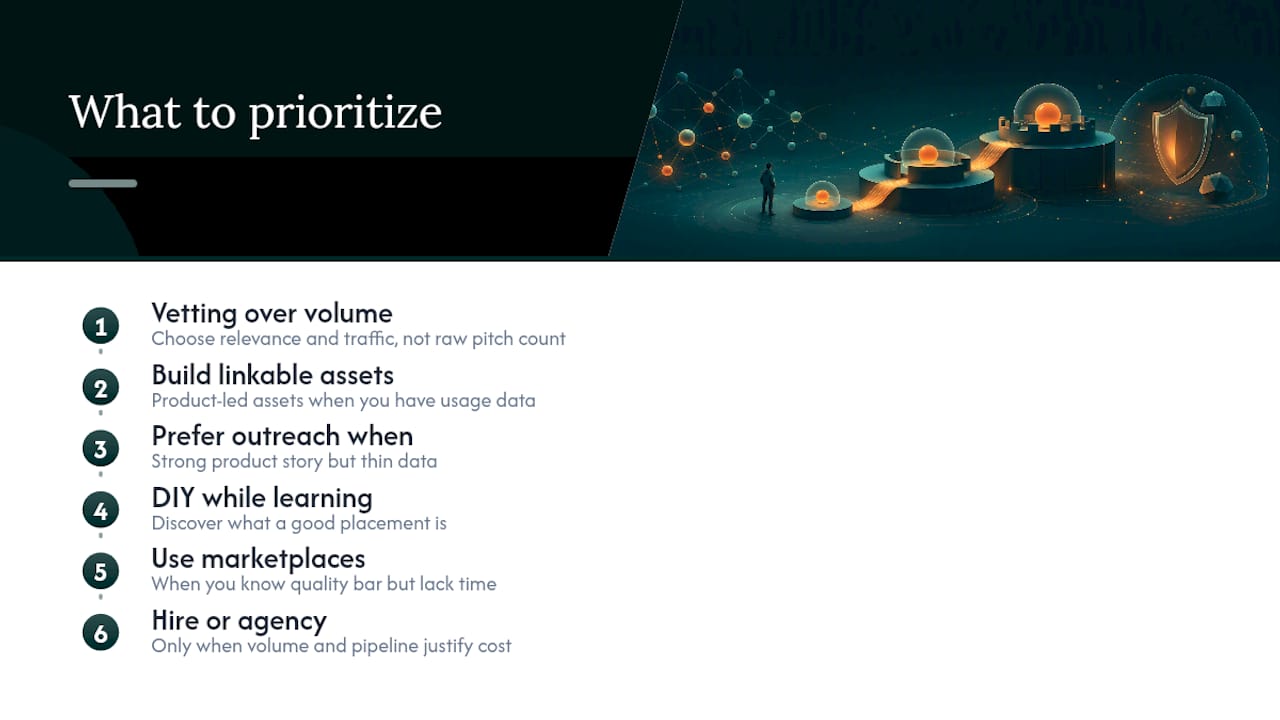
Most SaaS teams overinvest in outreach volume and underinvest in the assets worth linking to. A guest post on a mediocre site takes the same effort as one on a genuinely relevant, high-traffic site, so the vetting checklist matters more than the raw pitch count. Product-led assets win when you already have real usage data or a working feature you can spin into a free tool. Outreach wins when your product story is strong but your data is thin.
Use the DIY route while you’re still learning what a good placement looks like. Move to a marketplace once you know your quality bar but lack the hours. Hire in-house or bring in an agency only once link volume and pipeline numbers justify the cost. And be wary of any vendor promising a fixed number of links per month at a flat rate regardless of niche. That pricing model usually means volume over relevance, and one bad neighborhood of links can do more damage than a slow quarter of real ones ever would.
— Savannah
How Ranksector Fits Into Your Link Building Program
This platform provides linkable assets and publishing cadence that this playbook depends on without adding headcount. The platform handles daily, SEO-optimized article production, competitor-driven keyword research, and a contextual backlink exchange network designed to help smaller SaaS teams grow referring domains without running outreach full time.

For a team executing the roadmap above, that means Tier 3 and Tier 4 content (the cluster posts and pillar guides that feed your money pages) can publish on a steady schedule while you focus limited hours on digital PR and partner outreach. The backlink exchange system gives you a practical starting channel for referring domains during the quick-wins phase, and the built-in analytics dashboard connects to Google Search Console so you can verify indexation and traffic without stitching together separate tools. If you want to see whether your current site is ready for a scaled link program, start with a free SEO and AI visibility audit to spot indexation or technical gaps before you invest outreach budget. From there, most teams evaluate fit through the agency-focused plan built for managed, hands-free publishing workflows.
Sources
- SaaS link building: the complete playbook | Link Inbound
- SaaS link building: the strategy that wins - GrowthBacklinks
- SaaS Link Building Playbook: The Complete Guide 2026 | BacklinkGrid
- SaaS Link Building: The Complete 2026 Guide · Saaslinks