
Copy Ready Editorial Guidelines for AI Content for B2B SaaS Teams
Every AI-assisted SEO article needs an accountable human author, a substantive editor, and a documented source log before it goes live. That’s the whole policy in one sentence. The goal isn’t to slow down publishing. It’s to keep AI-assisted content inside Google’s E-E-A-T standards and away from the spam enforcement that hits sites publishing at scale with no meaningful human contribution.
TL;DR:
- Maintaining an accountable human review process with clear sign-off is essential before publishing any AI-assisted content to meet Google’s E-E-A-T standards.
- Content must include a detailed source log with claim details, primary sources, verification dates, and verifier identity stored as CMS metadata to ensure auditability.
- Specific, SEO-focused prompts that incorporate target keywords, search intent, audience details, and structured questions improve the quality and accuracy of AI drafts.
- Fact-checking requires primary source verification for every claim, with unverifiable information removed or clearly attributed to opinion.
- An effective AI content governance policy should define allowed and prohibited uses, include disclosure requirements for high-stakes topics, and establish quarterly review cycles.
Table of Contents
- What Are the Core Editorial Guidelines for AI Content?
- What Is the Human-in-the-Loop Workflow for AI Content?
- How Should You Write SEO Prompts for AI Content?
- How Do You Fact-Check AI-Generated Content?
- What Should an AI Content Governance Policy Include?
- How Do You Measure Whether AI Content Is Ready to Publish?
- How Does Ranksector Put These Editorial Guidelines Into Practice?
- An Editor’s Honest Take on AI Content Governance
- A Hands-Off Way to Run This Editorial System Daily
- Where to Go Deeper on AI Content Governance
- Sources
- FAQ
What Are the Core Editorial Guidelines for AI Content?
Google doesn’t penalize content for being written with AI help. It penalizes content that exists to manipulate rankings rather than help a reader, and scaled, unedited AI output is the fastest way to trip that wire. That’s the real baseline behind any set of editorial guidelines for AI content: quality and demonstrated expertise, not the tool that drafted the sentence.
E-E-A-T (Experience, Expertise, Authoritativeness, Trustworthiness) still sets the bar. Experience means the piece reflects something a real person would notice. Expertise means claims hold up under scrutiny. Authoritativeness means the byline and the brand behind it have a track record. Trustworthiness means sources are checked and disclosed.
Every article needs three human roles filled, even at a two-person startup:
- Author of record, accountable for the piece’s claims
- Substantive editor, who checks structure, voice, and logic, not just typos
- Final approver, who signs off before publish
Skip any of these and you’re publishing at scale with no human contribution. That’s the exact pattern Google’s guidance flags as a spam violation.
Pro Tip: Run an accessibility pass on every AI-generated image and chart before publish. Alt text, color contrast, and file size get missed constantly when content moves this fast.
What Is the Human-in-the-Loop Workflow for AI Content?
A rankable AI-assisted article follows a fixed sequence, not an improvised one. Semrush’s recommended process moves from AI-assisted research to a human-approved final draft, and skipping a stage is where quality erodes fastest.
- Research — AI pulls source candidates; a human confirms relevance
- Outline — Draft H2s built around search intent, reviewed for gaps
- AI draft — Model writes to the approved outline and brief
- Human edit — Editor rewrites for voice, cuts filler, checks logic
- Fact-check — Every claim gets a linked primary source
- QA sign-off — Final approver checks the source log and metadata
- Publish — Article goes live, ideally staged before full indexation
Two gates decide whether a draft ever gets indexed: a completed source log and a signed QA checklist. No sign-off, no crawl access.
Your per-article source log needs five fields, logged before publish:
- Claim — the exact statement being made
- Primary source URL — the page that supports it
- Date accessed — when the verifier checked it
- Verifier — who confirmed it
- Note — context, caveats, or confidence level
Build this as CMS metadata, not a separate spreadsheet nobody opens. A reasonable SLA is 48 hours from AI draft to human sign-off, with sign-off fields (editor name, fact-check date, QA status) stored directly on the article record. If your CMS can’t hold that metadata natively, a linked internal doc works as a fallback.
How Should You Write SEO Prompts for AI Content?
Vague prompts produce vague drafts. “Write a blog post about invoice automation” gives the model nothing to structure against, and you’ll spend more time fixing it than you would writing a real brief. Search Engine Land’s guidance is specific: bake SEO intent directly into the prompt instead of hoping the model guesses it.
A usable prompt template includes:
- Target keyword and its closest natural variants
- Search intent (informational, comparison, transactional)
- Audience description, specific enough to set vocabulary and depth
- H2 outline, written in question format where it fits naturally
- Entities to reference (tools, standards, named sources)
- Internal links to weave in contextually
- External sources the model should draw from or verify against
- Schema instructions (FAQ schema, article schema, whatever the CMS supports)
Structure matters as much as content. Ask for a 50-to-80-word direct-answer block up top, question-format H2s, and first sentences that answer the question rather than build up to it. That structure is also what improves AI-overview citation odds, since extraction favors direct answers over buildup.
Pro Tip: Add one line to every prompt: “Flag any claim you’re not confident is accurate.” It won’t catch everything, but it surfaces the weak spots before your fact-checker has to find them manually.
How Do You Fact-Check AI-Generated Content?
Every factual claim needs a primary source, not a summary of one. If a model cites a statistic, trace it back to the original study or dataset, not the blog post that mentioned it. If you can’t find a primary source, the claim gets cut or rewritten as clearly labeled opinion.
A few non-negotiables for the verification step:
- Never accept a claim on the model’s confidence alone. Confidence and accuracy aren’t correlated.
- Use a second model as a discrepancy checker, comparing draft claims against source text. It flags mismatches; it doesn’t get final say.
- Anything unverifiable gets removed or reframed with attribution (“industry observers suggest” instead of a bare stat).
- Store the completed source log where the accountable editor and any future auditor can both reach it, whether that’s CMS metadata or a linked internal record.
This is also where understanding what makes content citable to AI search tools pays off. Extractable, well-sourced content earns citations; unsourced claims just get ignored or, worse, flagged.
What Should an AI Content Governance Policy Include?
A governance document doesn’t need to be long. It needs to draw a clear line between what AI is allowed to do and what requires human judgment, and it needs an owner whose job it is to enforce that line. NisonCo’s policy template is a solid starting structure to adapt.
- Allowed uses: research assistance, first-draft generation, outline building, headline variants
- Prohibited uses: publishing unedited AI drafts, fabricating quotes or statistics, scaling output with no review capacity to match
- Disclosure: state AI involvement when the content is instructional, medical, financial, or otherwise high-stakes; skip it for routine blog support where human editing is substantial
- Review cadence: quarterly, with one named policy owner accountable for updates
- Data handling: no client data or proprietary information pasted into public AI tools
| Governance Item | Minimum Standard |
|---|---|
| Allowed AI use | Research, drafting, outline support |
| Prohibited AI use | Unedited scaled publishing, fabricated sourcing |
| Disclosure trigger | High-stakes topics (medical, financial, legal) |
| Review cadence | Quarterly, named owner |
How Do You Measure Whether AI Content Is Ready to Publish?
Rankings lag by weeks. Engagement doesn’t. Track scroll depth, time on page, and click-through rate from search as early signals, alongside whether the piece earns conversions once traffic arrives.
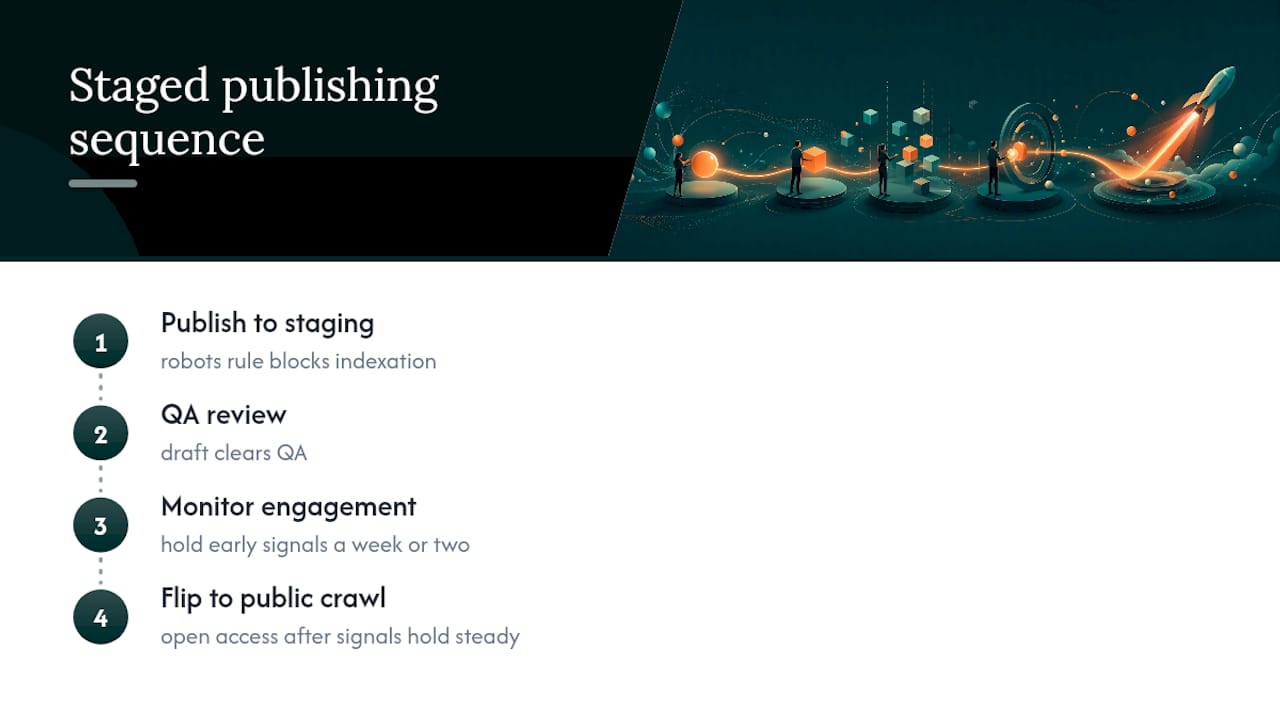
Indexation should be gated, not automatic. Publish new AI-assisted drafts to a staging directory with a noindex robots rule first, then flip to public crawl access only after the draft clears QA and shows early engagement signals holding steady for a week or two.
Adjust these to your own baseline rather than treating them as universal.
One underused leading indicator: whether your content gets cited in AI-generated answers at all. Direct-answer structure and question-format headings correlate with more citations, and citation frequency tends to move before rankings do.
How Does Ranksector Put These Editorial Guidelines Into Practice?
Ranksector has published more than 11,000 SEO-optimized articles for B2B SaaS companies, which means these editorial gates have run at real production volume, not just on paper. The platform pairs competitor-driven keyword research with a backlink exchange system, so domain authority growth and editorial discipline move together instead of competing for resources.
For small teams without a dedicated editorial staff, the practical challenge isn’t writing one good article. It’s holding the same standard on article 500. Ranksector’s daily publishing model is built around that constraint: hands-free execution with the QA structure baked into the pipeline rather than bolted on afterward. Author attribution and case-study data get stored consistently across every published piece, which is what makes an audit possible six months later instead of just a promise.
An Editor’s Honest Take on AI Content Governance
Most guidance on this topic treats governance as a compliance exercise, something you write once and file away. That’s backwards. The teams getting real value from AI-assisted publishing treat the source log and QA gate as product features of their content operation, not paperwork.
Here’s what the conventional advice underweights: disclosure gets far more attention than it deserves, while the human sign-off gate gets far less. Whether you tell readers AI helped draft a piece matters much less than whether a real editor actually caught the errors before publish. Google’s own guidance backs this. It cares about manipulation at scale, not the tool used to write a first draft.
If you’re building this from scratch, prioritize in this order: get the source log working before you scale volume, get a named human accountable before you add more writers, and only then worry about prompt sophistication. Teams do this backwards constantly. They perfect the prompt and skip the log, then wonder why a competitor’s AI-detection callout or a Google update catches them flat.
— Savannah
A Hands-Off Way to Run This Editorial System Daily
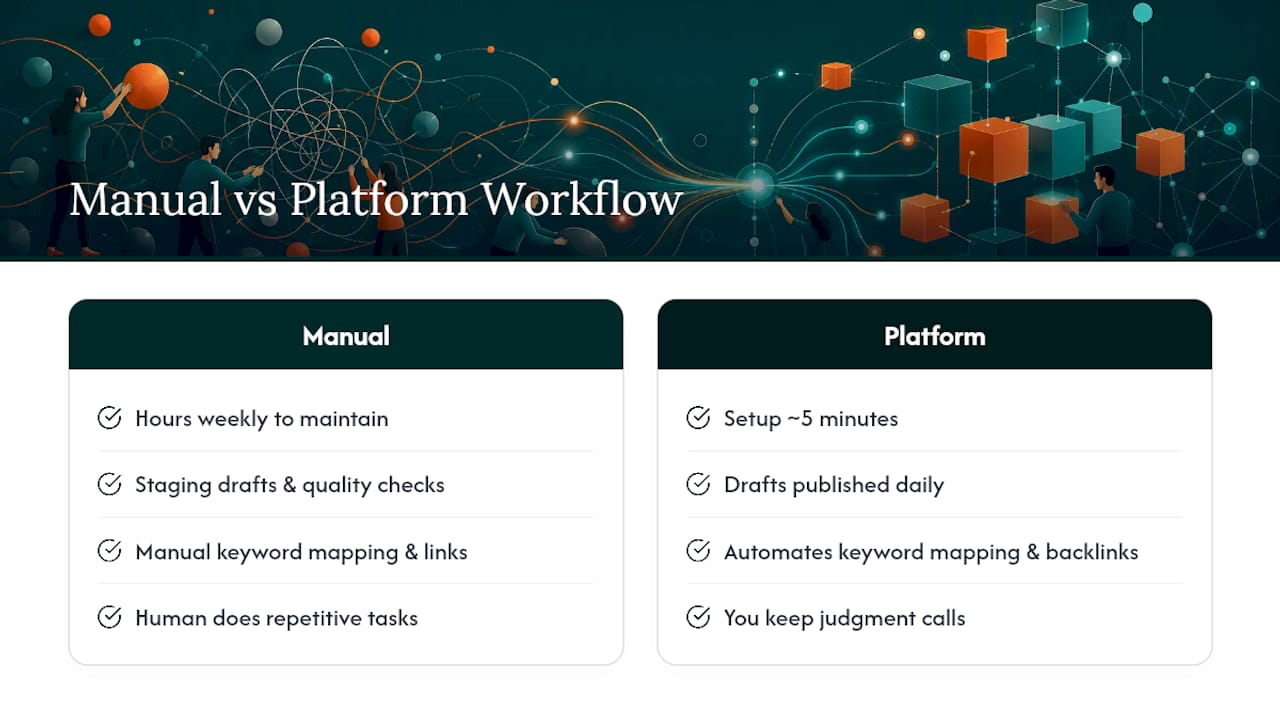
Everything above works. It also takes real hours: building prompt templates, maintaining a source log, staging drafts, checking engagement thresholds before flipping indexation. For a solo founder or a three-person marketing team, that’s often the part that quietly stops happening after the third week.

This platform runs this exact structure as the product, not as a side process someone has to remember. Daily articles are drafted against SEO-ready briefs, tied to competitor-driven keyword research, and published through a workflow built to keep quality gates in place at scale. You still bring the judgment calls. The service handles the repetitive infrastructure that usually breaks first: keyword mapping, formatting, internal linking, and the backlink exchange that helps build domain authority in the background.
Setup runs about five minutes, with direct integration into major CMS platforms. It fits best for teams that want daily output without hiring a content staff to babysit the process. If you want a clearer picture of where your current content stands before adding more, start with a GEO Audit. If you’re ready to put the workflow to work, the Pro plan runs $99 per month.
Where to Go Deeper on AI Content Governance
For primary guidance, start with Google’s own statement on AI content, then layer in practical frameworks from Search Engine Land and Semrush. For a governance template you can adapt directly, NisonCo’s policy framework covers allowed uses, disclosure, and review cadence in one document. For structural best practices on AI extraction, see this AEO guidance.
Sources
- Google Search’s guidance about AI-generated content | Google Search Central Blog | Google for Developers
- AI-generated content: Benefits, risks & SEO best practices | Search Engine Land
- AI-Generated Content: Can It Rank? (+ Expert SEO Tips) | Semrush
- AI Usage Policy Template for Content Teams | 2026
FAQ
What Are Editorial Guidelines for AI Content?
Editorial guidelines for AI content are the internal rules a team follows to produce, verify, and publish AI-assisted articles safely. They cover human sign-off, source documentation, prompt structure, and the indexation gates that keep content compliant with Google’s spam policies.
Does Google Penalize AI-Generated Content?
Google doesn’t penalize content simply for being AI-assisted. It penalizes content published at scale to manipulate rankings with no meaningful human contribution, which is a spam policy violation regardless of the tool used to draft it.
What Should a Source Log Include?
A source log should track the claim being made, the primary source URL, the date it was accessed, who verified it, and any relevant notes on confidence or context. Keeping this as CMS metadata makes the article auditable long after publish.
How Much Does Ranksector Cost?
Ranksector’s Pro plan runs $99 per month and includes daily article publishing, competitor-driven keyword research, and the backlink exchange system. A GEO Audit is also available for teams that want to assess their current content footprint first.
Should AI-Assisted Content Be Disclosed to Readers?
Disclosure matters most on high-stakes topics like medical, financial, or legal content, where readers benefit from knowing how a piece was produced. For routine blog content with substantial human editing, disclosure is optional but the human review standard still applies.