
How to Scale Content With AI Without Losing Quality
AI scales content reliably only when you pair it with process, governance, and orchestration. Generation speed alone doesn’t get you there. Adobe’s research points to a three-stage maturity model: build a durable foundation, close gaps in unmet demand, then layer in real-time personalization at the edge, with ROI compounding as organizations progress through each stage.
Ranksector runs this model operationally, publishing daily articles across thousands of client sites by combining automated drafting with structured quality gates rather than raw output volume. Canva’s own workflow data backs the productivity case: teams applying AI across ideation, drafting, and optimization save roughly 2.5 hours per day and about three hours per asset.
Here’s the practical takeaway before you build anything:
- Start with one narrow use case, not a company-wide rollout.
- Define what success looks like in numbers before you generate a single draft.
- Add a quality gate before you widen scope, not after.
Key Takeaways
AI scales content reliably only when generation is paired with governance, staged rollout, and a measurement loop that ties output to real business metrics.
| Point | Details |
|---|---|
| Pilot before you scale | Run 10 to 20 assets for four to six weeks before expanding scope company-wide. |
| Write your voice spec first | A documented skill file prevents brand-voice drift more than any editing tool does. |
| Decouple generation from publishing | Route drafts through a scored queue file so nothing publishes below your quality threshold. |
| Track outcomes, not volume | Measure organic sessions, rankings, and conversion lift, not the number of articles published. |
| Consider an operational example | Ranksector runs this staged model at production scale, publishing daily audience-tailored articles with built-in keyword research and quality controls. |
Table of Contents
- Why Does ‘More AI’ Usually Fail to Scale Content?
- A 7-Step Playbook to Scale Content With AI
- Who Needs to Own What When You Scale Content Production?
- What Tools Do You Need to Orchestrate Content at Scale?
- What Quality Checks Should Block Publishing?
- Which Metrics Prove Your AI Content Strategy Is Working?
- How Do You Repurpose and Personalize Content Without Extra Headcount?
- How Does Ranksector Apply This Playbook in Practice?
- Who Owns the Copyright on AI-Generated Content?
- Start Small, Then Prove It Before You Scale
- Ready to Put This Playbook to Work Without Building It Yourself
- Frequently Asked Questions
- Sources
Why Does ‘More AI’ Usually Fail to Scale Content?
Teams equate more output with more scale, and that assumption breaks pilots faster than anything else. Volume without structure just produces more content to fix, not more content that performs.
The failure modes repeat across nearly every stalled AI content project. Brand voice drifts because nobody wrote down what “on voice” actually means in specific, checkable terms. Governance is missing, so nobody knows which model version produced which article or why it got approved. Generation and publishing stay tightly coupled, meaning a bad draft goes live the moment it’s created instead of sitting in a review queue. And measurement never gets set up, so nobody can tell if the AI-generated batch actually moved rankings or just added noise to the site.
Concrete mistakes show up constantly: teams generate dozens of articles without checking for topic overlap, publish without an editorial rubric, and keep no audit trail of what was approved and by whom. Forbes’ guidance on scaling content is blunt about the fix: use AI for research and first drafts, then let human editors amplify the thinking rather than treating the draft as finished work.
Kompozy and similar “one idea feeds many outputs” platforms market exactly this convenience, and the pitch has real appeal for lean teams. But even those vendors build in review queues, because unreviewed autopilot output at volume is how sites end up flagged for thin or duplicate content. The lesson holds regardless of which tool sits behind the curtain: scale amplifies whatever process you already have. A weak process scaled by AI just produces more weak content, faster.
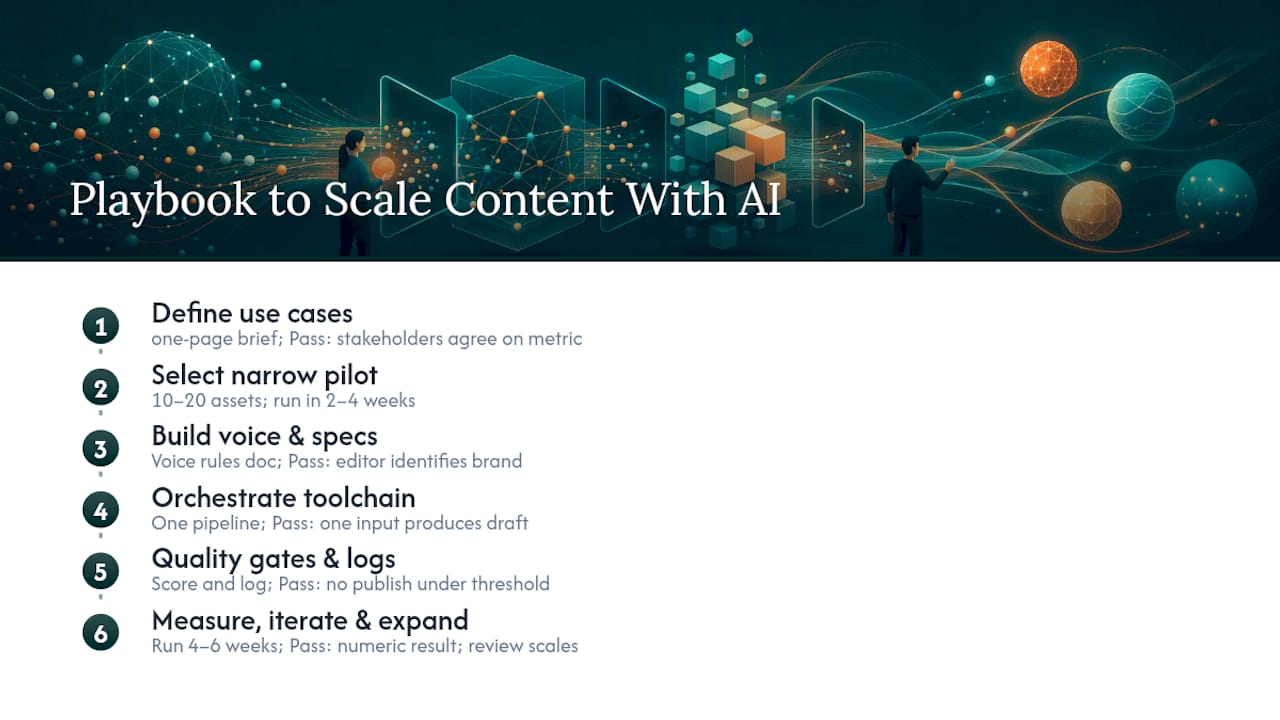
A 7-Step Playbook to Scale Content With AI
This is the sequence that separates teams who scale content successfully from teams who generate a pile of drafts nobody trusts. Each step has a concrete deliverable and a pass/fail bar, not a vague aspiration.
1. Define use cases and success metrics. Pick one content type (blog posts, product descriptions, help docs) and one measurable outcome (organic sessions, time-to-publish, editor hours saved). Minimum viable output: a one-page brief naming the format, the audience, and the target number. Pass bar: every stakeholder agrees on the same metric before the generation starts.
2. Select a narrow pilot. Choose 10 to 20 articles or assets, not 200. A pilot that’s too broad hides which variable actually caused the result. Pass bar: the pilot can run start to finish in two to four weeks with the team you already have.
3. Build voice and skill specs. Write down brand voice rules, formatting standards, and prohibited phrases in a document the AI tool can reference on every generation pass. This is the single most skipped step, and it’s the reason voice drift happens. Pass bar: an editor unfamiliar with the brand can read three AI drafts and correctly guess which brand they belong to.
4. Orchestrate the toolchain. Connect your research tool, drafting model, style editor, and publishing layer into one pipeline rather than juggling five browser tabs. Pass bar: a single input (a keyword or brief) produces a draft without manual copy-pasting between tools.
5. Add quality gates and audit logs. Score every asset against a rubric before it’s eligible for publishing, and log which model version, prompt, and reviewer touched it. An effective pipeline decouples generation from publishing entirely, writing outputs to a queue file and requiring a minimum score before anything goes live. Pass bar: no asset publishes without a logged score above your threshold.
6. Measure and iterate. Run the pilot batch for four to six weeks and compare it against your baseline metric. Pass bar: you can point to a specific number, not a feeling, that tells you whether to expand.
7. Expand with governance intact. Widen scope only after the pilot passes its bar, and carry every gate from step 5 forward at the new volume. Pass bar: your review capacity scales alongside your output volume, not behind it.
Realistic timelines: expect two to four weeks for pilot setup, four to six weeks to gather enough data to judge results, and two to three months before a full-scale rollout makes sense. Budget concentrates in three places: engineering time to wire the pipeline together, tooling subscriptions for drafting and optimization software, and editorial hours for review, which typically don’t shrink as much as teams expect even after automation matures.
Pro Tip: Decouple generation from publishing using a simple queue file pattern. Generate to a staging file, score it, and only push to your CMS after it clears the bar. This one architectural choice prevents most of the “AI published something embarrassing” incidents teams worry about.
If you’re integrating with an existing CMS, avoid building a direct pipe from your AI tool straight into your publishing platform. Route everything through a staging layer first, whether that’s a spreadsheet, a headless CMS draft state, or a dedicated queue file, so a human or an automated score check sits between generation and going live.
Who Needs to Own What When You Scale Content Production?
Scaling content with AI is a staffing problem before it’s a tooling problem. Skip the role mapping and you’ll end up with either bottlenecked review or unreviewed publishing, both of which sink pilots.
| Role | Core responsibility | Time commitment (pilot) | Time commitment (steady state) |
|---|---|---|---|
| Pipeline owner / project manager | Owns the workflow end to end, tracks metrics, approves scope changes | moderate weekly hours | fewer hours per week in steady state |
| Editor(s) | Reviews drafts against the rubric, catches voice drift and factual errors | significant weekly hours | somewhat reduced hours per week in steady state |
| Subject-matter expert | Validates technical accuracy on specialized topics | 2-4 hrs/week | 1-3 hrs/week |
| Data or ops engineer | Maintains the pipeline, integrations, and queue logic | 6-10 hrs/week | 2-4 hrs/week |
| Legal/compliance reviewer | Flags IP, claims, and regulatory risk where relevant | As needed | As needed |
Governance needs four specific artifacts, not a vague policy statement: a written editorial rubric with a numeric pass threshold, a model and version tracker so you know exactly what generated each asset, an approval gate that blocks publishing without sign-off, and a deduplication policy that checks new drafts against existing content before they go live.
Pro Tip: Staff the editor role first, before you scale generation volume. A team of one editor and a strong pipeline outperforms five writers and no review process, every time. Ranksector’s own workflow reflects this: automation handles drafting and formatting, but the scaling production strategies that actually move rankings depend on the governance layered on top.
What Tools Do You Need to Orchestrate Content at Scale?
No single tool scales content by itself. The teams that get this right treat AI tools as specialized instruments in a pipeline, not one all-purpose machine.
You need six categories working together. Ideation and research tools surface topics and gaps competitors haven’t covered. Long-form drafting tools like OpenAI’s GPT models or Anthropic’s Claude generate the initial structure and copy. Style and SEO editors, Grammarly among them, catch tone drift and readability issues before a human ever opens the draft. Creative asset tools such as Canva handle the images and graphics that accompany the text. Quality gates and scorecards rank each output against your rubric. Workflow automation platforms like n8n, Make, or Zapier connect these pieces so drafts move between stages without manual handoffs, and a publishing layer pushes approved content into your CMS.
Each category has non-negotiable features to check before you commit: API access so the tool fits your pipeline instead of requiring manual copy-paste, some form of model version tracking, template support for repeatable formats, webhook support for automation triggers, and an audit log you can actually query later. Canva’s guidance on AI content workflows makes the same point from the creative side: specialized tools work best paired together, ideation assistants for topics, generative models for drafts, optimization tools for polish, rather than any single tool trying to do everything.
The orchestration pattern that works in practice: generate to a queue file, not directly to your CMS. Score every asset against your rubric before it’s eligible to publish. Centralize your logs in one place so you can trace any published piece back to its model version, prompt, and reviewer. Open-source pipeline examples demonstrate this architecture concretely, pairing an LLM for generation with automation middleware and a separate scheduling layer, which keeps a single point of failure from taking your whole publishing calendar down.
Pro Tip: Don’t buy tools by category in isolation. Map your full workflow first, from keyword to published page, then fill each stage with the tool that fits. Buying a drafting tool before you’ve defined your quality gate is how teams end up with a fast way to generate content nobody trusts enough to publish.
What Quality Checks Should Block Publishing?
Every AI-generated asset needs to clear four gates before it touches your CMS: factual verification, originality checks, voice and style review, and SEO safety.
- Factual verification: cross-check claims, statistics, and named entities against a reliable source before publishing anything.
- Originality and overlap checks: run new drafts against your existing content library to catch duplication or over-similar topic coverage.
- Voice and style gates: score drafts against your written skill file, not a reviewer’s gut feeling.
- SEO safety checks: confirm keyword placement is natural, internal linking follows your semantic SEO structure, and headings match search intent.
Every asset needs an immutable record of why it passed or failed, including the model version, the reviewer’s name, and the score it received. This isn’t bureaucracy for its own sake. It’s how you diagnose a quality slip six weeks later instead of guessing.
Three signals should block publishing outright: hallucinated facts (claims with no verifiable source), high topic overlap with existing pages on your site, and brand-voice drift severe enough that a reader would question authorship. Each needs a fast escalation path. Route hallucinated facts back to the drafting stage with the source flagged. Route overlap issues to your content calendar for consolidation instead of publishing a near-duplicate. Route voice drift back to your skill file for revision, because repeated drift usually means the spec itself is unclear, not that the model failed. Ranksector’s own guidance on spotting AI content Google may penalize walks through these red flags in more depth.
Pro Tip: Keep your rejection reasons in a simple log, even a spreadsheet works. Patterns in why content fails tell you more about where to fix your pipeline than patterns in why it passes.
Which Metrics Prove Your AI Content Strategy Is Working?
Track outcomes, not output. A team publishing 50 articles a month that rank nowhere has scaled nothing worth having.
Six KPIs matter most: organic sessions to the published content, keyword rankings for your target clusters, time-to-publish from brief to live page, editor hours saved versus your pre-AI baseline, conversion lift on AI-assisted pages, and assisted conversions that show content’s role in a longer buying journey.
Run every meaningful change as a test before scaling it. A champion-challenger pattern works well here: publish your current approach alongside an AI-assisted variant, then compare performance after a fixed window rather than trusting first impressions.
The optimization loop runs in four steps:
- Collect performance signals across published assets on a fixed cadence.
- Score each asset against your KPIs, not just traffic volume.
- Retire underperforming variants and scale the ones that clear your bar.
- Feed what you learned back into your skill files and prompts, so the next batch starts smarter than the last.
Adobe’s staged-scaling research backs this loop directly: organizations that treat scaling as a compounding, staged process capture materially more ROI than teams that scale output volume all at once and hope the numbers work out.
How Do You Repurpose and Personalize Content Without Extra Headcount?
One well-researched piece of long-form content can become five social clips, an email snippet, and an FAQ block, all without a second research cycle. That’s the leverage repurposing gives you, and it’s the fastest way to multiply reach without multiplying your workload.

Automate variant generation with control tokens that specify tone, length, and platform for each output type. A LinkedIn clip needs different pacing than an email snippet, even when they’re pulled from the same source article. Set quality thresholds per variant type, since a social clip tolerates a looser structure than a page built for search intent.
Personalization is a different lever entirely, and it’s easy to over-apply. Use 1:1 dynamic generation only for high-value trigger moments, a returning customer viewing a specific product page, for example. For everything else, segment-level variants (by industry, by role, by funnel stage) deliver most of the relevance benefit at a fraction of the governance overhead. Every personalized variant still needs to clear the same quality gates as your primary content; personalization is not an exemption from review.
Practical repurposing frameworks for turning one long-form asset into multiple channel-specific formats are worth studying if you’re building this lane for the first time.
Pro Tip: Repurpose before you personalize. Get your one-to-many pipeline solid first; personalization at the edge is the third stage of the maturity curve, not the first place to invest your engineering hours.
How Does Ranksector Apply This Playbook in Practice?
Ranksector is the publisher of this article, and its own operation is a working example of the playbook above, not a hypothetical.
The platform has published over 11,000 articles across client sites, each generated for a specific target audience rather than as generic filler. That volume only works because of governance layered underneath it: keyword research grounded in competitor analysis (step 1, defining use cases), daily publishing cadence tuned per client (step 2 through step 4, orchestration at scale), and a contextual backlink exchange system designed to build domain authority over time rather than through a single burst of content.
Mapped against the seven-step playbook: Ranksector starts new clients with a narrow scope, defined keyword clusters, before expanding coverage. Voice and formatting specs are built into the generation process so output matches each client’s audience. Publishing integrates directly with major CMS platforms, and an analytics dashboard tied to Google Search Console closes the measurement loop described in step 6.
This is a disclosed operational example from Ranksector’s own platform, offered because it’s a real, evaluable case, not because it’s the only way to run this playbook. Teams building their own pipeline can still adapt the same staged structure with different tools.
Who Owns the Copyright on AI-Generated Content?
Copyright law in the United States currently requires meaningful human authorship for a work to qualify for protection, which means purely AI-generated text sits in a gray zone if no human materially shaped it. The safer practice for marketing teams: treat AI output as a first draft that a human editor substantively revises, structures, and approves, since that human contribution is what supports a copyright claim on the finished piece.
Separately, watch for two distinct risks. First, some AI models can reproduce phrasing close to their training data, which creates infringement exposure if a published piece echoes another source too closely, another reason overlap and originality checks belong in your quality gate. Second, confirm your AI vendor’s terms of service regarding who owns generated output. Most major providers grant the user rights to generated content, but the exact terms vary, and enterprise agreements sometimes differ from standard consumer terms.
If your content touches regulated claims, health, finance, or legal guidance, route it through a compliance reviewer regardless of whether AI or a human drafted it. The liability for a false or misleading claim doesn’t shift based on who wrote the sentence.
Start Small, Then Prove It Before You Scale
Every failure mode covered here comes down to teams skipping the boring parts: the rubric nobody wrote, the audit log nobody kept, the pilot that got skipped in favor of going straight to full volume. None of that is exciting advice, but it’s the difference between a content operation that compounds and one that generates noise. If you’re weighing where to start, pick one use case, run it for four weeks, and measure it honestly before you touch anything else. Ranksector’s own blog publishing comparisons walk through what that first pilot can look like in practice.
Ready to Put This Playbook to Work Without Building It Yourself
Everything in this playbook, the staged rollout, the voice specs, the quality gates, the measurement loop, is exactly what Ranksector runs behind the scenes for its subscribers. Instead of hiring an engineer to wire together a queue file pipeline and a separate editor to maintain a rubric, you get daily, audience-tailored articles published directly to your CMS with keyword research and backlink building built into the same subscription.
That matters most for small teams and B2B SaaS founders who don’t have the headcount to staff a pipeline owner, an editor, and a data engineer the way the roles table above describes. Ranksector’s agency-grade automation handles the orchestration layer for you, while still giving you the governance controls (Google Search Console integration, internal linking suggestions, audit visibility) that keep output accountable rather than just voluminous. If governance is your specific concern, the AI content audit tool checks your existing setup against the same quality gates covered in this article. Start with the free tools to see how the pipeline handles a real keyword before committing to anything.
Frequently Asked Questions
How long does it take to scale content with AI? A realistic timeline runs two to four weeks for pilot setup, four to six weeks to gather enough performance data to judge results, and two to three months before a full rollout makes sense. Skipping the data-gathering window is the most common reason teams scale the wrong approach.
Can small marketing teams scale content with AI without hiring more staff? Yes, but the editor role can’t disappear even at small scale. A team of one editor supported by a well-built pipeline, or a subscription platform that bundles drafting, editing, and publishing, can produce daily content that a five-person team without process couldn’t match.
What’s the biggest mistake teams make when they try to scale content production? Treating volume as the goal instead of the byproduct. Teams that generate first and add governance later almost always end up walking back published content, while teams that build the rubric and audit log before scaling rarely hit that problem.
Do AI content tools replace human editors? No. Every credible framework for scaling content, from Adobe’s maturity model to Forbes’ editorial guidance, keeps a human reviewer in the loop for factual checks, voice consistency, and final approval. AI compresses the drafting stage; it doesn’t replace judgment.
How do I know if my AI-generated content is safe from Google penalties? Run every piece through originality checks, verify factual claims against reliable sources, and confirm the content serves a genuine search intent rather than existing purely to target a keyword. Thin or duplicate AI content at scale is what triggers penalties, not the use of AI itself.
Sources
- AI content marketing — Canva Design School resource
- How to Build an Autonomous AI Content Pipeline (2026)
- danishashko/content-pipeline-studio
Recommended
- Scaling Content Production Strategies for Marketing Teams · Ranksector Blog · Ranksector
- How to Spot AI-Generated Content Google May Penalize · Ranksector Blog — Ranksector
- Best AI Content Tools for Agencies Managing 10+ Clients in 2026 · Ranksector Blog — Ranksector
- Best AI Tools for High-Volume Blog Publishing in 2026 · Ranksector Blog — Ranksector