
5 Step AI Brand Voice Pilot for Marketing Teams
An AI brand voice is a system that generates content matching your brand’s tone, vocabulary, and style automatically. Three approaches make this work: system prompts, fine-tuning, and dedicated voice-management platforms. For most teams, the fastest path is assembling 500+ words of representative content and testing one guardrail approach on a single channel before scaling further.
TL;DR:
- Using system prompts is the fastest way to implement an AI brand voice, but it becomes fragile as content scales across multiple channels.
- Fine-tuning requires a substantial dataset and ongoing maintenance, offering higher fidelity but at a higher setup cost.
- Voice-management platforms provide centralized control across channels, making them suitable for organizations publishing more than two or three content types.
- Setting up and maintaining a consistent AI brand voice demands careful collection of assets, iterative testing, and regular human audits to prevent drift.
- Effective governance includes daily review of outputs, escalation rules for sensitive topics, and tracking metrics like edit rate and voice deviation over time.
Table of Contents
- Three Practical Approaches To Delivering An AI Brand Voice
- How Do You Set Up An AI Brand Voice?
- Applying Brand Voice Across Different Channels
- Governance And Keeping Humans In The Loop
- Common Mistakes That Break Brand Voice Consistency
- Tools And Where To Store Your Brand Assets
- AI Brand Voice: A Practical Setup and Governance Guide
- Scale Your Voice Without Losing Control Of It
- Sources
Three Practical Approaches To Delivering An AI Brand Voice
Marketing teams typically select among several approaches depending on their resources and channel needs.
System prompts and instructions are the fastest way to get started. You write a persona description, feed it into your AI tool, and it shapes every output from there. The upside is speed and near-zero cost. The downside: prompts get fragile once you scale across channels, since a tone rule that works for blog posts can break down in a support chat where empathy needs to shift with the customer’s mood.
Fine-tuning or supervised training goes deeper. You train a model on hundreds of examples of your actual brand writing, which produces higher fidelity to your voice. It costs more, needs a real dataset, and needs ongoing maintenance as your brand evolves.
Voice-management platforms sit above both. They centralize guardrails, keep audit trails of every generation, and apply consistent rules across blogs, email, social, and support simultaneously. These make the most sense once you’re publishing across more than two or three channels and need one source of truth rather than five separate prompt libraries.
- System prompts: fast, cheap, fragile at scale
- Fine-tuning: high fidelity, high setup cost
- Voice-management platforms: centralized control, best for multi-channel scale
How Do You Set Up An AI Brand Voice?
Setup is sequential. Skip a step and you’ll spend more time fixing outputs later than you saved by rushing the front end.
- Collect your assets. Pull together your style guide, brand vocabulary list, and a substantial amount of representative writing. HubSpot recommends this as the minimum sample for configuring a usable brand voice, though more advanced tools analyze dozens of real messages to map patterns more precisely. Tag every sample by channel and audience so the system learns context, not just word choice.
- Choose your approach and scope a pilot. Don’t roll this out everywhere at once. Pick one channel and a small set of content types to test first.
- Build the persona. Write a system prompt with clear tone attributes, add exemplar responses that show the voice in action, and create a phrase blocklist for words your brand never uses.
- Run iterations. Generate content, score it against your brand criteria, have a human editor mark what’s off, then refine the prompt or retrain based on the pattern of edits.
- Define your metrics and review cadence. Decide upfront what “working” looks like and how often you’ll sample outputs to check.
Pro Tip: Start your pilot with your lowest-risk channel, usually blog content, not customer support. A voice misfire in a blog post gets a quiet edit. A misfire in a live chat reaches a customer instantly.
Applying Brand Voice Across Different Channels
The core vocabulary and personality stay fixed, but how you apply them changes by channel, and testing needs to reflect that.
- Blogs: Prioritize narrative consistency and readability alongside SEO-friendly phrasing. Long-form content is where voice drift is most visible over time, since readers absorb tone across paragraphs, not just sentences.
- Email: Test subject lines separately from body copy. Your CTA language and personalization tokens need their own voice checks, since a subject line that reads “on brand” in isolation can still feel robotic once a first name is dropped in.
- Social: Brevity rules here. Hooks and platform-native idioms matter more than full-sentence polish, but the core vocabulary from your style guide should still surface.
- Chat and support: This is the highest-stakes channel. Tone needs to escalate empathy during complaints while staying anchored to brand values, and every response needs a legal-safe check before it ships.
- Ad copy: Compliance with platform policies comes first, brand signals second. Concise wins over comprehensive here.
Governance And Keeping Humans In The Loop
Generative AI compresses ideation, but it also shifts the workload. A design research study on AI-assisted branding found teams spend more time vetting outputs than generating them once AI enters the workflow. That’s not a flaw. That’s the job moving downstream, and governance needs to account for it.
A workable governance model has four checkpoints:
- Editorial sign-off before anything publishes, no exceptions during the pilot phase.
- Weekly sample audits across a fixed percentage of output, not just the pieces someone happened to notice.
- Escalation rules for anything touching legal claims, pricing, or sensitive topics.
- Metrics tracked over time, including edit rate, voice-deviation incidents, CSAT, and publication throughput.
HubSpot’s guidance on brand voice rollout echoes this: start with a pilot, track edit frequency and satisfaction, and expand only once the numbers hold steady. The practical workflow looks like this: extract brand signals from your existing content, configure guardrails, automate generation, run a human audit, then publish through your CMS. Ranksector’s automated publishing pipeline follows this exact sequence, pairing daily article generation with internal linking and audit logs so brand consistency doesn’t erode as volume increases.
Common Mistakes That Break Brand Voice Consistency
Most voice failures trace back to a handful of avoidable setup mistakes.
- Do keep tone configurations focused strictly on linguistic style. Move behavioral rules, like how to respond to a refund request, into separate guidance modules. Gorgias’s documentation makes this distinction explicit, and mixing the two is one of the fastest ways to get inconsistent output.
- Do test in-context and sample frequently rather than approving a prompt once and walking away.
- Don’t overload a single prompt with every operational rule you can think of. A bloated prompt confuses the model and produces unpredictable results.
- Don’t assume outputs are automatically legally safe. Screen for trademark issues, biased phrasing, and regulatory exposure before anything ships, especially in regulated industries or search-sensitive content.
Tools And Where To Store Your Brand Assets
You need important categories of tooling, whether or not you name a specific vendor: brand-voice management plugins that centralize guardrails, CMS integrations for direct publishing, fine-tune pipelines if you’re going the training route, and observability tools to monitor drift over time. Some plugins now extract brand signals directly from dispersed documents like Notion, Drive, and Slack, turning scattered files into one enforceable guardrail.
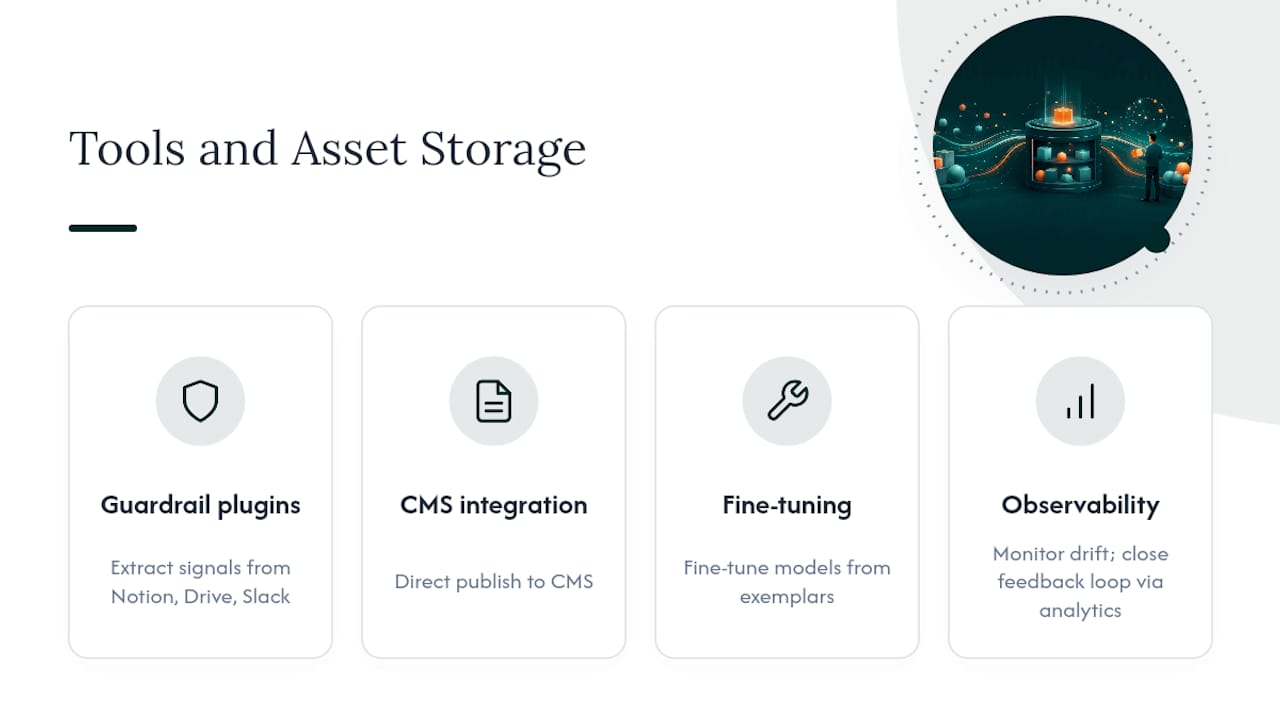
Integration priority should follow usage: a central content repository first, your CMS second, customer message archives third if you’re training conversational tone, and analytics last to close the feedback loop. On storage, version every prompt and exemplar set, restrict edit access to a small group, and label samples by channel and date so nobody trains a new iteration on stale examples. Teams managing multiple brands or markets should also look at how localization production workflows handle voice consistency across languages, since a guardrail that works in English rarely translates cleanly without adjustment.
AI Brand Voice: A Practical Setup and Governance Guide
The industry’s default advice treats brand voice like a one-time configuration task: write the prompt, load the samples, done. That’s backwards. The research on AI-assisted branding is consistent on this point: AI compresses the creative cycle but expands the evaluation cycle. If you set up your voice and never revisit it, drift is inevitable, not occasional.
What most teams get wrong is treating governance as a compliance afterthought rather than the actual product. The prompt is not the deliverable. The audit cadence is. A brand voice system without a weekly sampling habit and a defined edit-rate threshold isn’t a system, it’s a guess with better formatting.
Prioritize this in order: pick one pilot channel, build your exemplar library before you touch a single prompt, and put a human editor in the loop from day one rather than adding review after something goes wrong. Teams that skip straight to fine-tuning without a pilot usually end up retraining twice, once for the model and once for their own expectations of what “on brand” actually means in practice.
— Savannah
Scale Your Voice Without Losing Control Of It
Once your brand voice checklist is built, the harder problem is keeping it consistent across dozens of articles a month, especially if your team is small and content isn’t your only job. Ranksector runs daily SEO-optimized article publishing with brand guardrails applied automatically, so every piece follows your voice rules without a human rewriting each one from scratch.
The platform keeps an audit trail on every published article, suggests internal links that reinforce your existing content structure, and connects directly to your CMS so nothing sits in a review queue longer than it needs to. If you manage content for an agency or multiple brands, the managed publishing option applies the same guardrail logic across every client account without multiplying your workload. Not sure your current AI output is holding up under your own brand standards? Run it through Ranksector’s content audit and see exactly where the drift is happening before it reaches more readers.
Sources
- Set up brand voice using AI
- What is tone of voice in AI? | Decagon
- “AI shouldn’t feel like it’s creating for you”: Inside Leonardo.Ai’s human-led branding | Creative Bloq
- Brand identity design with generative AI (IASDR research paper)