
44% of AI Citations Come From the First 30%: How Small Teams Get Cited
To get cited in AI answers, you need three things working together: a front-loaded answer passage in the first third of your page, at least one piece of original, attributable data, and clean technical access so that crawlers like GPTBot can actually fetch and parse that passage. None of these guarantee a citation on any given prompt, since the process is probabilistic by nature, but stacking all three raises your odds far more than optimizing for keywords alone. The proof points below come from cross-engine audits, schema.org’s own documentation, and Google’s published guidance for AI search.
TL;DR:
- Placing your core answer and original data in the first 30 percent of your page significantly increases your chances of being cited by AI systems.
- Creating unique, verifiable data points and associating them with structured schema markup boosts the likelihood of your content being referenced.
- Technical readiness, including correct robots.txt settings, server-side rendering, and accurate schema markup, is crucial for crawlers to see and cite your content.
- High-quality backlinks from trusted domains and being featured on authoritative “best of” or reference pages amplify your citation potential.
- Regularly updating high-value pages with fresh data and maintaining accurate, structured metadata helps sustain and enhance your AI citation rate over time.
Table of Contents
- How Do You Get Cited in AI Answers, According to the Data?
- Build Pages That Are Built to Be Quoted
- What Technical Checks Make a Page Machine-Readable?
- Where Do Corroborating Mentions Actually Move the Needle?
- How Do You Measure Whether Your Citations Are Increasing?
- Does Publishing Frequently Improve Your AI Citation Odds?
- How Do You Write for Semantic Relevance Instead of Just Keywords?
- Do Backlinks Still Help You Get Cited by AI?
- What Small Teams Should Actually Do First
- Sources
- FAQ
How Do You Get Cited in AI Answers, According to the Data?
Query type changes everything about your odds. Commercial and comparison queries (“best project management software for small teams”) generate far more citations than pure informational queries, because retrieval systems lean harder on external sources when the answer requires a judgment call rather than a fact recall. If you’re writing “best of” roundups, buyer’s guides, or comparison pieces, you’re already playing in the highest-citation zone.
Placement matters almost as much as topic. Audits of cited pages show that roughly 44 percent of citations pull from the first 30 percent of an article, which means the passage sitting right under your H1 or first H2 is doing most of the work. Bury your best sentence in paragraph twelve, and a retrieval system may never surface it, no matter how good the rest of the page is.
By the Numbers: Pages that combine a front-loaded answer capsule with at least one original data point appear most often among cited pages, according to audits from Is My Brand in AI — outperforming either tactic run alone.
Original data is the second lever, and it’s the one most content teams skip because it takes actual work. Google’s own guidance for AI search experiences tells site owners to focus on unique, people-first content alongside technical readiness, and “unique” is doing a lot of lifting in that sentence. A survey you ran, a dataset you cleaned, a benchmark you calculated from your own product usage. Pages with genuinely proprietary numbers earn citations at materially higher rates than pages repeating stats that already exist elsewhere.
Domain authority still matters, but not the way most SEOs think. It’s less about your domain’s raw score and more about whether trusted reference domains have already validated your claim. Analyses of citation patterns show a power law: a handful of high-authority domains capture a disproportionate share of AI citations, and appearing alongside them amplifies your own citation probability rather than competing with it.
A few structural patterns show up again and again in the pages that get pulled into AI answers:
- Direct-answer paragraphs that state a conclusion before explaining it
- Numbered lists and short tables that act as clean extraction targets
- FAQ sections using structured Q&A markup
- Named statistics with a visible source and date
- Bylines tied to a real person and organization
Structured lists, tables, and short numbered passages consistently function as reliable extraction targets for retrieval layers, which is one reason list-heavy technical content tends to outperform dense prose on the same topic.
Build Pages That Are Built to Be Quoted
Once you understand why AI answer citations skew toward front-loaded, data-backed pages, the next question is how to build that structure into your own workflow without turning every article into a research project. Here’s the sequence that works, roughly in order of effort versus payoff.
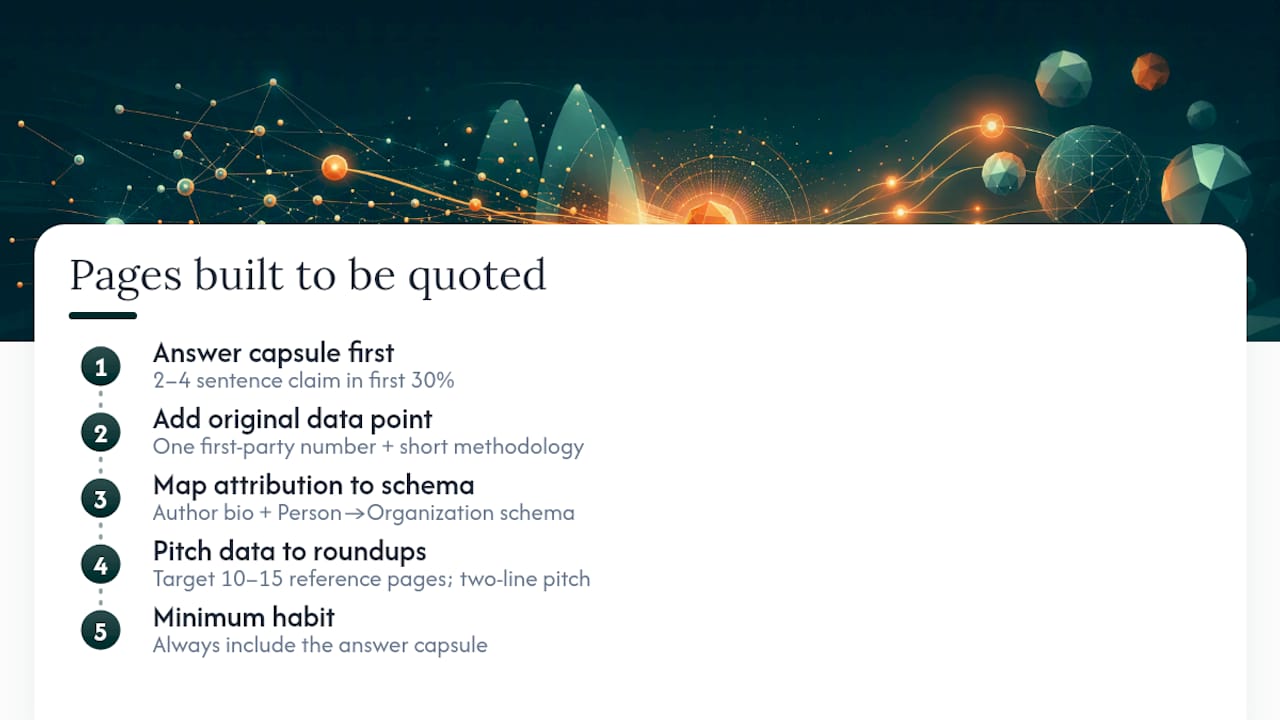
1. Write the answer capsule first, then write the article around it. Draft a two to four sentence passage that states your core claim plainly, no throat-clearing, no setup. Put it in the first 30 percent of the page, ideally right after the H1 or under the first H2. Test it by reading it alone: if it answers the reader’s question without any surrounding context, it’s ready.
2. Produce one original data point per major piece. This doesn’t require a research department. Pull a number from your own product analytics, run a 20-person survey, or aggregate public data into a chart nobody else has built. Structured Q&A and direct-answer formats paired with genuine first-party numbers consistently outperform pages built entirely on secondhand claims. Attach a short methodology note (sample size, date collected, how you measured it), state the headline claim in one sentence, and give readers a downloadable table or chart when possible.
3. Structure attribution so it maps to schema, not just to a name. A byline that says “By Jane Doe” does almost nothing for machine readability on its own. Pair every author name with a short bio, a link to an author page, and Person schema that connects to your Organization schema. This is the difference between a name printed on a page and an entity a retrieval system can actually verify.
4. Pitch your data asset to roundups and reference pages, not just to reporters. Build a short list of ten to fifteen “best of” or comparison pages already ranking for your target queries. Send a two-line pitch: what your data shows, why it’s new, and a direct link to the chart or table. Follow up once, about a week later, with a single fresh angle on the same dataset. This is slower than cold outreach for backlinks, but it’s the tactic most likely to land you on the exact pages AI models pull from for comparison queries.
Pro Tip: Keep your answer capsule and your original data point in separate paragraphs, not one crammed sentence. Retrieval systems tend to extract clean, self-contained passages. A sentence trying to do both jobs at once often gets cut awkwardly or skipped entirely.
If you’re running lean and can’t do all four steps every week, do step one on every single piece you publish. It costs almost nothing and it’s the single highest-leverage habit on this list. The daily publishing workflow can build the answer-capsule structure into articles by default, which is worth knowing if you’re trying to scale this practice without adding headcount.
What Technical Checks Make a Page Machine-Readable?
An answer capsule and a killer data point are worthless if the crawler retrieving your page can’t see them. Technical readiness is the part of this process most content teams skip, and it’s often the actual reason a well-written page never gets cited.
Start with robots.txt. Confirm you’re not blocking the crawlers that actually feed AI answer engines: GPTBot, PerplexityBot, ClaudeBot, and Google-Extended. Many sites inherited a blanket disallow rule years ago and never revisited it. A five-minute audit of your robots.txt file can undo months of otherwise solid content work.
Rendering is the second failure point. If your answer capsule loads via client-side JavaScript, some AI crawlers may never see it, since not all of them execute scripts the way a browser does. Server-side rendering or pre-rendering your key passages removes the risk entirely. Technical audits consistently flag JS-only delivery as one of the most common reasons a well-written passage never gets pulled into a citation.
Status codes and canonical stability round out the checklist. A page that redirects through two or three hops before landing, or one that occasionally throws a soft 404, teaches crawlers to distrust it over time.
| Technical element | What to check | Why it matters |
|---|---|---|
| Robots.txt | Named AI crawlers not blocked | Blocks retrieval entirely if misconfigured |
| Rendering | Key passages visible without JS execution | JS-only text may be invisible to some crawlers |
| HTTP status | Consistent site availability on canonical URLs | Redirect chains and errors reduce crawl trust |
| Schema markup | Article, FAQPage, Organization, Person present | Confirms entity identity and content type |
| dateModified | Visible on page and in schema | Signals freshness for time-sensitive queries |
Schema does the last bit of translation work. Article schema tells a crawler what kind of content it’s looking at. FAQPage schema, when your page genuinely contains a Q&A section, is one of the highest-leverage patterns for earning citations because it hands the model a pre-structured question-and-answer pair instead of asking it to extract one from prose. Organization and Person schema tie your content back to a verifiable entity rather than an anonymous domain. Validate all of it with a structured data testing tool, and make sure the markup actually matches what’s visible on the page. Mismatched schema is worse than no schema, because it teaches search systems your metadata can’t be trusted.
Finally, keep dateModified current and visible, both in your schema and on the page itself. Date-stamping and refresh cadence act as freshness signals that engines weight when a query has any time sensitivity, which covers more topics than most people assume, including a huge swath of B2B SaaS and marketing content.
Where Do Corroborating Mentions Actually Move the Needle?
Not every mention counts the same. Think of it as a hierarchy: being actively recommended sits at the top, followed by being compared favorably against alternatives, then cited as an authority on a subtopic, then compared neutrally, then simply mentioned in passing, and finally appearing as a passing reference with no real endorsement. A backlink from a low-context blog post lands near the bottom. A feature in an industry roundup that names you as a top pick lands near the top. That difference shows up in how often AI systems repeat the claim.
Authoritative domains and roundups deserve the bulk of your outreach time. Getting listed on an objective “best of” page or an industry reference site does more for citation odds than a dozen generic guest posts, because off-page mentions on high-citation domains compound: models weight claims more heavily when multiple independent sources repeat them.
Different platforms carry different signal types:
- Reddit threads and niche forums carry opinion and sentiment signals that some engines weight for subjective queries.
- YouTube transcripts increasingly surface in citation contexts for how-to and explainer queries.
- Review sites like G2 or Capterra carry weight specifically for product and category comparisons.
- Established media outlets carry general credibility signals that transfer across query types.
Balance your effort across three channels: organic outreach to roundup editors, contributed articles on industry publications, and data-led PR that pitches your original research as a story rather than a link request. The data-led angle tends to convert best, because editors would rather cite a number than a company.
How Do You Measure Whether Your Citations Are Increasing?
You can’t optimize what you don’t check by hand. Run a weekly manual prompt audit across ChatGPT, Perplexity, Google’s AI Overviews, and Claude, using the same five to ten queries your target audience actually types. Log which URL got cited, which passage was quoted, and where that passage sat on the page.
Analytics will only tell you part of the story. AI referral traffic is real but consistently undercounted, since a citation that never gets clicked leaves no trace in Google Analytics. Manual checks remain necessary precisely because referral data alone will make your citation rate look lower than it is. Track three numbers instead of one: citation rate across your prompt set, the distribution of citation context (recommended versus merely mentioned), and conversion rate on the AI referral traffic you can identify.
Run experiments the same way you’d run any content test:
- Move your answer capsule from paragraph three to paragraph one on a set of existing pages, then recheck citations after two to three weeks.
- Add one original data point to a page that previously had none, and compare citation rate before and after a similar window.
- Publish a data asset and pitch it to five roundups; track whether citation context shifts from “mentioned” to “cited as authority” over the following month.
Expect platform differences. What lifts citation odds on Perplexity, which leans heavily on retrieval, may do less on Gemini’s AI Overviews, which draws more from Google’s own index signals. Treat each engine as a separate experiment rather than assuming a single fix moves all of them equally.
Does Publishing Frequently Improve Your AI Citation Odds?
Freshness acts as a tiebreaker more than a primary ranking factor. When a query has any time sensitivity, whether it’s pricing, a statistic, or a “best tools” list, engines lean on dateModified signals to decide which of several similar pages to trust for a current answer. A page last touched three years ago competes at a real disadvantage against one updated last month, even if the older page’s content is technically still accurate.
That doesn’t mean republishing everything weekly. It means picking your highest-value pages, the ones already earning some citation activity, and refreshing them on a real cadence: updated numbers, a new example, a corrected claim. A quarterly refresh on your top twenty pages will do more for citation stability than publishing fifty new pages that never get touched again.
How Do You Write for Semantic Relevance Instead of Just Keywords?
Retrieval systems match meaning, not exact strings. A page optimized only for the literal phrase “AI answer citations” will miss queries phrased as “why isn’t my content showing up in ChatGPT” or “how do I get referenced by Perplexity,” even though all three questions want the same answer. Cover the topic’s full range of phrasing and subquestions rather than one exact-match term repeated a dozen times.
The practical fix is writing toward the underlying question, not the keyword. Address the reader’s actual confusion directly, use the vocabulary they’d naturally type, and answer adjacent subquestions in the same piece rather than spinning them into separate thin pages. This is the same logic behind semantic SEO: cover a topic’s full query fan-out in one strong page instead of fragmenting it across five weak ones.
Do Backlinks Still Help You Get Cited by AI?
Backlinks haven’t stopped mattering, but their job has shifted. A link from a relevant, trusted domain still signals to a crawler and to a retrieval model that other sources vouch for your content, which nudges you up the citation hierarchy from “mentioned” toward “cited as authority.” What’s changed is that raw link volume matters less than the credibility of who’s linking and what context surrounds the link.
A link buried in a generic directory does almost nothing. A link from an industry publication, embedded in a sentence that actually explains why your data or claim is relevant, does real work. This is exactly why a contextual backlink exchange alongside a daily content pipeline focuses on placing links inside relevant editorial context rather than farming volume from unrelated sites. Quality and context beat count here, every time.
What Small Teams Should Actually Do First
Most teams reading this don’t have a research department or a PR budget, so the sequencing matters more than the full checklist. Start with one answer capsule on your highest-traffic existing page. Then publish one piece of original data, even something as simple as an aggregated customer survey, with a clear methodology note and a visible date. Then commit to one outreach push per month, targeting a single high-value roundup rather than spraying pitches across twenty low-authority blogs.
Expect a trade-off. Citations sometimes reduce clicks, since a good AI answer can satisfy the reader without a visit to your site. What you gain instead is brand exposure at the moment a buyer is actively evaluating options, which is worth tracking separately from raw traffic. Measure both: referral clicks where you can capture them, and branded search lift over the following quarter as a proxy for the citations you can’t directly click through.
The credibility signals underneath all of this, real bylines, visible timestamps, schema that matches what’s on the page, aren’t decoration. They’re what lets a retrieval system trust your content enough to quote it instead of a competitor’s.
— Savannah
Sources
Perplexity behaves closest to a search engine with citations attached, favoring recent, well-structured pages with clear extraction points. ChatGPT’s browsing and retrieval features lean more toward pages that already rank well organically and carry recognizable domain signals. Google’s AI Overviews draw heavily from pages already indexed and trusted within Google’s own systems, which means traditional SEO fundamentals still matter more there than on Perplexity. Claude’s citation behavior, where enabled, tends to favor pages with clean, unambiguous factual statements over pages that require inference.
None of these systems publish a full ranking formula, and each updates its retrieval approach without warning. What stays consistent across all four is the underlying preference for content that answers a question directly, backs the claim with something verifiable, and doesn’t bury either behind ten paragraphs of preamble. Build for that baseline first, then adjust for platform quirks once you have enough logged citations to spot a pattern specific to your content and audience.
- Succeeding in AI search — Google Search Central blog
- How to Get Cited by AI: The Complete Data-Backed | Trakkr
- How to get cited by AI — the citation hierarchy + 8 patterns | Citare
FAQ
What Is the 30% Rule in AI Citations?
The 30% rule refers to the finding that a large share of AI citations, close to 44 percent in one cross-engine audit, come from the first third of an article. It’s the reason answer-first passages placed near the top of a page consistently outperform the same information buried deeper in the text.
Can AI-Generated Content Get Cited in AI Answers?
Yes, as long as it meets the same bar as any other content: a clear, front-loaded answer, verifiable facts, and clean technical access for crawlers. Google’s own guidance focuses on unique, people-first value and technical readiness rather than how the content was produced, so origin matters less than quality and structure.
Can AI Tools Help Me Find Citation Opportunities?
AI tools can help you identify roundups, comparison pages, and reference sites already ranking for your target queries, which speeds up the outreach research step. They’re less reliable at telling you whether you’ve actually been cited by other AI systems, since that still requires manual prompt checks across each engine.
How Do I Add Citations Using AI Tools?
If you mean citing sources within your own content, most AI writing assistants can pull in a reference link when you provide the source, but you should verify every claim and URL manually before publishing. If you mean getting your own content cited by AI answer engines, that comes down to the structural and technical factors covered above, not a tool you run once.