
SEO Agency vs. Automated Platforms: Real Cost Comparison
Traditional SEO agencies charge substantial monthly fees with minimum contracts that create significant annual commitments for mid-market companies. Automated SEO content platforms generally cost less per month and can reduce overall costs considerably while retaining most organic search traffic. For small B2B SaaS teams, that gap is not a minor budget line. It is the difference between a channel you can actually afford and one that eats your runway.
Table of Contents
- What does a cost comparison of SEO agency alternatives actually show?
- How do agencies and automated platforms actually differ in outcomes?
- What makes Ranksector different for B2B SaaS SEO?
- How do you decide between an agency and an automated platform?
- Key Takeaways
- The case for rethinking what “full-service” actually means
- Ranksector gives B2B SaaS teams a full content operation without the agency price tag
What does a cost comparison of SEO agency alternatives actually show?
The numbers tell a clear story, but the full picture includes fees most proposals bury in the fine print.
Traditional enterprise agencies add setup fees of $5,000–$25,000 on top of monthly retainers. Beyond that, pass-through tool costs like Semrush or Ahrefs subscriptions can add $200–$500 monthly to your invoice, costs the agency marks up and passes directly to you. Lock in a 12-month contract and you are committed before you have seen a single ranking move.
Automated platforms and affordable alternatives price differently. Performance-based models start at $2,500–$7,500 monthly with 90-day commitments instead of annual lock-ins. A DIY tool stack averages around $1,365 per month for platforms like Semrush and Surfer SEO combined, though that figure excludes the labor cost of someone actually running those tools.
| Approach | Monthly Cost | Setup Fees | Minimum Commitment | Hands-Free? |
|---|---|---|---|---|
| Traditional enterprise agency | $15,000–$50,000 | $5,000–$25,000 | 12 months | No |
| Mid-market agency | $15,000–$50,000 | $5,000–$25,000 | 12 months | No |
| Performance-based platform | $2,500–$7,500 | — | 90 days | Partial |
| Hybrid (in-house + consultant) | $7,000–$11,000 | — $3,000 | Month-to-month | No |
| Automated SEO content platform | $2,500–$7,500 | Low or none | Flexible | Yes |
| DIY tool stack (tools only) | ~$1,365 | None | None | No |
Key cost drivers to watch:
- Contract length. A 12-month agency retainer locks in spend before results materialize.
- Pass-through fees. Tool subscriptions billed at a markup add up fast.
- Setup and onboarding fees. Often non-refundable, even if the relationship ends early.
- Labor overhead. DIY stacks look cheap until you price your own hours at $100+.
How do agencies and automated platforms actually differ in outcomes?
Price is the easy comparison. The harder question is what you actually get for it.
Traditional agencies bring human strategists, custom link-building outreach, and deep technical audits. That expertise has real value, especially for complex sites or highly competitive markets. The tradeoff is coordination overhead. Managing an agency relationship consumes over 20 hours weekly in communication and alignment for many teams, time that a small B2B SaaS marketing team simply cannot spare.
Automated SEO content platforms flip that equation. They handle publishing, keyword research, and content scheduling without requiring your team to manage a vendor relationship. The degree of automation varies, but the best platforms run daily publication cycles with no manual input after initial setup. For AI-driven publishing workflows, the operational difference versus agency management is significant.

One capability gap worth noting: traditional agencies rarely offer optimization for answer engines like ChatGPT and Perplexity. AI-powered platforms increasingly build this in, which matters as AI-generated search results capture more of the traffic that used to flow through Google.
Core differences at a glance:
- Automation depth. Agencies rely on human execution; automated platforms run on scheduled workflows.
- Turnaround speed. Automated tools publish daily; agencies typically deliver monthly content batches.
- Internal time savings. Automation reclaims the hours lost to agency briefings, approvals, and revision cycles.
- Answer Engine Optimization (AEO). Most traditional agencies do not yet offer structured AEO as a standard service.
- Contract flexibility. Automated platforms typically offer monthly or quarterly terms versus agency minimums of 6–12 months.
Pro Tip: Before signing any agency contract, calculate your true hourly cost for managing the relationship. If your team spends 10+ hours monthly on calls, briefs, and approvals, add that to the retainer when comparing total cost.
What makes Ranksector different for B2B SaaS SEO?
Ranksector is built specifically for the B2B SaaS use case: a small marketing team that needs a consistent content output without hiring an agency or a dedicated SEO manager.
The platform has published over 11,000 articles and demonstrated rapid domain rating improvements for its clients. It combines competitor-driven keyword research with a backlink exchange system, so domain authority grows without manual outreach. Daily article publication runs on autopilot, which is the core promise for teams that cannot maintain a consistent editorial calendar on their own.
What sets Ranksector apart from both traditional agencies and generic AI writing tools:
- Hands-free publishing. Articles go live daily without requiring your team to brief, review, or schedule.
- Competitor-driven keyword research. The platform identifies gaps based on what your competitors rank for, not generic keyword lists.
- Backlink exchange system. Domain authority grows through an automated exchange, not manual outreach campaigns.
- B2B SaaS focus. Content is tailored to your audience, not repurposed from a generic template library.
- No agency overhead. No account managers, no monthly calls, no revision cycles eating your calendar.
For a solo founder or a two-person marketing team, Ranksector functions like a full content operation running in the background. The AI SEO platform comparison for SaaS teams shows why automation depth and B2B specificity matter more than raw feature counts.
How do you decide between an agency and an automated platform?
The right choice depends on four variables: budget, internal expertise, required output volume, and how much control you need over content.
Agencies make sense when your site has serious technical debt, you are in a highly competitive vertical, or you need a custom link-building strategy that requires human outreach. If your annual SEO budget exceeds $80,000 and you have the internal bandwidth to manage a vendor relationship, a full-service agency can deliver. DIY SEO is most cost-effective when internal expertise exists and market competition is moderate.
Automated platforms win when your primary need is consistent content output, your team is small, and you want predictable monthly costs without long-term contracts. For B2B SaaS companies that need to build topical authority through volume, daily publishing beats a monthly agency content batch every time.
Ask yourself these questions before deciding:
- Is your annual SEO budget under $80,000? Automation likely delivers better ROI.
- Does your team have 10+ hours per month to manage an agency relationship? If not, automation reclaims that time.
- Do you need 30+ articles per month? Agencies rarely produce at that volume without significant additional cost.
- Is your primary goal domain authority growth through content? Automated platforms are purpose-built for this.
- Do you need custom technical SEO or penalty recovery? An agency or specialist consultant is the better fit.
A hybrid approach works well for teams that need technical SEO handled by a specialist while keeping content production on an automated platform. Hybrid models combining in-house work with consultants reduce costs by 50–65% compared to full-service agency retainers, with typical monthly spend of $7,000–$11,000.
Key Takeaways
Automated SEO content platforms reduce costs by 40–70% compared to traditional agencies while retaining 85–95% of organic traffic, making them the stronger choice for most small B2B SaaS teams.
| Point | Details |
|---|---|
| Agency cost range | Traditional enterprise agencies run $15,000–$50,000/month with 12-month minimums and setup fees up to $25,000. |
| Automated platform savings | Automated platforms cost $2,500–$7,500/month with flexible contracts and no pass-through tool fees. |
| Hidden agency costs | Pass-through tool subscriptions add $200–$500/month; coordination overhead exceeds 20 hours weekly. |
| Decision criteria | Choose automation when budget is under $80,000 annually and your primary need is consistent content volume. |
| Ranksector | Ranksector publishes 11,000+ articles with hands-free daily output and a built-in backlink exchange for B2B SaaS teams. |
The case for rethinking what “full-service” actually means
The conventional wisdom says you need a full-service agency to do SEO properly. Pay the retainer, trust the account team, wait 12 months for results. That model made sense when SEO was primarily a technical and link-building discipline requiring deep human expertise at every step.
Content production is different. Publishing consistent, keyword-targeted articles at volume is exactly the kind of repeatable workflow that automation handles better than a human team billing by the hour. The agency model charges you for the overhead of that human team whether or not the work requires it.
What agencies genuinely do better is strategic technical work: site architecture, penalty recovery, competitive link analysis. The mistake is paying agency rates for work that a well-configured automated platform does faster and cheaper. For most B2B SaaS teams, the practical answer is not “agency or automation” but “automation for content, specialist for technical.” That split keeps costs predictable and output consistent without sacrificing quality where expertise actually matters.
Ranksector gives B2B SaaS teams a full content operation without the agency price tag
For a B2B SaaS team spending $15,000+ monthly on an agency to maintain a blog, the math rarely works out. Ranksector publishes daily SEO-optimized articles tailored to your audience, runs competitor-driven keyword research automatically, and builds domain authority through a backlink exchange, all without a single briefing call or revision cycle.
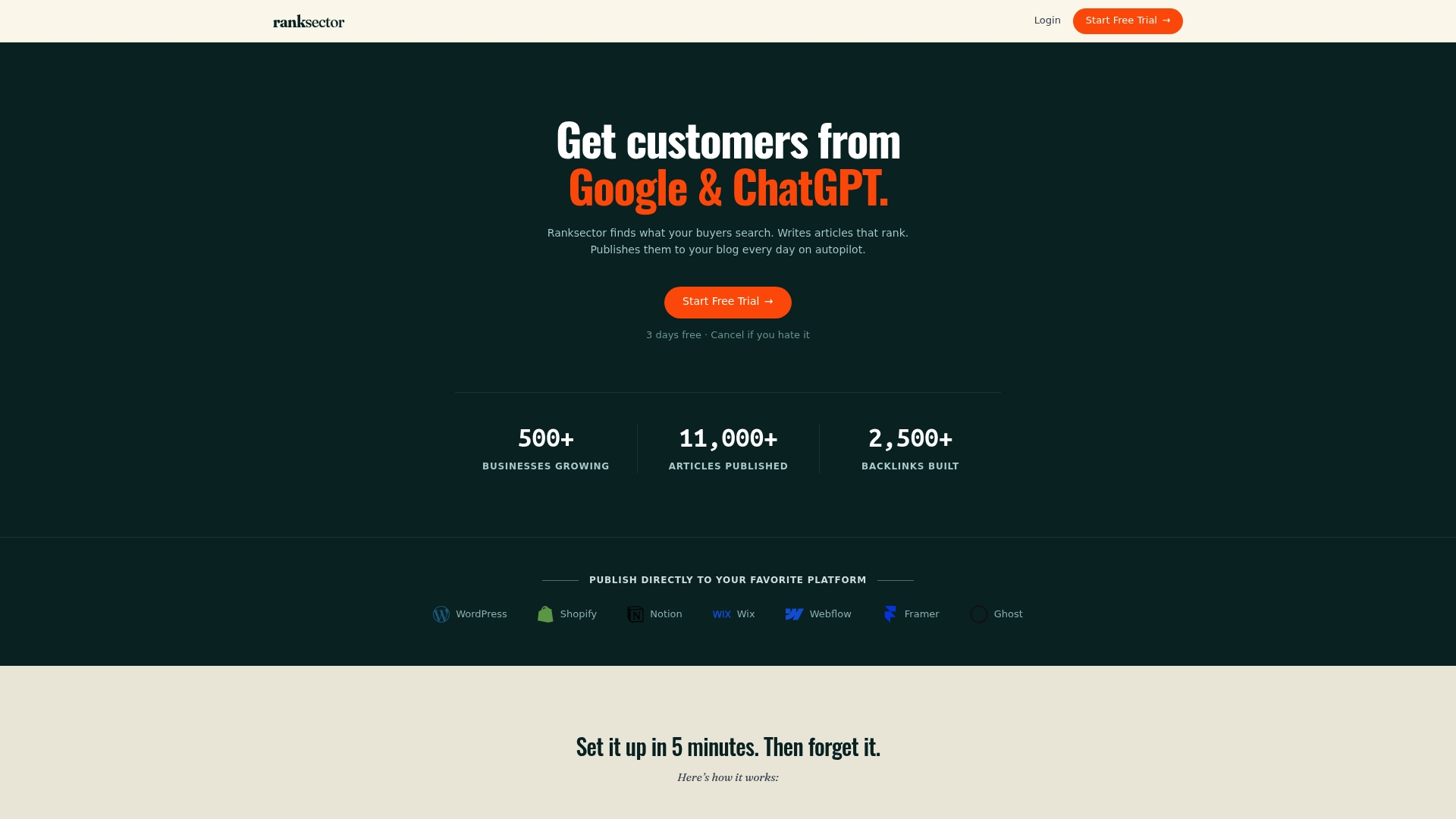
Over 11,000 articles published. Demonstrated domain rating improvements. No long-term contracts. If your team needs consistent content output without the overhead of managing an agency relationship, Ranksector’s automated SEO solution is built for exactly that. Start with the free SEO tools to see how the platform maps to your current content gaps before committing to anything.
Recommended
- AI SEO Platforms Compared: What SaaS Teams Should Actually Compare in 2026 · Ranksector Blog — Ranksector
- Pricing · Ranksector — Ranksector
- Free vs Paid AI SEO Tools: When Each Makes Sense for SaaS Teams in 2026 · Ranksector Blog — Ranksector
- Ranksector — AI-powered SEO content creation and publishing