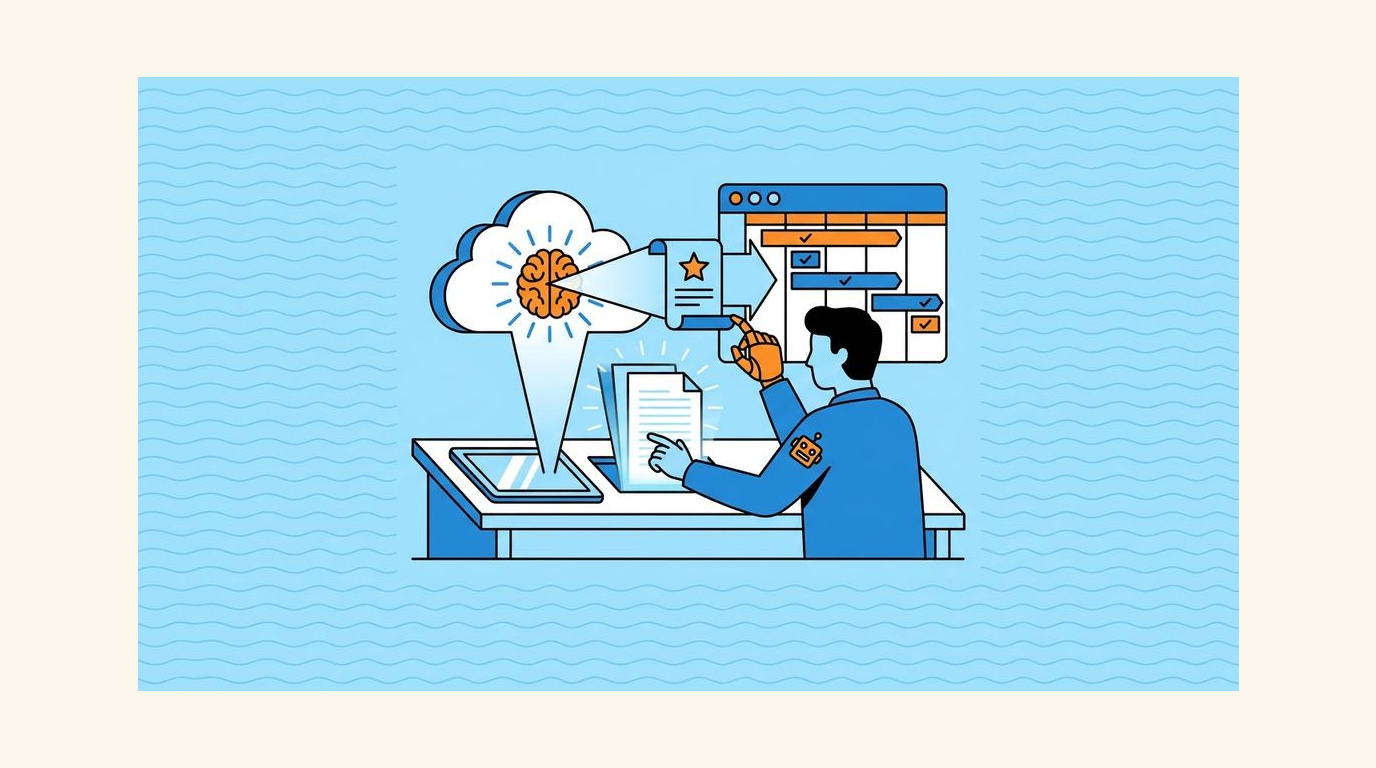
AI Content Strategy for SaaS: Streamline SEO Without Losing Quality
You mapped out a content calendar in January. By March, your team had published 4 articles instead of 12, the briefs took 3 hours each to write, and your SEO lead was still manually pulling competitor data in a spreadsheet. Sound familiar?
The problem isn't effort. It's the workflow. Manual content operations eat publishing velocity alive, and most SaaS teams don't realize how much time disappears before a single word gets written.
AI-powered content marketing isn't about replacing writers. It's about redesigning the workflow so your team spends time on judgment calls, not data collection. This guide shows you exactly where to start, what to automate first, and how to keep quality intact while you scale. 🎯
What AI content marketing actually changes in a SaaS SEO team
The framing matters here. AI content marketing is not a writing shortcut. It's a workflow redesign that touches research, briefs, optimization, distribution, and analysis.
For SaaS teams specifically, the stakes are higher than for generic B2C brands. Your content needs to be grounded in product knowledge, accurate about technical claims, and tied to real search intent from buyers at specific funnel stages.
Where AI actually saves the most time
In my experience, the biggest time savings come before the draft, not during it. Topic research that used to take hours per article can run in under 20 minutes with the right AI workflow. Brief writing that required a senior strategist can be templated and generated from a structured prompt.
AI also helps with distribution: repurposing a long-form article into multiple LinkedIn posts, a newsletter intro, and a short-form summary used to take a full afternoon. With a solid prompt library, it takes under 30 minutes.
Why SaaS teams need tighter guardrails
Generic AI content often lacks product grounding. A B2C recipe blog can afford some vagueness. A SaaS article that misrepresents an integration or overstates a feature creates real trust problems with technical buyers.
That's why the workflow matters more than the tool. Salesforce's guidance on AI content marketing emphasizes oversight and fact-checking as non-negotiable, not optional review steps.
AI is not the strategy. The workflow is. The tool only moves as fast as the system around it.
The manual content workflow SaaS teams still waste time on
Most SaaS content teams run a workflow that looks roughly like this: a strategist picks topics, a writer researches competitors, someone writes a brief, the writer drafts, an editor reviews, an SEO lead optimizes metadata, and then it publishes. Each handoff costs time.
Where the hours actually go
A useful heuristic from the teams I've seen: a single 1,500-word article takes between 6 and 10 hours of human time in a fully manual workflow. That includes 90 minutes for topic research, 2 hours for brief writing, 3 to 4 hours for drafting, and another hour for SEO optimization and final edits.
At 8 articles per month, that's roughly half of a 2-person team's entire capacity before any strategy, reporting, or stakeholder work.
The bottlenecks that compound
Brief writing is the most common bottleneck I see. It requires competitive research, keyword data, audience knowledge, and product context all in one document. When that step takes 2 hours per article, it becomes the ceiling on publishing velocity.
Competitor review is the second biggest drain. Pulling SERP data, reading multiple competing articles, and synthesizing gaps manually is slow, repetitive work. It's exactly the kind of task AI handles well.
- Topic research pulls strategists away from planning for 90+ minutes per article cycle.
- Brief writing requires cross-functional input that rarely arrives on time, stalling the whole pipeline.
- SEO metadata optimization often gets rushed or skipped entirely when deadlines hit.
- Distribution repurposing almost never happens because there's no time left after publishing.
- Performance analysis gets done quarterly at best, so teams keep publishing without knowing what's working.
If your brief process takes more than 90 minutes per article, that's where your AI workflow should start.
The AI-assisted workflow that replaces the slowest steps first
The goal isn't full automation. It's targeted automation of the steps that cost the most time and produce the least differentiated output. A phased approach steadily outperforms a wholesale switch.
The phased replacement model
Start with one bottleneck. In most SaaS teams, that's brief writing or competitor research. Automate that step for 4 weeks before touching anything else. Measure the time saved, the quality output, and the downstream effect on publishing speed.
Once that step runs smoothly, move to the next. A useful sequence: automate research first, then briefs, then metadata optimization, then distribution repurposing. Drafting comes later, once you have guardrails in place.
Manual vs. automated: a direct comparison
| Step | Manual time | AI-assisted time | Quality risk |
|---|---|---|---|
| Topic research | 90 min | 15 min | Low (human review still needed) |
| Competitor SERP review | 60 min | 10 min | Low |
| Brief writing | 120 min | 25 min | Medium (product grounding required) |
| First draft | 180 min | 40 min | High (human edit mandatory) |
| SEO metadata | 30 min | 8 min | Low |
| Distribution repurposing | 90 min | 20 min | Low |
The total manual time for one article: roughly 570 minutes. The AI-assisted total: roughly 118 minutes. That's not a marginal improvement. It's a structural change in what a 2-person team can publish per month.
Where the workflow still needs humans
The quality risk column in that table is honest. First drafts generated by AI require real editing, not a skim. Product claims, integration details, and technical accuracy need a human who knows the product. That's not optional governance theater. It's the difference between content that builds trust and content that quietly erodes it.
How SaaS teams use AI for topic clusters, briefs, and outlines
Topic clusters are where AI delivers some of its clearest SEO value for SaaS teams. Clustering keywords around product-led search intent is faster and more systematic with AI than it is manually.
Building topic clusters from product knowledge
Feed AI a list of your product features, common support questions, and competitor category terms. Ask it to group related queries by funnel stage and search intent. In 15 minutes, you get a working cluster map that would take a strategist hours to build from scratch.
The output isn't perfect. You'll remove irrelevant clusters, add product-specific angles, and adjust for your ICP. But the skeleton is there, and that's the part that takes the most time manually.
Turning SME input into usable briefs
One of the most underused AI workflows: paste a transcript from a 30-minute SME interview into a prompt that outputs a structured content brief. You get audience framing, key claims, technical context, and angle suggestions in under 5 minutes.
This matters because SME time is expensive and hard to schedule. Getting significantly more output from each interview changes the economics of expert-led content.
- Paste support ticket themes into a prompt to identify high-volume content gaps your team hasn't addressed yet.
- Use AI to map each cluster topic to a funnel stage so brief writers know the intended reader and intent before they start.
- Generate 3 competing outline structures for each article and let a human editor choose the strongest one.
- Pull competitor H2 structures from top-ranking pages and use AI to identify what's missing from all of them.
Where human review still matters most
Governance is the part most teams skip when they're excited about speed gains. That's where quality problems compound quietly over months until a technical buyer flags something wrong or a product team notices a misrepresentation.
The claims that always need a human
Any claim about your product's functionality, pricing, integrations, or competitive positioning needs human verification before it publishes. AI will write confidently about things it doesn't know. That confidence is the risk.
A useful heuristic: if the claim would embarrass your product team if it were wrong, a human should check it. That's not most sentences in a blog post. But it's probably 5 to 10 sentences per article that need a real review, not a skim.
A lightweight quality checklist for editors
- Verify every product feature claim against the current product documentation, not last quarter's.
- Check that competitor comparisons are accurate and not outdated by more than 6 months.
- Confirm that technical instructions (API calls, integration steps, workflow configurations) actually work as written.
- Review tone against your brand voice guide, especially in sections where AI tends toward generic phrasing.
- Confirm that the article's target keyword and internal linking choices align with your cluster map, not just the draft's surface topic.
If the claim matters to a technical buyer, a person should verify it. Speed gains mean nothing if the article ships with a wrong integration step.
How to measure whether AI content is actually improving organic traffic
Publishing more articles isn't the goal. Better organic performance is. Orbit Media's framing on AI content strategy gets this right: volume without measurement is just noise.
The metrics that actually tell you something
Track 4 layers: throughput (articles published per month), indexation rate (percentage of published pages indexed within 14 days), ranking velocity (how fast new articles enter the top 20 for their target query), and assisted conversions (content-influenced pipeline, not just last-click).
In my experience, teams that add AI to their workflow without changing their measurement approach often see a publishing spike in month 1 followed by flat or declining performance. The workflow improved. The strategy didn't. That's a different problem.
Monthly review cycles that actually improve output
Set a 30-day review cadence. Pull ranking data for every article published in the prior 30 days. Flag anything that hasn't moved into the top 30 for its primary keyword after 45 days. Diagnose whether the issue is the brief, the content depth, the internal linking, or the keyword selection.
Then update your prompt library accordingly. If AI-generated briefs keep producing thin introductions, add a specific instruction for that. The prompts are the operating procedures. Treat them like living documents.
A simple rollout plan for the first 30 days
Most AI content rollouts fail because teams try to automate everything at once. The result is a chaotic mix of half-finished workflows, inconsistent output quality, and a team that doesn't trust the new process. A controlled 4-week plan avoids that. 📋
Week 1: audit before you automate
Map your current content workflow step by step. Time each step for your last 3 articles. Identify the single step that consumed the most time and produced the most frustration. That's your starting point. Not the flashiest AI use case. The slowest one.
Week 2: automate one high-friction task
Pick brief writing or competitor research. Build a structured prompt. Run it on 3 real articles your team is planning. Compare the AI output against what a human would have produced. Refine the prompt until the output is 80% usable without major edits. That's the threshold worth building on.
Coursera's AI content marketing specialization frames this well: start narrow, prove value, then expand. Trying to automate 6 steps simultaneously before any of them are proven is how rollouts stall.
Week 3: publish a small batch and compare
Publish 3 to 5 articles using the new workflow. Track the time from brief to publish. Compare it against your baseline from Week 1. Note any quality differences flagged by your editor. Look at word count consistency, brief adherence, and whether the AI output required major structural rewrites.
Week 4: document and standardize
Write down what worked. Lock in the prompts that produced usable output. Create a one-page operating procedure for the automated step so any team member can run it. Then identify the next bottleneck and start the cycle again.
- Week 1 output: a documented workflow map with time-per-step data for your last 3 articles.
- Week 2 output: a tested prompt for one high-friction task, refined to 80% usability.
- Week 3 output: 3 to 5 published articles with time and quality data logged.
- Week 4 output: a written SOP and a shortlist of the next 2 automation candidates.
A good AI rollout should feel controlled after 30 days, not chaotic. If your team is confused about which step uses AI and which doesn't, the SOP isn't finished yet.
Frequently Asked Questions
What's the difference between AI content marketing and just using ChatGPT to write blog posts?
Using ChatGPT to write a blog post is a single-step shortcut. AI content marketing is a workflow redesign that touches research, clustering, brief writing, optimization, distribution, and measurement. The difference is whether you've built a repeatable system or you're just generating drafts one at a time. Systems compound. One-off prompts don't.
How long does it take to see organic traffic improvements after switching to an AI-assisted workflow?
In my experience, publishing velocity improvements show up within 30 days. Organic traffic improvements typically take 60 to 90 days for new articles to rank, assuming the content is well-optimized and the site has reasonable domain authority. The workflow change accelerates publishing. The SEO timeline stays the same.
Does AI content hurt SEO rankings?
Google's public guidance focuses on content quality and helpfulness, not the production method. AI-generated content that's accurate, well-structured, and genuinely useful for the reader performs the same as human-written content. AI content that's thin, generic, or factually wrong performs poorly. The issue is quality, not origin.
What's the biggest mistake SaaS teams make when adopting AI for content?
Automating everything at once. Teams that skip the audit phase and immediately deploy AI across their entire workflow end up with inconsistent output, confused editors, and no baseline to measure improvement against. Start with one bottleneck, prove the workflow, then expand. That's the approach that sticks.
How do I maintain brand voice when using AI to generate content at scale?
Build your brand voice into the prompt, not just the editing step. That means including tone examples, banned phrases, preferred sentence structures, and audience framing in every brief-generation and drafting prompt. Airtable's content operations guidance covers this well. The voice guide needs to live in the workflow, not just in a Google Doc nobody reads.
Ranksector
Start with Ranksector to see how SaaS content teams are redesigning their workflows, one bottleneck at a time. Read the playbooks, steal the frameworks, and build a content operation that publishes regularly without burning out your team.